
Latest Tech Trends Gamrawtek Report 2026: What the Experts Agree On
The latest tech trends Gamrawtek readers ask about most are easy to hype and hard to verify.

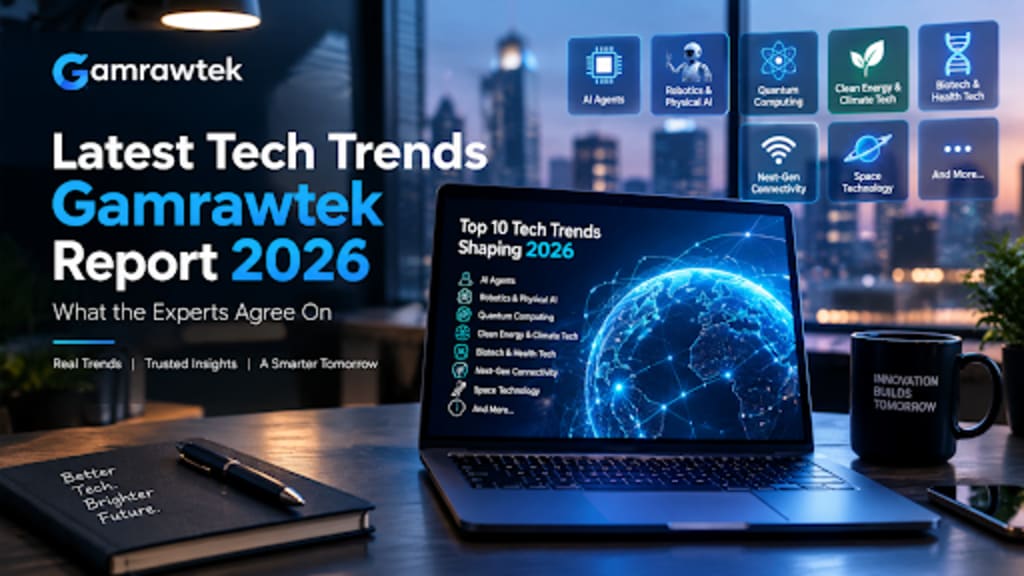
The latest tech trends Gamrawtek readers ask about most are easy to hype and hard to verify. Every year brings new predictions, but only some of them survive contact with budgets, regulators and real users. The useful question for 2026 isn't "what's new?" but "what do independent experts keep pointing to, and what evidence backs it up?"
This latest tech trends Gamrawtek report answers that question. We compared the major 2026 reports from Gartner, McKinsey, the World Economic Forum, Stanford and MIT Technology Review, and pulled out ten trends with the strongest evidence behind them. For each one, you'll get a plain explanation, the latest data, what's still hype, and what it means for your business, your career and the devices you buy.
Latest Tech Trends Gamrawtek Readers Should Know in 2026
The Short Version
AI agents are the most-watched trend, but Gartner places them at the peak of inflated expectations: interest is far ahead of real deployments.
AI is moving into the physical world. The World Economic Forum says eight of its ten emerging technologies for 2026 act directly on physical systems.
AI's growth depends on power. McKinsey says AI infrastructure spending doubled in a single year.
Quantum-safe encryption is now a present-day task, not a future one.
Energy, biotech and smart wearables are where many of the practical gains are showing up.
For most readers, the latest tech trends Gamrawtek covers reward small, practical steps over big bets.
Where These Trends Come From
Instead of relying on one opinion, this report cross-checks the most-cited sources:
Report
Published
Headline signal
Gartner Top Strategic Technology Trends 2026
October 2025
Multiagent systems, physical AI, AI security
Stanford AI Index 2026
April 2026
AI investment more than doubled in 2025
World Economic Forum Top 10 Emerging Technologies
June 2026
Innovation shifting to energy, health and physical systems
Gartner Hype Cycle for Agentic AI
2026
Agents at the peak of expectations
MIT Technology Review 10 Breakthrough Technologies
January 2026
Generative coding, sodium-ion batteries, AI data centers
McKinsey Technology Trends Outlook 2026
September 2026
14 trends; AI and robotics investment surging
A trend earned a place among the latest tech trends Gamrawtek tracks only if at least one of these reports highlights it and there's measurable real-world activity behind it, such as products on sale, standards or major investment. Most appear in two or more.
Latest Tech Trends Gamrawtek Scorecard: Evidence and Maturity
The table below summarizes the latest tech trends in this report, which sources back them, and how mature each one is today:
#
Trend
Highlighted by
Maturity in 2026
1
AI agents
Gartner, McKinsey
Early deployment, heavy hype
2
Physical AI and robots
WEF, Gartner, McKinsey
Robotaxis live; humanoids in trials
3
AI infrastructure and chips
McKinsey, Stanford, MIT TR
Rapid build-out
4
Quantum-safe security
WEF, McKinsey, NIST
Standards ready; migration starting
5
Quantum computing
WEF, McKinsey
Research stage, first uses emerging
6
Energy and climate tech
WEF, McKinsey, MIT TR
Scaling up
7
Biotech
WEF, McKinsey, MIT TR
Early clinical use
8
Smart glasses and wearables
McKinsey
Early consumer products
9
Wi-Fi 8 and 6G
McKinsey (connectivity)
Wi-Fi 8 early; 6G around 2030
10
Space tech
McKinsey, MIT TR
Investment rising fast
1. AI That Acts: Agents Move From Demo to Deployment
Agentic AI refers to AI systems that plan and complete multi-step tasks, such as handling a support ticket or updating records, rather than just generating text. Gartner lists multi-agent systems among its top trends for 2026, and McKinsey tracks both agentic AI and agentic software development as separate trends.
The data shows both momentum and caution. In Gartner's 2026 survey of CIOs and tech executives, only 17% of organizations had deployed AI agents, but more than 60% expected to within two years. Gartner also places agentic AI at the Peak of Inflated Expectations and notes that fully autonomous agents aren't ready for most enterprise uses.
Good guardrails matter as much as the model: limit what an agent can access, log what it does, and require approval before it spends money or changes customer data. The practical reading: agents work best today on narrow, well-defined tasks, such as coding support and customer service, with a human reviewing important actions.
2. AI Gets Physical: World Models, Robots and Robotaxis
The biggest shift among the latest tech trends Gamrawtek follows is where AI is headed. The World Economic Forum notes that eight of its ten emerging technologies for 2026 act directly on physical systems.
One of them is world models: AI systems that build an internal picture of how the physical world works, so robots and vehicles can reason about situations they haven't seen before. Gartner calls the broader category physical AI.
The clearest real-world example is robotaxis. Waymo reported about 500,000 paid rides a week across 10 US cities in March 2026. In July 2026, it announced driverless service for four more cities, including Denver and San Diego, with a goal of one million weekly rides by year-end.
Humanoid robots get the headlines, but most public deployments still look like limited trials in warehouses and factories. McKinsey expects robotics investment in 2026 to at least double from 2025, so progress may speed up.
3. The AI Infrastructure Boom and Its Power Bill
Every one of the latest tech trends on this list depends on computing power, and that power costs money.
AI runs on data centers, chips and electricity, and spending on all three is climbing fast. According to reporting on Stanford's AI Index, global AI investment topped $581 billion in 2025, more than double the $253 billion of 2024. McKinsey says spending on AI infrastructure doubled in a single year.
The energy side is striking. McKinsey projects that US data centers running AI workloads could use as much electricity by 2030 as California does today. Globally, the International Energy Agency expects data center electricity use to roughly double, to about 945 TWh, by 2030.
That pressure is also driving demand for application-specific semiconductors, chips designed for one job, such as running AI efficiently.
Not all AI runs in giant data centers, though. On-device AI uses smaller models on phones and laptops, which can be faster and more private. Microsoft's Copilot+ PCs, for example, need a chip capable of more than 40 trillion AI operations per second.
4. Security Goes Quantum-Safe
Future quantum computers could break much of today's encryption. That's why the WEF put lattice-based cryptography, a type of encryption built on math problems quantum computers are expected to struggle with, on its 2026 list.
This isn't theoretical anymore. NIST published its first post-quantum cryptography standards in August 2024, two of which are lattice-based, and urged organizations to start switching immediately.
AI is also powering new attacks, including deepfakes: fake audio or video that imitates real people, sometimes used to trick staff into sending money. Verifying unusual payment requests through a second channel is a simple defense. For everyday users, passkeys are the most practical upgrade: the FIDO Alliance describes them as phishing-resistant.
5. Quantum Moves Toward Real Uses
Quantum computing is still early, but its first useful applications are coming into focus. The WEF highlighted quantum simulation for drug discovery, which uses quantum computers to model how molecules behave more accurately than regular computers can.
Hardware keeps improving too. Google's Willow chip, announced in December 2024, reduced errors as it scaled up, a key step toward reliable machines. Everyday quantum computing remains years away, so for most businesses the immediate action is on the security side.
6. Energy and Climate Tech Get Practical
Four of the WEF's ten picks for 2026 are energy or environmental technologies:
Everything-to-grid energy: electric vehicles and home batteries sending stored power back to the grid at peak times.
Direct lithium extraction: pulling lithium from brine in hours rather than the long evaporation process.
Passive radiative cooling materials: coatings that keep surfaces cooler than the surrounding air without electricity.
Breaking down "forever chemicals": new ways to destroy PFAS, the long-lasting pollutants found in water and soil.
For households, this is where the latest tech trends can show up on a utility bill, through home batteries, rooftop solar and smarter EV charging.
The money is following. McKinsey reports that energy technologies drew nearly $200 billion in investment in 2025. MIT Technology Review also named sodium-ion batteries, a cheaper alternative to lithium, among its 2026 breakthroughs.
7. Biotech's Big Leap
Health and life sciences feature heavily across the reports. The WEF's 2026 list includes:
Personalized mRNA cancer vaccines, designed to train a patient's immune system to recognize their specific tumor
Precision fermentation, which uses microbes to produce proteins, enzymes and drugs
Exosome drug delivery, which uses tiny natural particles to carry medicines through the body
Brain-computer interfaces, which let people control devices with brain signals, are also in early human trials, mainly to help people with paralysis.
Gene editing has already reached patients. In December 2023, Casgevy became the first FDA-approved therapy using CRISPR gene editing, for sickle cell disease in patients 12 and older. Many of these treatments are still in trials, and none replace advice from a doctor.
8. Smart Glasses and Wearables Get Useful
McKinsey tracks immersive-reality technologies as a trend, and the most practical form is arriving in glasses rather than bulky headsets. Meta's Ray-Ban Display glasses launched in the US in September 2025 at $799, including the Meta Neural Band, a wristband that reads muscle signals so you can control the glasses with small hand movements.
That wrist-based control is a glimpse of new ways to interact with devices beyond touchscreens. For buyers, battery life, comfort and privacy are still the key questions, so hands-on gadget reviews matter before you spend.
9. Connectivity: Wi-Fi 8 and the Road to 6G
The next Wi-Fi generation focuses on reliability, not just speed. Wi-Fi 8 aims to reduce lag and dropped connections in crowded homes and offices.
The first consumer gear is arriving now: TP-Link unveiled what it calls the first complete Wi-Fi 8 lineup at IFA 2026, with regional pre-orders starting September 30, 2026. The IEEE standard itself has a target approval date of September 2028.
Further out, under the timeline agreed by the 3GPP standards group, the first 6G standards are expected in early 2029, pointing to commercial rollout around 2030. For most households, a solid Wi-Fi 7 router is still the sensible upgrade today.
The next Wi-Fi generation focuses on reliability, not just speed. Wi-Fi 8 aims to reduce lag and dropped connections in crowded homes and offices.
The first consumer gear is arriving now: TP-Link unveiled what it calls the first complete Wi-Fi 8 lineup at IFA 2026, with regional pre-orders starting September 30, 2026. The IEEE standard itself has a target approval date of September 2028.
Further out, under the timeline agreed by the 3GPP standards group, the first 6G standards are expected in early 2029, pointing to commercial rollout around 2030. For most households, a solid Wi-Fi 7 router is still the sensible upgrade today.
10. Space Tech Joins the Mainstream
McKinsey lists the future of space technologies among the five trends on track to receive more than double their 2025 investment in 2026. MIT Technology Review also named commercial space stations a 2026 breakthrough.
Space tech may be the least visible of the latest tech trends for everyday users. The main result so far is satellite connectivity, such as texting from phones in areas without cell towers.
Where the Experts Disagree
Following the latest tech trends means spotting hype as well as progress. The reports differ most on timing:
Trend
Optimistic view
Cautious view
AI agents
Rapid adoption within two years
Gartner: hype is ahead of maturity
Humanoid robots
Investment doubling
Deployments still mostly trials
Quantum computing
Drug discovery uses emerging
Everyday use still years away
Smart glasses
New controls like EMG wristbands
Price, comfort and privacy concerns
Public opinion is mixed too. According to reporting on Stanford's AI Index, 59% of people surveyed said AI's benefits outweigh its drawbacks, while 52% said AI products make them nervous.
Putting the Trends to Work
The latest tech trends matter most when you turn them into small, specific actions:
For businesses: start AI agents on narrow tasks with human review, switch to passkeys, and ask vendors about post-quantum encryption plans.
For your career: learn to use AI tools well, build data literacy, and understand security basics. McKinsey notes that most jobs in AI-related trends are R&D roles, while fields like energy, cybersecurity and connectivity have more non-R&D openings.
For buyers: check whether AI features solve a real need, compare Wi-Fi 7 and early Wi-Fi 8 gear carefully, and read reviews before buying smart glasses.
The Costs Behind the Progress
The latest tech trends Gamrawtek has analyzed also carry real costs:
Energy use: AI's power demand puts new pressure on electricity grids.
Jobs: automation is likely to change many roles, and some may shrink.
Trust and privacy: more sensors, cameras and AI mean more personal data collected.
Uneven maturity: treating every trend as equally ready can waste budgets.
How to Judge New Tech Claims
Not every headline about the latest tech trends deserves your attention. Before you act on a new claim, ask:
Who is using it today? Named customers and real deployments beat demos.
Who is paying for it? Sustained spending signals staying power.
Is there a standard or rule? Standards usually mean a technology is maturing.
Who benefits from the claim? Vendor predictions deserve more skepticism than independent research.
These four questions filter out most hype in a few minutes.
Reader Questions, Answered
What is the biggest tech trend of 2026?
AI agents get the most attention, but the broader shift is AI moving into physical systems like robots, vehicles, power grids and factories.
Are AI agents ready for business use?
For narrow tasks with human review, yes. Gartner says fully autonomous agents aren't ready for most enterprise uses.
What is a world model in AI?
It's an AI system that learns how the physical world behaves, helping robots and vehicles handle situations they haven't seen before.
Why is everyone talking about data center energy?
AI needs huge computing power, and global data center electricity use is projected to roughly double by 2030.
Is Wi-Fi 8 worth waiting for?
Not for most people. The first products are arriving before the standard's target approval in 2028, so Wi-Fi 7 is the safer choice today.
Do these trends matter for small businesses?
Yes. Several of the latest tech trends Gamrawtek features, such as passkeys and AI assistants, can be low-cost to adopt and quick to show value.
How can I keep up with tech trends?
Follow a few reliable sources on the latest tech trends, focus on trends that affect your work, and look for real deployment data rather than predictions.
Final Word: Evidence Over Hype
The main takeaway from this latest tech trends Gamrawtek report: the major reports point the same way. AI is moving from answering questions to taking actions and controlling physical systems, and energy, security and biotech are where much of the real progress is happening. The evidence also shows hype running ahead of reality, especially for AI agents and humanoid robots.
Your next step: choose one trend from the table that affects your work and one that affects your home, and take a single concrete action on each this month. To keep following the latest tech trends Gamrawtek reports on, with evidence rather than hype, subscribe to its newsletter.
About the Creator
Enjoyed the story? Support the Creator.
Subscribe for free to receive all their stories in your feed.
Comments
There are no comments for this story
Be the first to respond and start the conversation.