
Korea Semiconductor Device Market Set for Strong Growth as AI, 5G, and Memory Chip Demand Accelerate Innovation
South Korea’s semiconductor industry is strengthening its global leadership through advanced memory technologies, AI-focused chip development, government-backed investments, and expanding applications across automotive, communications, and data processing sectors.

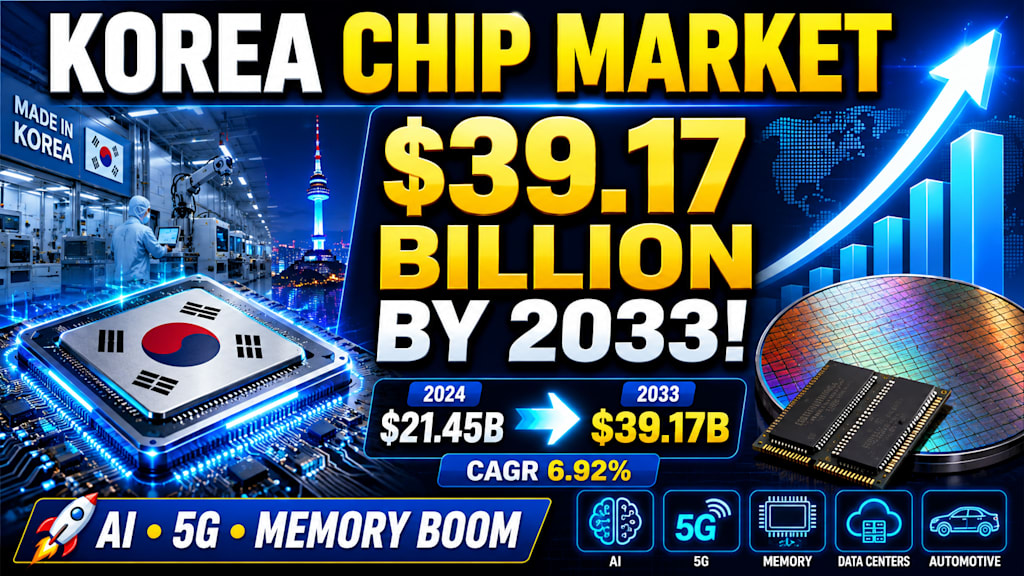
Korea Semiconductor Device Market Size and Forecast 2025–2033
The Korea Semiconductor Device Market is poised for substantial growth over the next decade, reflecting the country's continued dominance in the global semiconductor ecosystem. According to Renub Research, the Korea Semiconductor Device Market is expected to grow from US$ 21.45 billion in 2024 to US$ 39.17 billion by 2033, expanding at a CAGR of 6.92% during 2025–2033.
This growth trajectory is being fueled by rising global demand for memory chips, increasing adoption of artificial intelligence (AI), the rapid rollout of 5G infrastructure, expanding cloud computing services, and strong government support aimed at maintaining South Korea’s technological leadership. As semiconductors become the foundation of digital transformation worldwide, South Korea remains at the center of innovation and production.
South Korea’s Strategic Position in the Global Semiconductor Industry
South Korea has established itself as one of the world's most influential semiconductor manufacturing hubs. The country plays a pivotal role in supplying memory chips used in smartphones, personal computers, data centers, gaming devices, industrial systems, and emerging AI applications.
The nation’s semiconductor leadership is largely supported by industry giants such as Samsung Electronics and SK Hynix, which collectively command a significant share of the global DRAM and NAND flash memory markets. Their technological expertise, large-scale manufacturing capabilities, and continuous research investments have enabled South Korea to remain highly competitive despite increasing global competition.
Semiconductors are not merely an industrial sector for South Korea; they represent a strategic national asset. The industry contributes significantly to exports, economic growth, employment generation, and technological advancement. Consequently, both public and private sectors continue investing heavily in expanding production capacity and developing next-generation semiconductor technologies.
Memory Chips Continue to Drive Market Expansion
One of the primary drivers behind Korea’s semiconductor device market growth is the robust global demand for memory chips.
As businesses and consumers generate unprecedented volumes of digital data, the need for high-performance memory solutions continues to rise. Technologies such as cloud computing, AI-driven analytics, machine learning, edge computing, and IoT applications require advanced memory systems capable of processing and storing massive datasets efficiently.
Data centers worldwide are expanding rapidly to accommodate increasing digital workloads. This trend directly benefits Korean semiconductor manufacturers, particularly those specializing in DRAM and NAND flash memory products.
Additionally, the growing popularity of high-performance smartphones, gaming consoles, laptops, and enterprise storage systems further reinforces demand for advanced memory solutions. Since South Korea remains a dominant supplier of these products, the country is expected to maintain strong revenue growth throughout the forecast period.
Government Initiatives Strengthen Industry Competitiveness
The South Korean government has recognized semiconductors as a cornerstone of the country's future economic growth strategy.
To maintain global leadership, policymakers have introduced various initiatives designed to strengthen domestic manufacturing capabilities and encourage innovation. Tax incentives, research grants, infrastructure development programs, and talent cultivation initiatives have become central components of the government’s semiconductor roadmap.
One notable strategy is the development of the K-Semiconductor Belt, which seeks to create a comprehensive semiconductor ecosystem encompassing design, manufacturing, testing, packaging, and research facilities.
Government-backed support has also encouraged collaboration among universities, research institutions, and private companies. These partnerships help accelerate innovation while addressing workforce shortages and technological challenges.
As countries around the world seek to localize semiconductor production, South Korea’s proactive approach provides a competitive advantage that supports long-term market growth.
Artificial Intelligence Creates New Opportunities
Artificial intelligence is rapidly becoming one of the most important growth catalysts for the semiconductor industry.
AI applications require specialized processors capable of handling complex computational workloads efficiently. Training large language models, processing massive datasets, and supporting intelligent automation systems all depend on advanced semiconductor technologies.
South Korean companies are increasingly investing in AI-specific chip development to diversify beyond traditional memory products. These investments are helping create new revenue streams while strengthening Korea’s position in emerging semiconductor segments.
AI deployment is expanding across multiple industries, including healthcare, manufacturing, finance, retail, logistics, and telecommunications. As organizations adopt AI-powered systems, demand for high-performance chips is expected to increase significantly.
This transformation presents substantial opportunities for Korean semiconductor manufacturers seeking to capture greater value from next-generation computing applications.
5G Deployment Fuels Semiconductor Demand
The ongoing expansion of 5G networks worldwide is generating significant demand for advanced semiconductor devices.
5G infrastructure requires highly sophisticated chips capable of supporting ultra-fast data transmission, low-latency communications, and efficient power management. Semiconductor devices are essential components in network equipment, base stations, mobile devices, and connected IoT ecosystems.
South Korean companies are particularly well-positioned to benefit from this trend due to their strong expertise in communications technologies and advanced chip manufacturing.
As governments and telecom operators continue investing in next-generation network infrastructure, semiconductor demand associated with 5G deployment is expected to remain strong throughout the forecast period.
Automotive Semiconductor Market Emerges as a Growth Engine
The automotive industry is becoming an increasingly important customer segment for semiconductor manufacturers.
Modern vehicles rely heavily on electronic systems for safety, navigation, infotainment, connectivity, and power management. The rise of electric vehicles (EVs), autonomous driving technologies, and advanced driver assistance systems (ADAS) is further accelerating semiconductor adoption.
South Korean semiconductor firms are expanding their automotive-focused product portfolios to capitalize on these opportunities. Advanced sensors, microcontrollers, power semiconductors, and AI-enabled processing units are becoming critical components in next-generation vehicles.
As automotive electrification continues worldwide, demand for specialized semiconductor solutions is expected to grow substantially, creating a new avenue for market expansion.
Expanding Focus Beyond Memory Chips
Historically, South Korea’s semiconductor success has been largely tied to memory chip production. However, industry leaders are increasingly diversifying into higher-value semiconductor categories.
Companies are investing heavily in logic chips, image sensors, AI accelerators, and foundry services. This strategic shift reduces dependence on cyclical memory markets while opening opportunities in rapidly growing segments.
Samsung Electronics, for example, has significantly expanded its foundry business and system semiconductor operations. The company aims to become a leading player in advanced logic chip manufacturing and AI processor development.
This diversification strategy strengthens the resilience of Korea’s semiconductor industry and positions it for sustained long-term growth.
Challenges Facing the Korea Semiconductor Device Market
Despite strong growth prospects, several challenges continue to impact the industry.
Geopolitical Uncertainty
South Korea's semiconductor sector remains highly interconnected with global supply chains. Trade tensions involving major economies such as the United States, China, and Japan can create disruptions affecting raw material access, technology transfers, and export markets.
Previous trade disputes have highlighted vulnerabilities in sourcing critical semiconductor manufacturing materials. Consequently, Korean companies are increasingly focused on supply chain diversification and domestic production capabilities.
Rising Global Competition
Countries worldwide are investing heavily in semiconductor manufacturing to strengthen technological independence.
The United States, China, Taiwan, and several European nations have introduced substantial incentive programs designed to attract semiconductor investments. These initiatives increase competitive pressure on Korean manufacturers.
Maintaining technological leadership will require continuous innovation, capital investment, and strategic partnerships.
Talent Shortages
The semiconductor industry requires highly skilled engineers, researchers, and technical specialists.
As technologies become increasingly complex, demand for specialized expertise in areas such as advanced lithography, chip design, AI processors, and quantum computing continues to rise. However, workforce development has not always kept pace with industry requirements.
Addressing this skills gap will be critical to sustaining Korea’s competitive advantage in semiconductor innovation.
Market Segmentation Analysis
By Product Type
- Discrete Semiconductors
- Optoelectronics
- Sensors
- Integrated Circuits
- Others
Integrated circuits continue to dominate the market due to their extensive use across consumer electronics, communications equipment, computing systems, and industrial applications.
By Material
- Silicon (Si)
- Silicon Carbide (SiC)
- Gallium Nitride (GaN)
- Gallium Arsenide (GaAs)
- Others
Silicon remains the primary semiconductor material due to its cost efficiency and mature manufacturing ecosystem. However, SiC and GaN are gaining popularity in power electronics, EVs, and high-frequency applications.
By End Use
- Networking & Communications
- Data Processing
- Industrial
- Consumer Electronics
- Automotive
- Government
Consumer electronics and data processing currently represent major demand segments, while automotive applications are expected to experience some of the fastest growth rates during the forecast period.
Recent Developments from Leading Semiconductor Companies
1. Samsung Electronics Accelerates 2nm Technology Development
In April 2025, Samsung Electronics announced accelerated progress in its 2nm semiconductor manufacturing process while reporting first-quarter revenue of KRW 79.14 trillion.
2. SK Hynix Posts Strong Profit Growth
SK Hynix reported a 157.8% year-over-year increase in operating profit during Q1 2025, driven largely by strong HBM3E memory sales supporting AI workloads.
3. Hyundai Mobis Expands Automotive Chip Production
In March 2025, Hyundai Mobis confirmed plans to begin mass production of automotive semiconductors using Samsung foundry facilities.
4. Korean AI Startup Attracts Meta Interest
Meta reportedly initiated acquisition discussions in February 2025 with a Korean AI-chip startup founded by a former Samsung engineer.
5. Samsung Increases AI Processor Investments
Samsung continues expanding investments in AI-focused semiconductor development to address growing demand for high-performance computing applications.
6. SK Hynix Strengthens HBM Leadership
The company continues scaling High Bandwidth Memory (HBM) production to support AI servers and advanced data center infrastructure.
7. Rebellions Advances AI Semiconductor Innovation
Rebellions is expanding its AI accelerator portfolio aimed at enterprise AI workloads and next-generation data processing applications.
8. FuriosaAI Expands AI Chip Commercialization
FuriosaAI continues developing energy-efficient AI processors designed to improve performance while reducing power consumption.
9. Micron Increases Advanced Memory Investments
Micron Technology is strengthening global advanced memory production capabilities to meet increasing AI and cloud infrastructure demand.
10. Infineon and STMicroelectronics Enhance Automotive Semiconductor Portfolios
Both companies are expanding power semiconductor and automotive electronics offerings to support electric vehicle growth worldwide.
Competitive Landscape
The Korea Semiconductor Device Market features intense competition among global and domestic manufacturers. Key market participants continue investing heavily in innovation, production capacity, and strategic partnerships.
Major companies operating in the market include:
- Samsung Electronics Co., Ltd.
- SK Hynix Inc.
- Rebellions Inc.
- FuriosaAI
- Micron Technology Inc.
- Texas Instruments Inc.
- ON Semiconductor Corp.
- Infineon Technologies AG
- STMicroelectronics N.V.
- Renesas Electronics Corporation
These companies are focusing on AI chips, memory technologies, automotive semiconductors, advanced manufacturing nodes, and power-efficient solutions to strengthen their market positions.
Final Thoughts
South Korea remains one of the most influential forces in the global semiconductor industry. With strong leadership in memory chips, expanding investments in AI and system semiconductors, robust government support, and growing opportunities across automotive, 5G, and cloud computing applications, the industry is well-positioned for long-term expansion.
According to Renub Research, the market is expected to grow from US$ 21.45 billion in 2024 to US$ 39.17 billion by 2033, achieving a CAGR of 6.92% between 2025 and 2033. While challenges such as geopolitical uncertainty, talent shortages, and rising competition remain, South Korea’s commitment to innovation and technological excellence ensures that it will continue playing a central role in shaping the future of the global semiconductor landscape.
About the Creator
Enjoyed the story? Support the Creator.
Subscribe for free to receive all their stories in your feed.
Comments
There are no comments for this story
Be the first to respond and start the conversation.