
Key Features Every White Label Perpetual DEX Platform Should Have
Understanding how White Label Perpetual DEX platforms work and why they matter in crypto trading

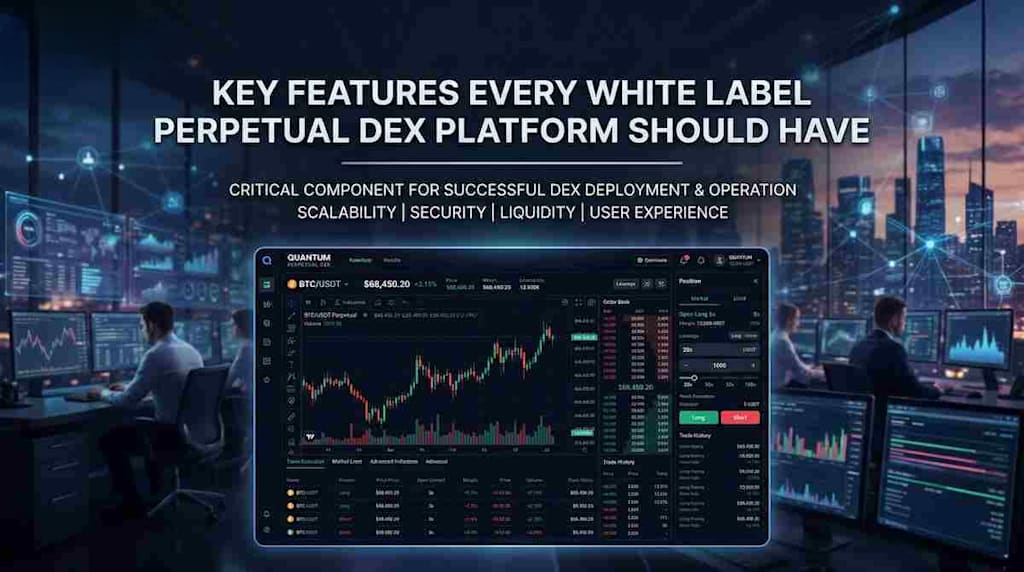
The decentralized finance (DeFi) sector has evolved from a niche blockchain experiment into a multi-billion-dollar ecosystem that is reshaping how financial products are created, traded, and accessed. Among the most significant innovations in this space are perpetual decentralized exchanges (Perpetual DEXs), which enable traders to speculate on asset prices without owning the underlying assets and without expiration dates on contracts. As demand for decentralized derivatives continues to rise, businesses are increasingly seeking turnkey solutions that allow them to launch trading platforms quickly and efficiently. This has fueled the growth of the White Label Perpetual DEX Platform market.
However, not all solutions are created equal. A perpetual DEX is far more complex than a standard spot exchange because it must manage leverage, liquidity, funding rates, risk controls, and real-time pricing while maintaining the transparency and decentralization expected in blockchain-based systems. Choosing the right platform therefore requires careful evaluation of the features that directly impact performance, security, user adoption, and long-term scalability.
This article explores the essential features every modern perpetual DEX solution should offer and explains why these capabilities are critical for success in an increasingly competitive market.
High-Performance Trading Infrastructure
Speed and execution quality are among the most important factors influencing trader satisfaction. In traditional financial markets, even milliseconds can affect profitability, and crypto derivatives traders have adopted similar expectations.
A perpetual DEX must be capable of processing large volumes of orders with minimal latency. While decentralized systems historically struggled with speed compared to centralized exchanges, recent advances in Layer-2 scaling technologies, optimistic rollups, zero-knowledge rollups, and off-chain order matching have significantly improved performance.
A robust infrastructure should support:
- High transaction throughput
- Near-instant order execution
- Minimal slippage
- Efficient settlement mechanisms
- Consistent performance during market volatility
During periods of extreme market movement, trading volume can increase several times above average levels. Platforms lacking scalable infrastructure often experience delays, failed transactions, or liquidity disruptions. Such issues can quickly erode user trust and damage a platform's reputation.
The most successful perpetual DEXs leverage hybrid architectures that combine decentralized settlement with optimized execution layers, delivering both speed and transparency.
Deep Liquidity Management
Liquidity is the foundation of every successful trading platform. Without sufficient liquidity, traders face wider spreads, increased slippage, and difficulty entering or exiting positions.
A quality perpetual DEX solution should incorporate sophisticated liquidity mechanisms that ensure healthy market depth across trading pairs. Depending on the architecture, liquidity may be sourced through:
- Automated Market Makers (AMMs)
- Liquidity pools
- Professional market makers
- Aggregated external liquidity
- Hybrid liquidity models
Many leading decentralized derivatives platforms utilize incentive structures that reward liquidity providers with trading fees and token rewards. These mechanisms encourage capital participation and create more stable markets.
Deep liquidity becomes especially important for leveraged trading. When traders open large positions using leverage, inadequate liquidity can lead to exaggerated price swings and unnecessary liquidations. Therefore, effective liquidity design directly impacts user retention and trading volume.
Advanced Leverage and Margin Trading Capabilities
Perpetual contracts derive much of their appeal from leverage. Traders can control larger positions with a smaller amount of capital, amplifying both potential gains and risks.
An enterprise-grade perpetual DEX should provide flexible leverage configurations while maintaining strong risk controls. Features commonly expected include:
- Cross-margin functionality
- Isolated margin options
- Adjustable leverage ratios
- Real-time margin calculations
- Automated liquidation systems
The ability to choose between isolated and cross-margin modes gives traders greater flexibility in managing risk. Professional traders often rely on these tools to optimize capital efficiency while protecting their portfolios from excessive exposure.
At the same time, leverage functionality must be supported by transparent risk parameters and clear liquidation procedures. Poorly designed liquidation mechanisms can create cascading losses and destabilize entire markets.
Reliable Oracle Integration
One of the most critical components of any perpetual trading platform is its price oracle system. Since perpetual contracts rely on external price feeds, inaccurate or manipulated data can result in unfair liquidations and financial losses.
A dependable oracle framework should provide:
- Real-time market pricing
- Multi-source data aggregation
- Tamper-resistant architecture
- High-frequency updates
- Redundant backup feeds
The collapse of several DeFi protocols in previous market cycles highlighted the dangers of oracle vulnerabilities. Flash-loan attacks and price manipulation incidents demonstrated that weak oracle infrastructure can compromise an otherwise secure protocol.
For this reason, businesses evaluating a White Label Perpetual DEX Platform should prioritize solutions that integrate proven oracle providers and employ multiple validation mechanisms to ensure pricing accuracy.
Comprehensive Security Architecture
Security remains one of the defining concerns within decentralized finance. According to multiple blockchain security reports, billions of dollars have been lost to hacks, exploits, and protocol vulnerabilities over the past few years.
Because perpetual DEXs handle significant trading volumes and user funds, they must incorporate institutional-grade security measures.
Essential security features include:
Smart contract audits
- Multi-signature wallet systems
- Role-based access controls
- Penetration testing
- Bug bounty programs
- Continuous monitoring tools
Security should not be treated as a one-time implementation but as an ongoing process. Threat landscapes evolve rapidly, and successful platforms continuously update defenses against emerging attack vectors.
Transparency also plays a major role. Public audit reports, security certifications, and open communication help establish credibility among users and investors.
Intuitive User Experience and Professional Trading Interface
Even the most technically advanced exchange can struggle if users find it difficult to navigate. User experience is often the deciding factor between platforms with similar functionality.
Modern traders expect interfaces comparable to those offered by leading centralized exchanges. Therefore, a perpetual DEX should feature:
- Advanced charting tools
- One-click order placement
- Customizable dashboards
- Mobile responsiveness
- Position management panels
- Real-time portfolio analytics
New users entering decentralized trading may already face a learning curve involving wallets, blockchain transactions, and gas fees. An intuitive interface reduces friction and improves onboarding efficiency.
Professional traders also value advanced trading capabilities such as limit orders, stop-loss settings, take-profit orders, and conditional execution strategies. Providing these features enhances platform competitiveness and attracts experienced market participants.
Risk Management and Automated Liquidation Systems
Risk management is essential for maintaining market integrity and protecting platform solvency. Since perpetual contracts allow leveraged exposure, losses can accumulate rapidly if risk controls are insufficient.
A sophisticated perpetual DEX should include:
- Dynamic liquidation engines
- Insurance funds
- Auto-deleveraging mechanisms
- Position monitoring systems
- Exposure management tools
Insurance funds serve as critical safety nets during periods of extreme volatility. They absorb losses that exceed collateral levels and reduce the likelihood of systemic failures.
Similarly, auto-deleveraging systems help maintain platform stability when liquidation mechanisms are unable to close positions efficiently. These safeguards contribute to long-term sustainability and foster user confidence.
Multi-Chain Compatibility and Scalability
The blockchain ecosystem is no longer dominated by a single network. Traders increasingly operate across multiple chains, including Ethereum, Arbitrum, Optimism, Base, Avalanche, and BNB Chain.
A future-ready White Label Perpetual DEX Platform should support multi-chain deployment and interoperability. This capability allows businesses to access broader user bases while reducing dependence on any single blockchain ecosystem.
Benefits of multi-chain functionality include:
- Lower transaction costs
- Greater liquidity access
- Expanded market reach
- Improved scalability
- Enhanced user flexibility
Cross-chain integrations can also facilitate seamless asset transfers and improve capital efficiency across decentralized markets.
As blockchain adoption grows, scalability will become even more important. Platforms that fail to adapt to evolving network demands risk losing users to more agile competitors.
Customization and Branding Flexibility
One of the primary reasons businesses choose white-label solutions is the ability to launch quickly while maintaining a unique brand identity.
A high-quality solution should offer extensive customization options, including:
- Custom branding elements
- Personalized user interfaces
- Flexible fee structures
- Configurable trading pairs
- Tailored reward mechanisms
Brand differentiation is particularly important in the increasingly crowded crypto marketplace. Businesses need the freedom to create distinct experiences that resonate with their target audiences while leveraging proven backend technology.
The ideal solution balances flexibility with reliability, enabling customization without compromising platform performance or security.
Analytics, Reporting, and Administrative Controls
Data-driven decision-making has become essential for digital businesses. Perpetual DEX operators require visibility into trading activity, user behavior, liquidity metrics, and platform performance.
Comprehensive administrative dashboards should provide insights such as:
Trading volume trends
- Open interest metrics
- Revenue analytics
- Liquidity pool performance
- User acquisition data
- Risk exposure reports
These analytics empower operators to optimize trading incentives, identify growth opportunities, and respond proactively to market conditions.
Advanced reporting capabilities are particularly valuable for institutional partnerships and ecosystem stakeholders who require transparent performance data.
Conclusion
The decentralized derivatives market continues to mature, creating significant opportunities for businesses seeking to enter the rapidly expanding DeFi landscape. However, launching a successful perpetual exchange requires much more than basic trading functionality. Performance, liquidity, security, risk management, scalability, and user experience all play critical roles in determining long-term success.
When evaluating a White Label Perpetual DEX Platform, decision-makers should focus on the features that directly impact trader confidence and platform sustainability. High-speed execution, deep liquidity, robust oracle systems, institutional-grade security, advanced risk controls, and multi-chain compatibility are no longer optional they are fundamental requirements.
As decentralized finance moves toward broader mainstream adoption, platforms that combine technical excellence with exceptional user experiences will be best positioned to capture market share. By prioritizing these essential capabilities, businesses can launch competitive perpetual trading ecosystems that meet the evolving demands of modern crypto traders and establish a strong presence in the future of decentralized derivatives.
About the Creator
Alexei
A blockchain token development specialist skilled in Solidity and Rust, building secure, compliant, and scalable digital assets, with strong experience in smart contracts, security audits, and DApp integration.
Enjoyed the story? Support the Creator.
Subscribe for free to receive all their stories in your feed.
Comments
There are no comments for this story
Be the first to respond and start the conversation.