
Japan Warehouse Automation Market Size, Share and Future Outlook 2026-2034
How E-Commerce Growth, Robotics Innovation, and Smart Logistics Solutions Are Transforming Japan’s Warehouse Automation Industry

Market Overview
Warehouse automation is becoming a critical component of Japan’s logistics and supply chain ecosystem as businesses seek greater operational efficiency, faster order fulfillment, and reduced labor dependency. The growing expansion of e-commerce, rising consumer expectations for rapid delivery, and increasing labor shortages are encouraging organizations to invest in advanced warehouse automation technologies. Automated systems are helping businesses optimize inventory management, improve warehouse productivity, and enhance supply chain resilience.
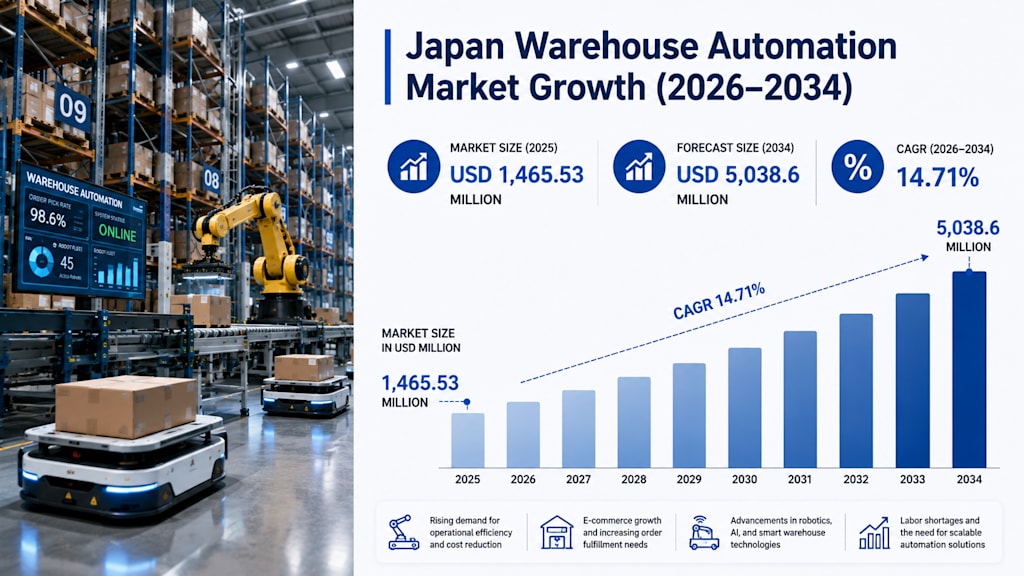
The Japan warehouse automation market size reached USD 1,465.53 Million in 2025. The market is projected to reach USD 5,038.6 Million by 2034, exhibiting a growth rate (CAGR) of 14.71% during 2026-2034. Market growth is being driven by increasing adoption of robotics, artificial intelligence, warehouse management software, and automated material handling systems across logistics and distribution facilities.
Request PDF Sample for more detailed market insights:
Role of Innovation in Market Development
· Expansion of Autonomous Mobile Robots and AGVs
Autonomous mobile robots (AMRs) and automated guided vehicles (AGVs) are increasingly being deployed to streamline material transportation and warehouse operations. These technologies improve operational efficiency, reduce manual labor requirements, and enhance workplace safety.
· Integration of AI-Powered Warehouse Management Systems
Warehouse operators are adopting advanced warehouse management systems (WMS) and warehouse execution systems (WES) to improve inventory visibility, order accuracy, and workflow optimization. Artificial intelligence and predictive analytics are enabling smarter decision-making and real-time operational control.
· Growth of Automated Storage and Retrieval Systems
Automated storage and retrieval systems (AS/RS) are helping businesses maximize storage capacity while improving picking speed and inventory management accuracy. These solutions are particularly valuable for high-volume warehouses and distribution centers.
Japan Warehouse Automation Industry Trends and Drivers
· Rapid Expansion of E-Commerce Activities
The continuous growth of online retail is creating strong demand for efficient warehouse operations and faster fulfillment capabilities. Warehouse automation technologies are helping businesses meet increasing order volumes and customer expectations for rapid delivery.
· Rising Labor Shortages and Workforce Challenges
Japan’s aging population and shrinking workforce are encouraging logistics operators to adopt automation solutions to maintain productivity and reduce dependence on manual labor. Automated systems are becoming essential for addressing long-term labor constraints.
· Increasing Demand for Supply Chain Efficiency
Businesses across industries are investing in warehouse automation to improve inventory accuracy, reduce operational costs, and enhance supply chain performance. Automation technologies are supporting greater flexibility and resilience within logistics networks.
Japan Warehouse Automation Market Segmentation
Component Insights
Hardware
· Mobile Robots (AGV, AMR)
· Automated Storage and Retrieval Systems (AS/RS)
· Automated Conveyor and Sorting Systems
· De-palletizing/Palletizing Systems
· Automatic Identification and Data Collection (AIDC)
· Piece Picking Robots
Software
· Warehouse Management Systems (WMS)
· Warehouse Execution Systems (WES)
Services
· Value Added Services
· Maintenance
End User Insights
· Food and Beverage
· Post and Parcel
· Retail
· Apparel
· Manufacturing
· Others
Regional Insights
· Kanto Region
· Kansai/Kinki Region
· Central/Chubu Region
· Kyushu-Okinawa Region
· Tohoku Region
· Chugoku Region
· Hokkaido Region
· Shikoku Region
This segmentation highlights the diverse automation technologies and end-user industries contributing to the growth of Japan’s warehouse automation market.
Competitive Landscape
The Japan warehouse automation market includes robotics manufacturers, logistics technology providers, software developers, material handling equipment companies, and automation solution providers. Competition is influenced by technological innovation, system integration capabilities, operational efficiency, scalability, and after-sales support services. Companies investing in AI-powered automation platforms, advanced robotics, and intelligent warehouse software are strengthening their market position.
Market Outlook
The Japan warehouse automation market is expected to witness strong long-term growth driven by increasing e-commerce penetration, labor shortages, and rising demand for efficient logistics operations. Continued advancements in robotics, AI-driven warehouse management systems, automated storage solutions, and smart logistics infrastructure will remain key growth drivers. Japan’s commitment to digital transformation and supply chain modernization is expected to further accelerate adoption of warehouse automation technologies over the forecast period.
About IMARC Group
IMARC Group is a leading market research and consulting firm providing strategy development, industry analysis, feasibility studies, and data-driven insights across global markets. The firm supports businesses, investors, and governments in making informed decisions through reliable and actionable research.
About the Creator
Yoshio
Market Research Analyst with 5+ years of experience in consumer insights and market segmentation. Skilled in data analysis and qualitative research.
Enjoyed the story? Support the Creator.
Subscribe for free to receive all their stories in your feed.
Comments
There are no comments for this story
Be the first to respond and start the conversation.