
Japan Tea Market: Size, Share and Growth 2026-2034
How Cultural Heritage, Health Consciousness, and Ready-to-Drink Innovation Drive Japan's Tea Sector

Market Overview
Tea represents one of the most widely consumed beverages globally, prepared by steeping dried leaves, buds, or twigs of the Camellia sinensis plant in hot water, yielding a flavorful and aromatic drink with numerous health benefits. Tea varieties include green tea produced through minimal oxidation preserving natural antioxidants and catechins, black tea created through full oxidation developing robust flavor and higher caffeine content, oolong tea representing partially oxidized variant combining characteristics of both green and black tea, and specialty varieties including white tea, herbal infusions, and blended teas. Japan's tea culture holds deep historical roots with the traditional Japanese tea ceremony representing a ritualized preparation and presentation of matcha embodying principles of harmony, respect, purity, and tranquility. Green tea dominates Japan's market reflecting cultural significance and established health benefits with matcha, sencha, and gyokuro representing premium heritage varieties. Tea applications span residential daily consumption, commercial foodservice including cafes and restaurants, and industrial processing for ready-to-drink beverage production. Ready-to-drink tea formats have transformed tea consumption enabling on-the-go access for modern consumers. Packaging innovations from traditional loose-leaf formats to convenient tea bags and sustainable cartons broaden accessibility across consumer segments. In Japan's context, tea represents deeply embedded cultural beverage supporting daily wellness rituals, social occasions, and premium lifestyle positioning.
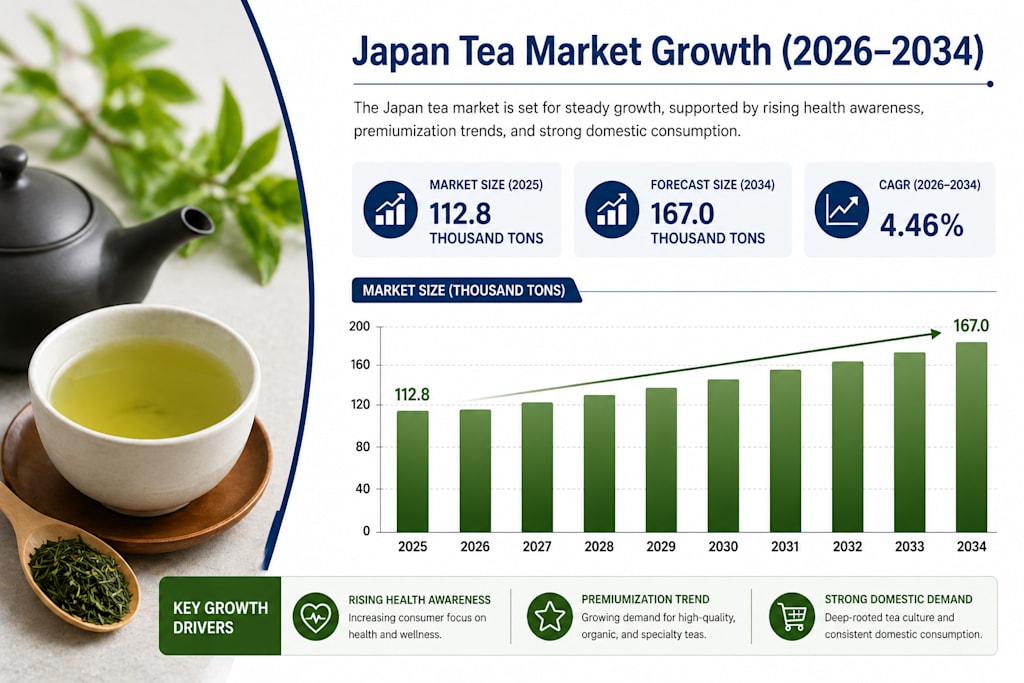
The Japan tea market size reached 112.8 Thousand Tons in 2025, reflecting robust and culturally embedded demand across residential and commercial segments. Looking ahead, the market is projected to reach 167.0 Thousand Tons by 2034, exhibiting steady growth rate (CAGR) of 4.46% during 2026-2034. This sustained expansion is supported by growing health consciousness among Japanese consumers driving preference for antioxidant-rich beverages, rich cultural heritage of tea ceremonies sustaining generational demand, rising popularity of flavorful fresh and ready-to-drink beverage formats appealing to younger demographics, increasing focus on managing weight and metabolic health enhancing appeal of catechin-rich teas, global matcha boom driving export growth with Japan's tea exports exceeding 10,000 tons in January through October 2025 for first time in 71 years since 1954, innovations in tea flavors and packaging attracting diverse consumer segments, consumer preference for natural and premium products driving organic and specialty tea adoption, collaboration between international firms and Japanese tea companies expanding market reach, Ministry of Agriculture Forestry and Fisheries support for producers transitioning from sencha to tencha cultivation responding to global matcha demand, and Asahi Soft Drinks launching Japanese Black Tea Unsweetened Straight targeting 2 million cases in annual sales.
Request PDF Sample for more detailed market insights:
Role of Innovation in Market Development
• Ready-to-Drink Innovation and Convenience Format Development
Innovation is revolutionizing Japan's tea market through RTD product development. Bottled and canned tea formats enable on-the-go consumption for busy consumers. Cold brew production methods preserve delicate flavors and antioxidants. Nitrogen-infused tea beverages create smooth creamy texture. Sugar-free and unsweetened RTD formulations address health-conscious demand. Functional RTD teas incorporating adaptogens, vitamins, and minerals. Flavored RTD varieties expanding beyond traditional plain formats. Premium RTD teas targeting specialty and convenience retail channels. Innovative packaging preserving freshness and extending shelf life. RTD innovation drives volume growth and younger consumer recruitment.
• Matcha Premium Development and Export Positioning
Matcha represents transformative innovation driving market expansion. Ceremonial grade matcha commanding premium pricing for traditional preparation. Culinary grade matcha enabling diverse food and beverage applications. Matcha-infused confectionery, desserts, and culinary products proliferating. Ito En's new ginger-flavored matcha featuring powder stored in cap for fresh preparation at purchase combining convenience with premium quality. Specialty matcha products targeting international export markets. Sustainability initiatives including Ito En converting used tea leaves into compost for feed crop cultivation in Miyazaki Prefecture marking Japan's first such application. Yame City pursuing ESG certification for export expansion. Global matcha boom creating unprecedented export opportunity. Premium positioning enables value growth alongside volume expansion.
• Functional Tea and Wellness Formulation Innovation
Functional tea development represents critical market innovation. Antioxidant-enriched formulations supporting cardiovascular health claims. Catechin-concentrated products for metabolic health positioning. Fortified tea products incorporating vitamins B1, B2, B3, B6, and vitamin C as demonstrated by Teaflex's dissolvable powder format launch in February 2025. Fat reduction formula teas targeting weight management consumers. Probiotic-enhanced kombucha and fermented tea varieties. Adaptogen and botanical ingredient integration. Beauty-focused collagen-supporting tea formulations. Sleep support and relaxation blend development. Functional claims attract health-conscious premium consumers.
Japan Tea Industry Trends and Drivers
• Health Consciousness and Antioxidant Awareness
Health consciousness represents primary market growth driver. Green tea antioxidant benefits association with reduced heart disease and cancer risk. Catechin content attracting health-focused consumers replacing sugary beverages. WHO estimates 20 million new cancer cases and 9.7 million deaths in 2022 creating preventive health motivation. Weight management and metabolic health focus among younger demographics. Studies indicating health benefits of consuming three to five cups of green tea daily enhance appeal. In Japan 72.3% of people consume green tea daily and 89.6% drink it more than once a week. Preference for green tea increases with age with older individuals showing higher consumption tendency. Health imperative ensures fundamental sustained demand.
• Cultural Heritage and Tea Ceremony Tradition
Cultural significance provides stable market foundation. Traditional Japanese tea ceremony sustaining ceremonial matcha demand. Intergenerational cultural transmission ensuring continued appreciation. Tourism interest in tea ceremony experiences expanding cultural reach. Premium heritage variety appreciation including gyokuro and kabusecha. Tea master craft preservation supporting premium positioning. International interest in Japanese tea culture driving export awareness. Cultural education expanding appreciation beyond Japan. Heritage positioning commands premium pricing and loyalty.
• Global Matcha Boom and Export Opportunity
International matcha popularity creates exceptional growth catalyst. Global matcha market valued at USD 4.05 Billion in 2025 projected to reach USD 8.72 Billion by 2034 at CAGR of 8.90%. Japan's tea exports exceeding 10,000 tons in January through October 2025 for first time since 1954. Tenzo premium matcha collaborating with boutique tequila brand Lo Siento creating matcha-infused cocktails demonstrating innovation versatility. Ministry of Agriculture Forestry and Fisheries supporting producer transition to tencha cultivation responding to global demand. Favorable currency exchange rates supporting competitive export pricing. Export expansion diversifies revenue beyond domestic consumption.
Key Growth Drivers of Japan Tea Market
• Premium and Organic Tea Segment Growth
Premium segment expansion drives value growth. Organic certification commanding premium consumer pricing. Single-origin variety differentiation attracting connoisseurs. Specialty tea shop proliferation providing premium retail channels. Heritage variety appreciation including gyokuro and rare regional teas. Japan organic tea market valued at USD 82.80 Million in 2024 projected to reach USD 159.94 Million by 2033. Clean label and chemical-free positioning supporting organic adoption. Premium gifting culture supporting high-value tea products. Premium positioning enables margin improvement alongside volume growth.
• Digital Commerce and E-Commerce Channel Expansion
Online retail growth expands market accessibility. E-commerce platforms enabling direct-to-consumer brand building. Subscription delivery models ensuring regular purchasing. International market access through online retail channels. Social media and influencer marketing driving product discovery. Import product accessibility through online platforms. Consumer review systems building product trust. Convenience of home delivery reducing purchase friction. Digital channel expansion broadens addressable consumer base.
• Foodservice and Cafe Culture Integration
Cafe culture expansion drives commercial segment growth. Specialty cafe matcha latte and tea-based beverage adoption. Tea-based cocktail and mocktail menu development. Premium tea pairing with food offerings. Hotel and hospitality tea service sophistication. Restaurant menu specialty tea offering expansion. Corporate catering and office service tea adoption. Tea experience destination development attracting tourists. Foodservice integration provides commercial volume growth.
Opportunities of Japan Tea Market
• Functional and Fortified Tea Product Development
Substantial opportunities exist in functional formulation development. Immunity-boosting vitamin and mineral fortification. Probiotic-enhanced gut health positioning. Weight management catechin-concentrated products. Cognitive support L-theanine emphasized formulations. Beauty supplement tea targeting skin health. Athletic performance recovery tea development. Sleep support evening blend creation. Functional positioning enables premium pricing and healthcare market alignment.
• International Export and Global Market Expansion
Significant opportunities exist in export market development. Premium Japanese tea variety global positioning. Heritage terroir storytelling for international premium consumers. Specialty tea gift set export development. Online direct export to international consumers. Partnership with international specialty retailers. Japanese food trend alignment supporting tea interest. Cultural experience packaging enhancing export value. Export market provides volume and value growth beyond domestic limitations.
• Sustainable Packaging and Eco-Friendly Innovation
Emerging opportunities exist in sustainability-focused products. Recyclable and biodegradable packaging development. Reduced plastic packaging transition. Carbon-neutral production and distribution certification. Sustainable farming and organic certification. Waste reduction through innovative processing. Eco-conscious consumer segment targeting. Environmental certification achievement supporting premium positioning. Sustainability alignment attracts environmentally motivated consumers.
Japan Tea Market Segmentation
By Product Type
• Green Tea
o Sencha (Most Widely Consumed Variety)
o Matcha (Ceremonial and Culinary Grade)
o Gyokuro (Shade-Grown Premium Variety)
o Hojicha (Roasted Green Tea)
o Bancha and Others
• Black Tea
o Domestic Japanese Black Tea
o Imported Black Tea Varieties
o Flavored and Blended Black Tea
• Oolong Tea
o Traditional Oolong Varieties
o Flavored and Infused Oolong
• Others
o White Tea
o Herbal and Botanical Infusions
o Blended and Specialty Varieties
o Kombucha and Fermented Tea
By Packaging
• Plastic Containers (RTD Bottle and PET Formats)
• Loose Tea (Traditional and Premium Formats)
• Paper Boards (Eco-Friendly Carton Packaging)
• Aluminium Tin (Premium Preserve and Gift Packaging)
• Tea Bags (Convenient Single-Serve Formats)
• Others (Pouches, Capsules, Biodegradable Formats)
By Application
• Residential (Household Daily Consumption)
• Commercial (Cafes, Restaurants, Foodservice, Hospitality)
By Distribution Channel
• Supermarkets and Hypermarkets (Mass Retail, Wide Variety)
• Specialty Stores (Premium Tea Shops, Health Food Stores)
• Convenience Stores (On-the-Go RTD Formats)
• Online (E-Commerce Platforms, Direct-to-Consumer)
• Others (Vending Machines, Institutional Supply, Export)
By Region
• Kanto Region (Tokyo, Yokohama — largest consumer market, RTD innovation hub)
• Kansai/Kinki Region (Osaka, Kyoto — traditional tea culture stronghold)
• Central/Chubu Region (Nagoya — Shizuoka Prefecture major tea production region)
• Kyushu-Okinawa Region (Yame City gyokuro heritage, ESG export focus)
• Tohoku Region (regional tea consumption, health-conscious demographics)
• Chugoku Region (regional distribution, sustainable farming alignment)
• Hokkaido Region (growing health beverage adoption, RTD demand)
• Shikoku Region (regional specialty tea traditions, organic farming)
This comprehensive segmentation reflects the diverse structure of Japan's tea market, encompassing premium green tea varieties to diverse tea types, traditional loose leaf to convenient RTD formats, residential and commercial applications, diverse distribution channels from mass retail to specialty, and geographic distribution across all major Japanese regions aligned with both production heritage and consumption patterns.
Competitive Landscape
The Japan tea market includes major domestic leaders including Ito En Ltd. renowned for premium matcha and extensive RTD portfolio, Suntory Holdings producing popular RTD green tea beverages, Kirin Beverage competing in RTD tea segment, Asahi Soft Drinks expanding domestic black tea lineup, specialized premium tea retailers including Ippodo and Lupicia, and international tea brands establishing Japan market presence. Competitive positioning is influenced by brand heritage, product quality, distribution reach, RTD innovation capability, sustainability credentials, and premium positioning. Domestic leaders leverage cultural authority and established distribution. Premium specialists command heritage pricing premiums. RTD innovators drive volume through convenience formats. Sustainability-focused brands attract environmentally conscious consumers. Export-oriented producers leverage global matcha demand. Successful competitors balance tradition with innovation and authenticity with accessibility. Strategic partnerships between domestic producers and international distributors expand global reach.
Market Outlook
The Japan tea market is expected to witness steady and sustained growth as health consciousness deepens, global matcha demand intensifies, and RTD innovation expands consumption occasions. Matcha export volume will continue growing substantially. Functional tea formulations will proliferate addressing diverse health goals. RTD innovation will accelerate recruiting younger consumers. Premium and organic segments will command increasing market share. Digital commerce will expand both domestic and export reach. Sustainable farming and packaging will become market differentiators. International collaboration will drive product innovation. Cultural heritage storytelling will enhance premium positioning. Government support for tencha cultivation will expand matcha supply. Corporate sustainability commitments will align with organic and eco-friendly teas. As Japan maintains global leadership in tea culture and matcha excellence, the tea market will continue expanding through sustained innovation, export growth, and premiumization. Market expansion from 112.8 Thousand Tons in 2025 to 167.0 Thousand Tons by 2034 reflects steady demand driven by domestic health consciousness, global matcha enthusiasm, and innovation-led consumption growth. Tea will continue serving as Japan's most culturally significant beverage supporting daily wellness, social rituals, and premium lifestyle through sustained market expansion and continuous innovation.
About the Creator
Yoshio
Market Research Analyst with 5+ years of experience in consumer insights and market segmentation. Skilled in data analysis and qualitative research.
Enjoyed the story? Support the Creator.
Subscribe for free to receive all their stories in your feed.
Comments
There are no comments for this story
Be the first to respond and start the conversation.