
Japan’s Watch Market Is Evolving Through Precision Engineering, Minimalist Design, and Technological Innovation
From reliable quartz watches and multifunctional electronic models to premium luxury timepieces, Japan’s watch industry continues balancing traditional craftsmanship with cutting-edge innovation.

Japan’s watch industry has long been recognized as one of the most influential and technologically advanced in the world.
Known for precision engineering, reliability, and groundbreaking innovation, Japanese watchmakers transformed the global timepiece market through quartz technology and electronic watchmaking. Today, Japan continues to maintain a globally respected position by balancing traditional craftsmanship with modern technological advancement.
Watches in Japan are no longer viewed simply as practical timekeeping tools.
They are increasingly considered:
Lifestyle accessories
Fashion statements
Symbols of craftsmanship
Everyday functional essentials
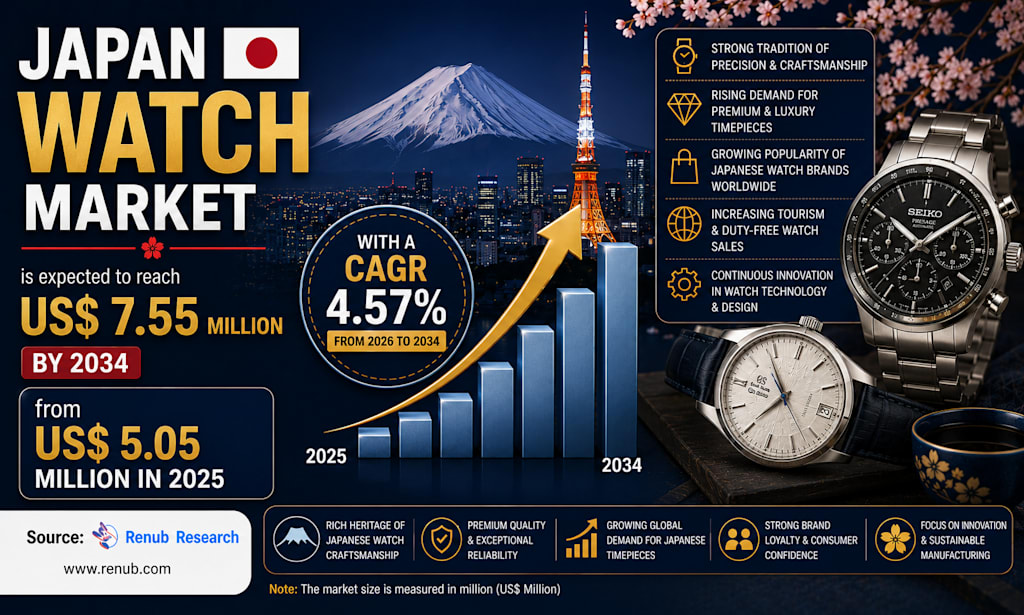
According to Renub Research, the Japan Watch Market is expected to grow from US$ 5.05 million in 2025 to US$ 7.55 million by 2034, expanding at a CAGR of 4.57% between 2026 and 2034. The market’s stable growth is being supported by technological innovation, strong domestic brands, evolving consumer preferences, and steady demand across both luxury and everyday watch categories.
Japanese consumers continue valuing:
- Durability
- Precision
- Simplicity
- Long product life cycles
- Functional design
At the same time, younger generations are increasingly embracing multifunctional and fashion-oriented watches that combine aesthetics with technology.
This blend of tradition, practicality, and innovation continues shaping the future of Japan’s watch industry.
Japan’s Legacy of Innovation Continues Driving Growth
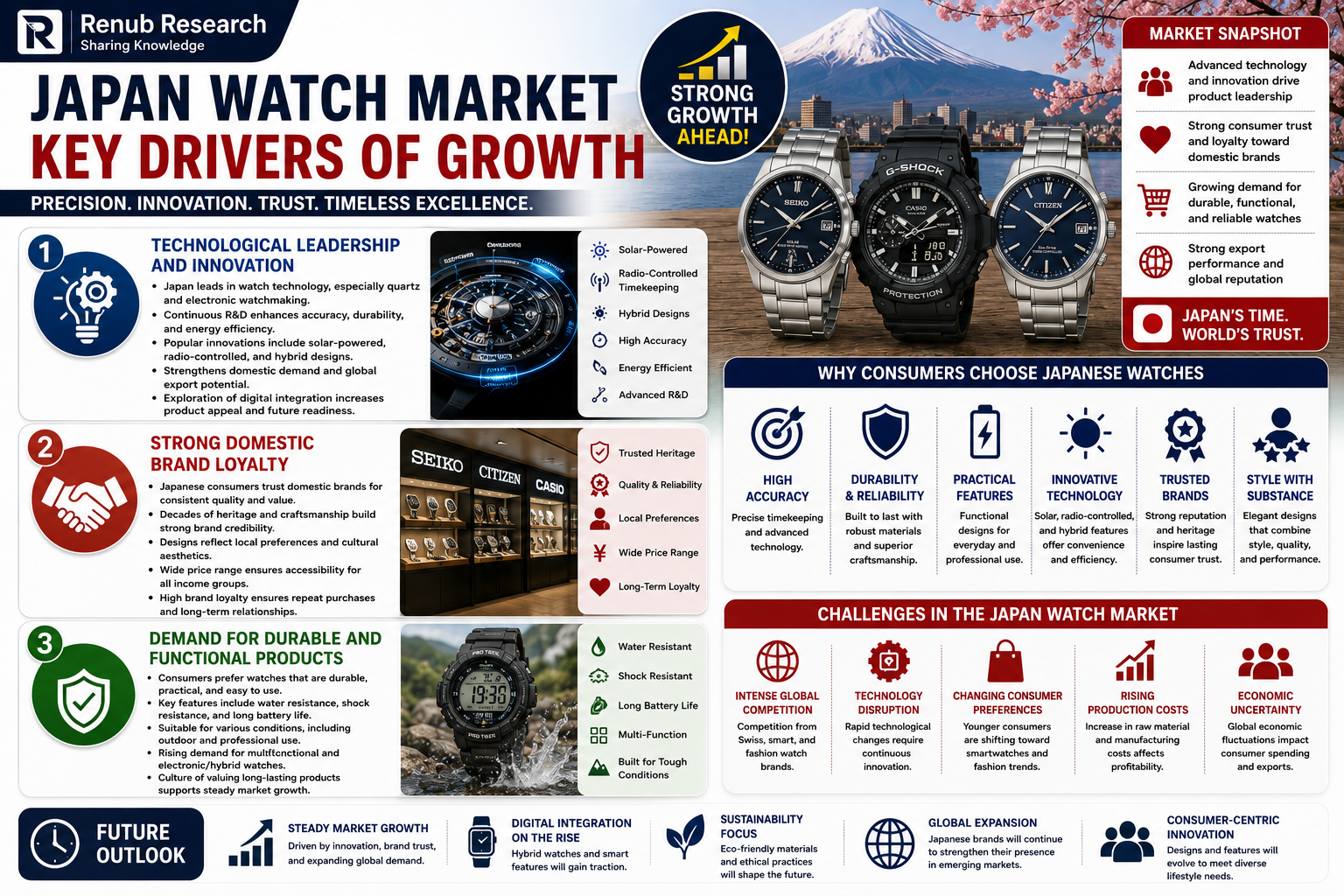
One of the biggest strengths of Japan’s watch market is its longstanding reputation for technological leadership.
Japanese companies revolutionized the global watch industry through the development of quartz technology, electronic movements, and highly efficient manufacturing systems.
Today, manufacturers continue investing heavily in research and development to improve:
- Accuracy
- Durability
- Energy efficiency
- Material quality
- Multifunctional performance
Modern Japanese watches increasingly feature:
- Solar-powered mechanisms
- Radio-controlled timekeeping
- Lightweight materials
- Hybrid analog-digital designs
- Energy-saving systems
Consumers strongly trust Japanese brands because of their consistent reputation for quality and performance.
This technological leadership not only strengthens domestic demand but also supports strong international competitiveness.
Manufacturers continue exploring advanced technologies and digital integration to remain relevant in a rapidly evolving global market.
Strong Domestic Brand Loyalty Supports Market Stability
Japanese consumers show exceptionally strong loyalty toward domestic watch brands.
Over decades, companies such as:
- Seiko
- Citizen
- Casio
have built reputations centered around:
- Reliability
- Precision engineering
- Long-term durability
- Value for money
This trust significantly influences consumer purchasing decisions, particularly among middle-aged and older demographics.
Domestic brands also benefit from a deep understanding of local consumer preferences, enabling them to design products that align with Japanese cultural aesthetics emphasizing:
- Simplicity
- Practicality
- Minimalism
- Functionality
Marketing campaigns often highlight:
- Heritage
- Craftsmanship
- Technological excellence
- Reliability
which further strengthens customer loyalty.
Because domestic brands operate across multiple price categories, they appeal to a broad consumer base ranging from affordable everyday buyers to luxury watch collectors.
This widespread acceptance provides strong long-term market stability.
Practicality and Durability Remain Essential Consumer Priorities
Japanese consumers are highly practical when purchasing watches.
Unlike some global markets where luxury and fashion dominate purchasing decisions, many Japanese consumers prioritize:
- Reliability
- Durability
- Ease of use
- Long-term performance
Features such as:
- Water resistance
- Shock resistance
- Long battery life
- Lightweight construction
remain extremely important across multiple market segments.
Consumers increasingly seek watches suitable for:
- Professional environments
- Outdoor activities
- Everyday commuting
- Long-term daily use
This focus on practicality has encouraged manufacturers to maintain exceptionally high manufacturing standards.
The demand for multifunctional watches featuring hybrid and electronic capabilities is also growing steadily.
Japan’s cultural appreciation for long-lasting and dependable products continues supporting strong demand for premium-quality timepieces.
Quartz Watches Continue Dominating Everyday Demand
Quartz watches remain one of the most important segments within Japan’s watch market.
Japan’s historical leadership in quartz innovation continues influencing strong consumer trust and widespread adoption.
Quartz watches remain highly popular because they offer:
- High accuracy
- Low maintenance
- Affordable pricing
- Everyday practicality
These watches appeal strongly to:
- Office workers
- Professionals
- Older consumers
- Budget-conscious buyers
Manufacturers continue refining quartz technology through improved:
- Energy efficiency
- Lightweight materials
- Design aesthetics
- Long-term durability
Despite growing competition from smartwatches and wearable technology, quartz watches continue maintaining stable demand because of their simplicity and dependability.
Modern minimalist designs and improved comfort are helping attract younger demographics as well.
Electronic Watches Are Expanding Through Innovation
Electronic watches remain a major segment within Japan’s watch industry due to the country’s strong technological expertise.
These watches offer advanced functionalities such as:
- Digital displays
- Alarms
- Multifunctional interfaces
- Enhanced convenience features
Electronic watches are especially popular among:
- Younger consumers
- Tech-oriented buyers
- Active lifestyle users
Manufacturers continue focusing on:
- Improved battery efficiency
- Sleek modern designs
- Enhanced durability
- Lightweight construction
to strengthen product appeal.
The segment also overlaps increasingly with smart-enabled functionality, helping bridge the gap between traditional watches and wearable devices.
Japan’s strong electronics industry continues supporting innovation and competitiveness within this category.
Unisex Watches Are Reflecting Minimalist Fashion Trends
The unisex watches segment is growing steadily in Japan as consumers increasingly embrace versatility and minimalistic fashion aesthetics.
Unisex watches are designed to appeal across genders through:
- Neutral styling
- Clean aesthetics
- Lightweight comfort
- Functional simplicity
This trend aligns closely with broader Japanese fashion culture, which often emphasizes understated elegance and practicality.
Younger consumers especially appreciate products that can adapt easily across:
- Casual settings
- Professional environments
- Social occasions
Manufacturers are responding with products featuring:
- Adjustable sizes
- Slim profiles
- Versatile color schemes
- Modern minimalist designs
The gifting culture in Japan also contributes strongly to unisex watch demand because these products appeal to broader audiences.
Luxury Watches Continue Attracting Affluent Consumers
Japan’s luxury watch segment remains highly respected and resilient.
Consumers purchasing luxury timepieces strongly value:
- Heritage
- Precision craftsmanship
- Exclusivity
- Premium materials
- Sophisticated engineering
Luxury watches are often viewed as:
- Status symbols
- Collector’s items
- Long-term investments
Both domestic and international luxury brands compete actively within Japan’s premium watch market.
Affluent consumers and collectors frequently seek:
- Limited editions
- Bespoke designs
- Mechanical craftsmanship
- High-end materials
Luxury department stores, specialty boutiques, and premium retail experiences remain highly important distribution channels.
Despite economic fluctuations, the luxury segment continues benefiting from Japan’s strong appreciation for quality craftsmanship and heritage products.
Retail Distribution Is Becoming Increasingly Omnichannel
Japan’s retail environment for watches remains highly organized and diversified.
Consumers purchase watches through:
- Specialty stores
- Department stores
- Hypermarkets
- Convenience stores
- Online platforms
Physical retail continues playing a major role because many consumers prefer:
- In-store product evaluation
- Personalized customer service
- Hands-on inspection
before purchasing watches, particularly premium models.
However, e-commerce is growing steadily due to increasing consumer preference for convenience and broader product accessibility.
Online platforms offer:
- Product comparisons
- Customer reviews
- Competitive pricing
- Wider brand availability
Brands are increasingly investing in omnichannel strategies combining online convenience with offline retail experiences to improve customer engagement and accessibility.
Smartwatch Adoption Is Challenging Traditional Segments
One of the biggest challenges facing Japan’s traditional watch market is the rapid rise of smartwatches and connected wearable devices.
Younger consumers increasingly seek products offering:
- Smartphone connectivity
- Health monitoring
- Fitness tracking
- Multifunctional convenience
This trend is impacting demand for traditional watches, especially within lower and mid-range segments.
Manufacturers must therefore adapt by either:
- Integrating smart functionality
- Repositioning products around luxury and craftsmanship
However, incorporating advanced technology often requires substantial investment and may alter traditional brand identity.
The rapid pace of digital innovation creates additional pressure on manufacturers attempting to maintain long-term relevance.
Market Saturation and Demographics Create Long-Term Challenges
Japan’s watch market is relatively mature and highly saturated.
Many consumers already own multiple watches, reducing replacement frequency and limiting opportunities for rapid expansion.
Additionally, Japan’s slow population growth and aging demographics create challenges related to long-term consumer base expansion.
Competition remains intense across:
- Luxury brands
- Mid-range manufacturers
- Electronic watch companies
- Smartwatch providers
To maintain competitiveness, brands must continuously focus on:
- Product innovation
- Niche positioning
- Value-added features
- Customer loyalty strategies
Balancing tradition with modernization will remain one of the industry’s biggest long-term challenges.
Tokyo and Kansai Continue Leading Consumer Demand
Tokyo remains Japan’s largest and most influential watch market.
Consumers in Tokyo strongly value:
- Innovation
- Premium craftsmanship
- Fashion-forward design
- Luxury branding
The city’s advanced retail infrastructure and affluent consumer base support strong demand across both luxury and everyday watch categories.
Kansai, including cities such as Osaka and Kyoto, also remains an important regional market driven by strong retail activity and cultural appreciation for craftsmanship.
Other regions including:
- Aichi
- Kanagawa
- Saitama
- Hokkaido
- Fukuoka
continue contributing steadily to national market demand as consumers increasingly seek reliable and stylish timepieces.
Key Market Segments
By Type
- Quartz Watches
- Electronic Watches
- Mechanical Watches
By Gender
- Men
- Women
- Unisex
By Price Range
- Luxury
- Non-Luxu
ry
By Distribution Channel
- Hypermarket/Supermarket
- Convenience Stores
- Online
Top Cities
- Tokyo
- Kansai
- Aichi
- Kanagawa
- Saitama
- Hyogo
- Chiba
- Hokkaido
- Fukuoka
- Shizuoka
Major Companies Operating in the Market
Leading companies in the Japan watch market include:
- Seiko Holdings Corporation
- Casio Computer Co. Ltd
- Timex Group
- Rolex SA
- Compagnie Financière Richemont S.A
- The Swatch Group Ltd
- Citizen Watch Co. Ltd.
- Fossil Group Inc.
- Google LLC (Fitbit Inc.)
These companies continue investing heavily in technological innovation, premium craftsmanship, digital integration, and sustainable manufacturing practices.
Final Thoughts
Japan’s watch market continues evolving through a unique combination of technological leadership, precision engineering, minimalist design, and strong cultural appreciation for quality craftsmanship.
Consumers increasingly seek products that balance:
- Functionality
- Durability
- Innovation
- Style
- Long-term value
According to Renub Research, the Japan watch market is projected to grow from US$ 5.05 million in 2025 to US$ 7.55 million by 2034, highlighting stable long-term growth potential despite market maturity and rising smartwatch competition.
About the Creator
Enjoyed the story? Support the Creator.
Subscribe for free to receive all their stories in your feed.
Comments
There are no comments for this story
Be the first to respond and start the conversation.