
Japan’s Smart Home Revolution: How AI, Automation, and Connected Living Are Transforming Everyday Life
From AI-powered appliances and intelligent security systems to voice-controlled ecosystems and energy-efficient homes, Japan is rapidly becoming one of the world's most advanced smart living markets.

For decades, Japan has been recognized as a global leader in technological innovation. From consumer electronics and robotics to advanced manufacturing and artificial intelligence, the country has consistently pioneered technologies that shape everyday life.
Today, another transformation is underway inside Japanese homes.
Smart home technologies are redefining how people interact with their living spaces. Connected appliances, intelligent climate control systems, automated lighting, smart security devices, and AI-powered assistants are making homes safer, more efficient, and increasingly personalized.
What once seemed futuristic is quickly becoming a practical reality for millions of Japanese households.
Driven by rapid technological advancement, demographic changes, energy-efficiency goals, and growing consumer demand for convenience, Japan's smart home market is entering a period of remarkable growth.
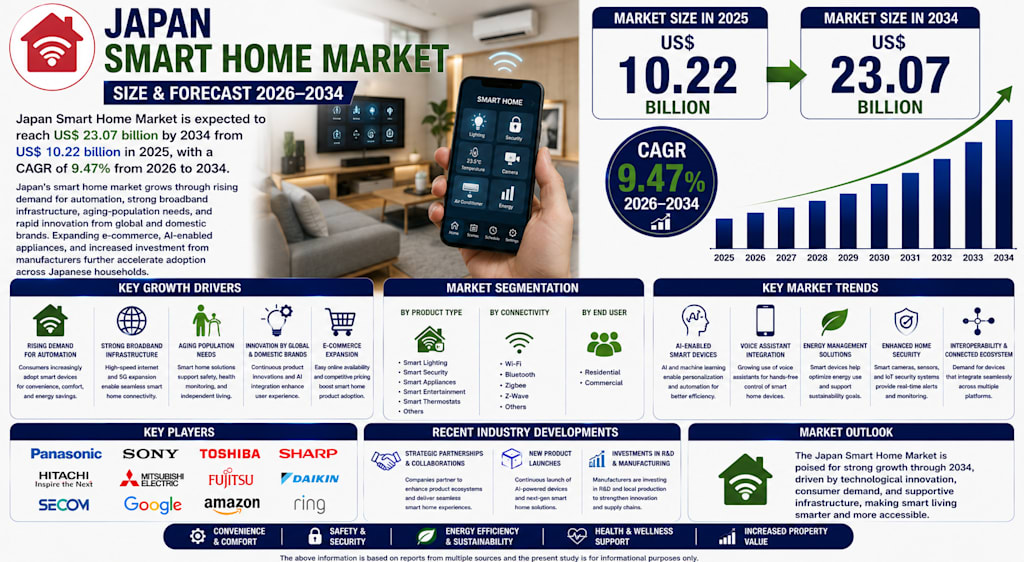
According to Renub Research, the Japan Smart Home Market is projected to grow from US$ 10.22 billion in 2025 to US$ 23.07 billion by 2034, expanding at a compound annual growth rate (CAGR) of 9.47% between 2026 and 2034. Rising automation demand, strong broadband infrastructure, AI-enabled appliances, expanding e-commerce channels, and increasing investment by manufacturers are among the key factors fueling market expansion.
As technology becomes more deeply integrated into daily life, Japan's smart home ecosystem is rapidly evolving into one of the most sophisticated in the world.
Understanding the Smart Home Concept
A smart home uses connected devices and automated systems to improve convenience, safety, comfort, and energy efficiency.
These systems integrate multiple household functions, including:
Lighting, climate control, entertainment systems, security cameras, sensors, appliances, and energy management solutions.
Through centralized platforms, smartphone applications, voice assistants, and AI-powered automation, homeowners can control and monitor their living environments remotely.
Modern smart homes go beyond simple remote control.
Advanced systems can learn user preferences, anticipate behaviors, optimize energy consumption, and automate routine tasks without manual intervention.
For many consumers, the appeal lies in the combination of convenience, security, cost savings, and personalized experiences.
As devices become more affordable and connectivity continues improving, smart home adoption is accelerating throughout Japan.
AI-Powered Appliances Are Leading Market Growth
One of the most powerful drivers of Japan's smart home market is the rapid expansion of AI-enabled appliances.
Japanese consumers increasingly seek products capable of adapting to their lifestyles automatically.
Artificial intelligence allows appliances to analyze user behavior, optimize performance, and improve efficiency.
Smart air conditioners, refrigerators, washing machines, and heating systems can now adjust settings based on usage patterns, weather conditions, occupancy levels, and energy demand.
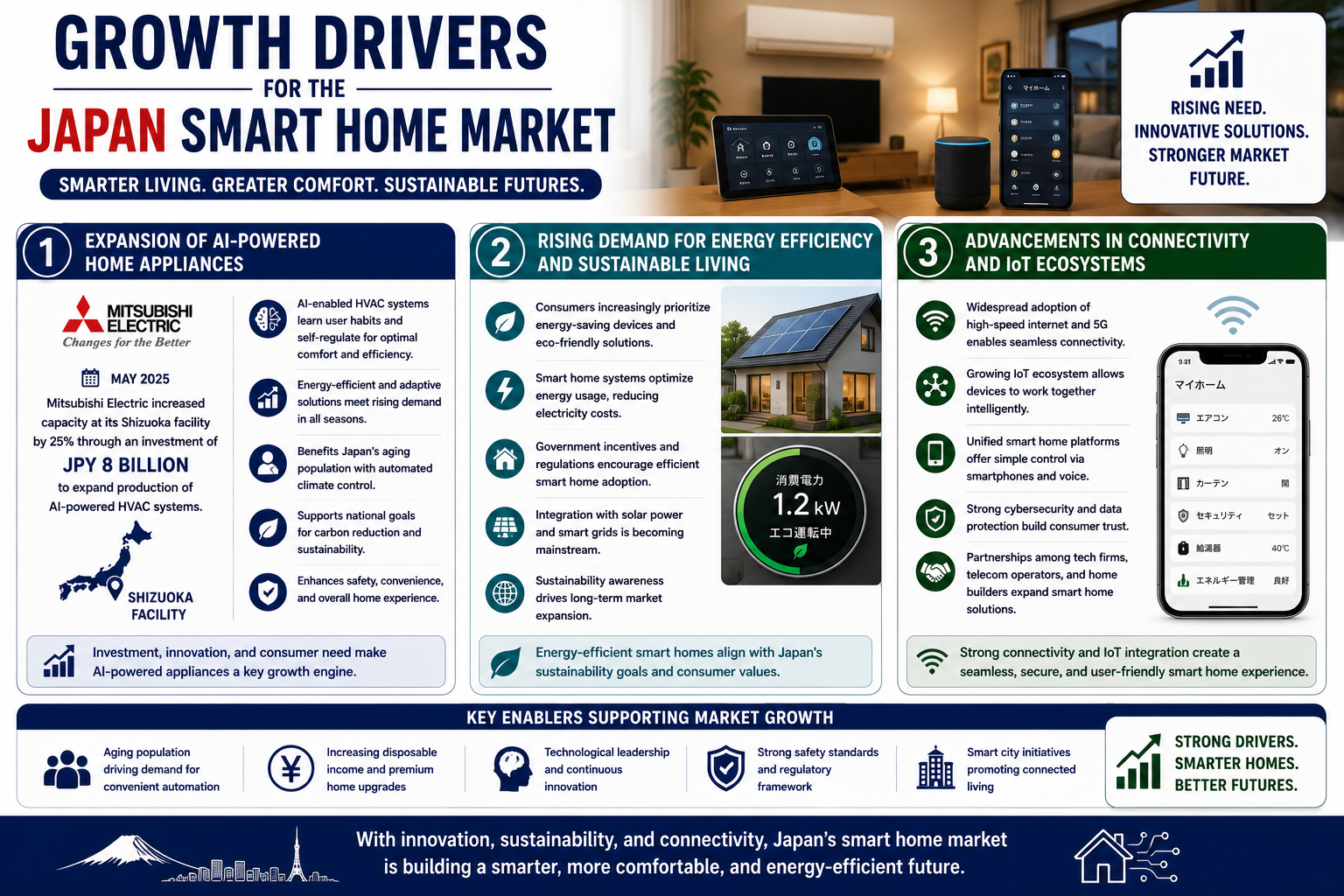
A major example occurred in May 2025 when Mitsubishi Electric expanded production capacity at its Shizuoka facility by 25% through an investment of approximately JPY 8 billion.
The expansion was specifically designed to increase production of AI-powered HVAC systems capable of self-regulation and intelligent energy management.
These innovations are particularly valuable in Japan, where energy efficiency, comfort, and sustainability are major consumer priorities.
As AI capabilities continue improving, smart appliances are expected to become increasingly common throughout Japanese households.
Aging Population Creates Unique Opportunities
Japan's demographic profile represents one of the most important factors influencing smart home adoption.
The country has one of the world's oldest populations, creating growing demand for technologies that support independent living.
Smart home systems can significantly improve quality of life for older adults by reducing physical effort and enhancing safety.
Examples include:
Voice-controlled appliances, automated lighting, remote monitoring systems, fall detection technologies, medication reminders, and intelligent climate management.
These technologies allow elderly individuals to maintain independence while providing reassurance to family members and caregivers.
The ability to automate routine household tasks also reduces daily stress and improves accessibility.
As Japan's aging population continues to grow, demand for senior-friendly smart home solutions is expected to increase substantially.
E-Commerce Is Accelerating Smart Home Adoption
The rapid growth of online retail has made smart home technology more accessible than ever before.
Consumers can easily compare products, review specifications, access installation guides, and purchase devices without visiting physical stores.
E-commerce platforms have become important distribution channels for both domestic and international brands.
A significant development occurred in 2024 when Aqara launched its dedicated Amazon store in Japan.
The launch introduced several connected devices, including sensors and smart cameras, providing Japanese consumers with easier access to affordable smart home products.
Online platforms also encourage ecosystem adoption by enabling consumers to purchase compatible devices from a single source.
As digital shopping habits continue strengthening, e-commerce will remain a major catalyst for market expansion.
Smart Security Is Becoming a Top Priority
Security has emerged as one of the fastest-growing segments within Japan's smart home market.
Urban density, growing awareness of personal safety, and increasing concerns regarding disaster preparedness are encouraging consumers to invest in connected security solutions.
Popular products include:
Smart cameras, video doorbells, motion sensors, smart locks, remote monitoring systems, and AI-powered surveillance technologies.
These devices provide real-time alerts, remote access, and intelligent threat detection capabilities.
Consumers increasingly value the ability to monitor their homes from anywhere using smartphones and connected applications.
A notable example occurred in May 2024 when Qsee Technology entered the Japanese market through a partnership with UNIQ STYLE.
The collaboration focuses on introducing advanced surveillance products and customized smart home security solutions tailored specifically to Japanese consumers.
As awareness regarding home safety continues increasing, smart security is expected to remain a major growth driver.
Energy Efficiency Is Driving Consumer Interest
Japan's long-standing commitment to environmental sustainability strongly supports smart home adoption.
Consumers increasingly seek technologies that reduce energy consumption while maintaining comfort and convenience.
Smart thermostats, automated lighting systems, energy monitoring platforms, and AI-powered climate control solutions help households optimize electricity usage.
These technologies not only reduce utility bills but also contribute to national carbon-reduction goals.
Government initiatives promoting energy conservation and disaster resilience further encourage adoption.
The ability to track and manage household energy consumption in real time has become particularly attractive as energy costs fluctuate.
As sustainability remains a national priority, energy-efficient smart home technologies are expected to see continued growth.
Voice Assistants Are Simplifying Home Automation
Voice-controlled technology has become a key component of modern smart homes.
Consumers increasingly prefer natural and intuitive methods of interacting with connected devices.
Voice assistants enable users to control:
Lighting, security systems, entertainment devices, appliances, and climate controls through simple spoken commands.
This functionality is especially beneficial for elderly residents and individuals with mobility limitations.
The growing popularity of smart speakers is helping expand awareness of home automation capabilities.
As voice recognition technologies become more accurate and multilingual support improves, adoption is expected to accelerate further.
Tokyo Leads the Smart Home Revolution
Tokyo remains Japan's largest and most advanced smart home market.
Several factors contribute to its leadership position.
The city's dense population, high-income households, advanced digital infrastructure, and strong technology adoption rates create ideal conditions for smart home growth.
Residents prioritize convenience, security, and energy efficiency, making smart locks, AI-powered appliances, automated lighting systems, and connected security products particularly popular.
Tokyo's large population of working professionals and elderly residents further supports demand for automation technologies.
Government initiatives focused on sustainability and carbon reduction also encourage adoption throughout the city.
Osaka Emerges as a Strong Growth Market
Osaka continues experiencing robust smart home growth driven by increasing interest in automation, home security, and energy management.
Consumers favor practical and affordable technologies such as connected air conditioners, voice-controlled devices, and monitoring systems.
The city's combination of modern apartments and traditional homes creates opportunities for both retrofit and new-construction smart home installations.
Strong retail networks and growing e-commerce penetration further support market expansion.
As awareness of energy efficiency increases, Osaka remains an important contributor to national smart home adoption.
Innovation Continues Across the Industry
Manufacturers continue introducing new products and partnerships designed to expand smart home capabilities.
In October 2025, Panasonic Holdings partnered with Amazon Web Services to integrate HomeX with AWS IoT Core.
The collaboration enables predictive maintenance features capable of reducing household energy consumption by approximately 15%.
In September 2025, NTT introduced Hikari Cross 2.0, a bundled smart home solution combining speakers, cameras, and home energy management systems with fiber-optic internet services.
Meanwhile, Sony launched a home-monitoring system built on its Aibo platform featuring fall detection and anomaly-alert capabilities specifically designed to support elderly residents.
These developments demonstrate how innovation continues expanding the possibilities of connected living.
Challenges Still Need to Be Addressed
Despite strong growth prospects, several challenges remain.
One major obstacle is cost.
Advanced automation systems, AI-powered appliances, and integrated security solutions often require significant investment.
Many consumers remain hesitant to adopt complete smart home ecosystems due to equipment costs, installation expenses, and ongoing service fees. Older housing stock may also require infrastructure upgrades before integration becomes possible.
Another challenge involves interoperability.
Consumers often worry about compatibility between devices from different manufacturers.
Differences in communication standards, software platforms, and ecosystem requirements can complicate installation and management. Older users may find setup processes particularly challenging. Concerns regarding privacy, cloud dependence, and data security also influence purchasing decisions.
Improving affordability and seamless integration will be essential for maximizing future adoption.
Final Thoughts
Japan's smart home market represents one of the most exciting examples of how technology can transform everyday living.
Driven by AI innovation, demographic needs, energy-efficiency goals, expanding e-commerce channels, and growing consumer demand for convenience, smart homes are becoming increasingly common throughout the country.
Connected devices are helping households become safer, more efficient, and more responsive to individual needs.
With the Japan Smart Home Market projected to grow from US$ 10.22 billion in 2025 to US$ 23.07 billion by 2034, the industry is entering a period of extraordinary opportunity.
As manufacturers continue integrating artificial intelligence, automation, and connectivity into household products, the future of Japanese living will likely be defined by intelligent environments capable of learning, adapting, and supporting residents in ways that were once considered science fiction.
About the Creator
Enjoyed the story? Support the Creator.
Subscribe for free to receive all their stories in your feed.
Comments
There are no comments for this story
Be the first to respond and start the conversation.