
Japan Robotics Market Size, Share and Growth Forecast 2026-2034
How Industrial Automation, AI Integration, and Service Robots Are Transforming Japan's Manufacturing and Healthcare Sectors

Market Overview
Japan's robotics market represents one of the world's most advanced and sophisticated segments, encompassing industrial robots, service robots, and collaborative robots designed to enhance efficiency, precision, and safety across diverse applications. Industrial robots automate manufacturing processes in industries including automotive, electronics, and machinery production. Service robots address labor shortages and operational challenges in healthcare, elder care, logistics, and hospitality sectors. The integration of artificial intelligence, machine learning, and advanced sensors has transformed robots into intelligent systems capable of complex decision-making and adaptive learning.
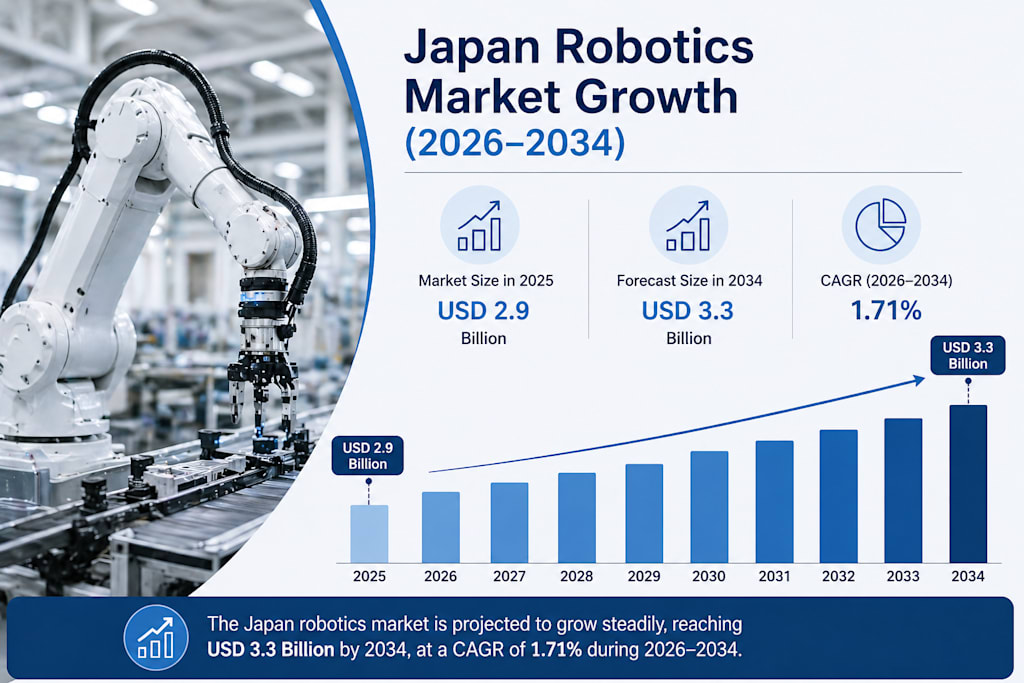
The Japan robotics market size was valued at USD 2.9 Billion in 2025. Looking ahead, IMARC Group estimates the market to reach USD 3.3 Billion by 2034, exhibiting a compound annual growth rate of 1.71% during 2026-2034. Market growth is being driven by advancements in industrial automation, escalating demand for service robots addressing aging population challenges, and rapid integration of artificial intelligence and machine learning technologies that enhance robotic capabilities.
Request PDF Sample for more detailed market insights
Role of Innovation in Market Development
• Artificial Intelligence and Machine Learning Integration
Advanced AI and machine learning capabilities are transforming robotics by enabling robots to learn from data, adapt to dynamic environments, and make autonomous decisions. AI-powered robots can perform increasingly complex tasks with minimal human intervention, improving efficiency and reducing operational costs. Machine learning algorithms enable robots to continuously improve performance through experience, becoming more effective and adaptable over time.
• Collaborative Robot (Cobot) Development
Collaborative robots that work safely alongside humans are addressing labor shortages while maintaining safety standards. These robots excel at tasks that are repetitive, hazardous, or physically demanding, freeing human workers for higher-value activities. Cobots feature advanced safety systems including force-limiting technology and intuitive programming interfaces that enable rapid deployment across diverse manufacturing environments.
• Robotics for Healthcare and Elder Care
Innovative robotic solutions address Japan's demographic challenges by providing assistance in healthcare settings and elder care facilities. Robotic systems support mobility assistance, rehabilitation, patient monitoring, and surgical applications. These healthcare robots enhance patient outcomes while addressing severe labor shortages in nursing and caregiving professions.
Japan Robotics Market Trends and Drivers
• Industrial Automation and Manufacturing Efficiency
Advances in industrial automation significantly drive Japan's robotics market, particularly in automotive and electronics manufacturing. Robotic systems enhance precision, reduce defects, improve productivity, and reduce operational costs. Japan's commitment to maintaining global leadership in high-tech manufacturing drives continuous investment in advanced robotic systems and automation technologies.
• Addressing Labor Shortages Through Service Robotics
Japan's aging population and declining workforce create urgent demand for service robots. Robots in logistics, retail, hospitality, and healthcare sectors address labor shortages while improving operational efficiency. Recent deployments in railway maintenance and emergency response demonstrate expanding applications for service robots.
• Advanced Sensor and Connectivity Integration
Integration of advanced sensors, IoT connectivity, and 5G communication enables more sophisticated robotic systems with real-time monitoring and control capabilities. Robots equipped with comprehensive sensor suites can navigate complex environments, make safety-critical decisions, and provide detailed operational feedback.
• Government Support and Strategic Initiatives
Japanese government initiatives promoting robotics innovation and deployment provide funding and regulatory support for market development. Public-private partnerships accelerate technology advancement and facilitate rapid commercialization of robotics solutions.
Japan Robotics Market Segmentation
By Product Type
Industrial Robots:
• Articulated Robots
• Cartesian Robots
• SCARA Robots
• Cylindrical Robots
• Others
Service Robots:
• Personal and Domestic
• Professional
Articulated robots dominate the industrial segment, offering flexibility for complex manufacturing tasks. SCARA robots excel at high-speed, repetitive assembly operations. Service robots address household tasks, entertainment, defense, logistics, healthcare, and infrastructure applications. The professional service robot segment demonstrates particularly strong growth driven by demand in healthcare, logistics, and infrastructure maintenance applications.
By Region
• Kanto Region
• Kansai/Kinki Region
• Central/Chubu Region
• Kyushu-Okinawa Region
• Tohoku Region
• Chugoku Region
• Hokkaido Region
• Shikoku Region
The Kanto region, encompassing Tokyo and surrounding areas, serves as the primary innovation hub with concentration of leading robotics companies, research institutions, and advanced manufacturing facilities. The Chubu region, Japan's manufacturing heartland, demonstrates robust robotics adoption in automotive production. Hokkaido and Tohoku regions focus on agricultural and disaster response robotics applications.
Competitive Landscape
Major global corporations and leading domestic robotics firms drive competition in Japan's market. Established players maintain dominance in industrial robotics through advanced automation technologies. Emerging companies concentrate on collaborative and service robotics addressing healthcare and logistics applications. Ongoing investments in research and development, strategic partnerships, and international collaborations accelerate innovation and market penetration.
Market Outlook
The Japan robotics market is expected to witness steady growth as demographic challenges intensify and automation technologies advance. The market is projected to grow at a compound annual growth rate of 1.71% during 2026-2034. Investments in AI-powered robotics, healthcare automation, collaborative robot systems, and service robot solutions will remain critical for addressing Japan's labor shortages and maintaining manufacturing competitiveness. Robotics will continue to play a vital role in supporting Japan's aging society while strengthening industrial competitiveness in global markets.
About the Creator
Yoshio
Market Research Analyst with 5+ years of experience in consumer insights and market segmentation. Skilled in data analysis and qualitative research.
Enjoyed the story? Support the Creator.
Subscribe for free to receive all their stories in your feed.
Comments
There are no comments for this story
Be the first to respond and start the conversation.