
Japan Online Grocery Market Size, Demand, Growth and Share Forecast 2026–2034
How E-Commerce Expansion, Changing Consumer Shopping Habits, and Digital Innovation Are Driving Japan Online Grocery Industry

Market Overview
The online grocery market in Japan has witnessed remarkable growth as consumers increasingly embrace digital shopping platforms for purchasing everyday food and household essentials. Online grocery services offer convenience, time savings, wider product selection, and doorstep delivery, making them an attractive alternative to traditional retail shopping. The rapid adoption of smartphones, improved internet connectivity, and advancements in logistics infrastructure are further accelerating market expansion across the country.
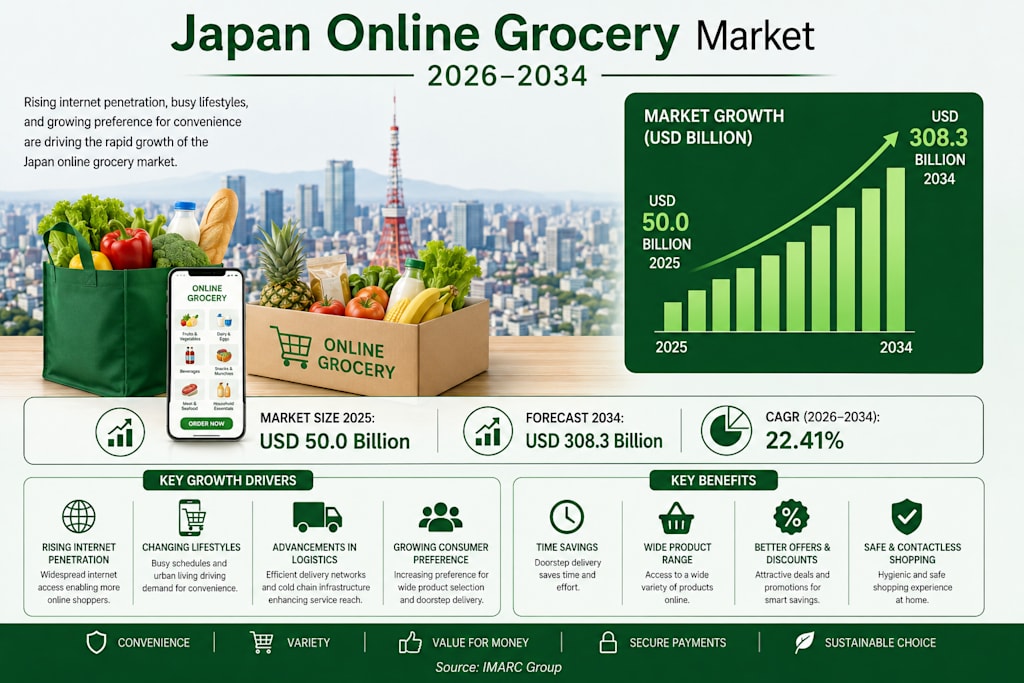
Japan online grocery market size reached USD 50.0 Billion in 2025. Looking forward, IMARC Group expects the market to reach USD 308.3 Billion by 2034, exhibiting a growth rate (CAGR) of 22.41% during 2026-2034. The market is experiencing substantial growth due to increasing digitalization, evolving consumer preferences, and the expansion of advanced delivery and fulfillment networks.
Request PDF Sample for more detailed market insights:
Role of Technology in Market Development
- Growth of Mobile Commerce and Digital Platforms
The widespread use of smartphones and mobile applications is transforming grocery shopping behavior in Japan. App-based grocery platforms provide consumers with convenient access to thousands of products, personalized recommendations, digital payment options, and real-time order tracking. These features are significantly enhancing customer engagement and shopping convenience.
- Advancements in Logistics and Delivery Infrastructure
Efficient logistics networks and last-mile delivery solutions are playing a critical role in the success of online grocery services. Companies are investing in automated warehouses, route optimization technologies, and temperature-controlled transportation systems to ensure timely delivery of fresh and perishable products while maintaining product quality.
- Integration of Artificial Intelligence and Data Analytics
Online grocery retailers are increasingly utilizing artificial intelligence and data analytics to improve customer experiences and operational efficiency. These technologies help businesses forecast demand, optimize inventory management, personalize marketing campaigns, and streamline supply chain operations, contributing to higher customer satisfaction and profitability.
Japan Online Grocery Industry Trends and Drivers
- Increasing Consumer Preference for Convenience
Modern consumers are increasingly seeking shopping solutions that save time and simplify daily routines. Online grocery platforms allow customers to purchase fresh produce, dairy products, staples, and household essentials from the comfort of their homes, making convenience one of the key drivers of market growth.
- Rising Adoption of Subscription-Based Models
Subscription services are becoming increasingly popular among consumers who value recurring deliveries of frequently purchased products. These models provide convenience, cost savings, and predictable purchasing experiences, helping retailers improve customer retention and long-term engagement.
- Growing Demand for Fresh and Premium Products
Consumers are increasingly purchasing fresh fruits, vegetables, dairy products, meat, and seafood through online channels. Improved cold chain logistics and enhanced quality assurance measures are boosting consumer confidence in online grocery purchases, particularly for perishable and premium products.
Japan Online Grocery Market Segmentation
Product Type Insights
• Vegetables and Fruits
• Dairy Products
• Staples and Cooking Essentials
• Snacks
• Meat and Seafood
• Others
Business Model Insights
• Pure Marketplace
• Hybrid Marketplace
• Others
Platform Insights
• Web-Based
• App-Based
Purchase Type Insights
• One-Time
• Subscription
Regional Insights
• Kanto Region
• Kansai/Kinki Region
• Central/Chubu Region
• Kyushu-Okinawa Region
• Tohoku Region
• Chugoku Region
• Hokkaido Region
• Shikoku Region
The segmentation highlights the broad range of products, business models, and digital platforms contributing to the growth of Japan’s online grocery market.
Competitive Landscape
The Japan online grocery market includes e-commerce companies, supermarket chains, grocery delivery platforms, and digital retail startups. Competition is driven by product assortment, delivery speed, pricing strategies, platform usability, and customer service quality. Companies are investing in fulfillment centers, advanced logistics technologies, and personalized shopping experiences to strengthen their market position and expand their customer base.
Market Outlook
The Japan online grocery market is expected to witness exceptional growth over the coming years, supported by increasing internet penetration, growing consumer reliance on digital commerce, and continuous improvements in logistics infrastructure. The expansion of app-based shopping, subscription services, and AI-powered retail solutions will continue to shape market development. As consumers increasingly prioritize convenience, accessibility, and seamless shopping experiences, online grocery platforms are expected to become a central component of Japan’s retail ecosystem.
About IMARC Group
IMARC Group is a leading market research and consulting company that provides management strategy and market research services worldwide. The company offers industry analysis, market forecasting, feasibility studies, business consulting, and data-driven intelligence solutions across a wide range of industries and global markets.
About the Creator
David Michel
David Michel brings precision and depth to the world of market research. By uncovering trends, analyzing data, and delivering meaningful insights, he helps businesses navigate opportunities with confidence.
Enjoyed the story? Support the Creator.
Subscribe for free to receive all their stories in your feed.
Comments
There are no comments for this story
Be the first to respond and start the conversation.