
Japan Nanorobotics Market Set to Reach Nearly US$ 1 Billion by 2033 as Medical Innovation Accelerates
How Japan's Leadership in Robotics and Nanotechnology Is Creating the Next Frontier in Healthcare, Manufacturing, and Precision Engineering

The convergence of robotics and nanotechnology is opening doors to a new era of scientific possibilities. Among the countries driving this transformation, Japan stands out as one of the most influential innovators. Known globally for its expertise in precision engineering, advanced robotics, and scientific research, Japan is now making significant strides in the rapidly emerging nanorobotics industry.
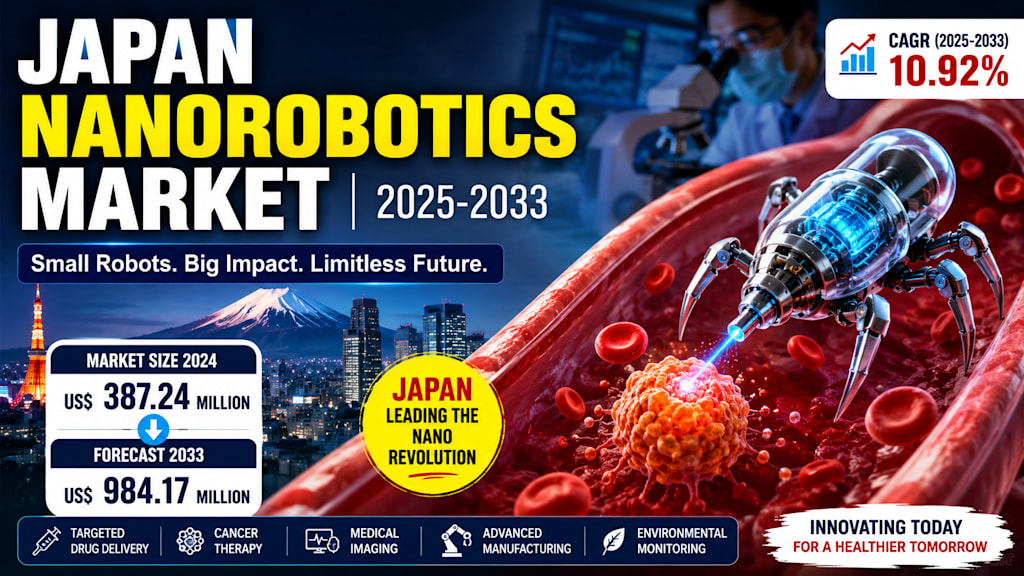
According to Renub Research, the Japan Nanorobotics Market is projected to grow from US$ 387.24 million in 2024 to US$ 984.17 million by 2033, expanding at a CAGR of 10.92% during 2025–2033. This remarkable growth reflects increasing investments in nanotechnology research, rising demand for targeted medical treatments, and expanding applications across multiple industrial sectors.
Nanorobotics may sound like science fiction, but it is quickly becoming a scientific reality. These microscopic machines have the potential to revolutionize healthcare, transform manufacturing processes, improve environmental monitoring, and redefine precision engineering. As Japan strengthens its position in this innovative field, the country is becoming a major contributor to the future of intelligent nanoscale systems.
Understanding Nanorobotics: Tiny Machines with Massive Potential
Nanorobotics involves the design and development of microscopic robots capable of performing tasks at molecular or cellular levels. These robots are often measured in nanometers, making them thousands of times smaller than the width of a human hair.
Unlike conventional robots used in factories or warehouses, nanorobots can operate within highly complex environments such as the human body, microelectronic circuits, or advanced materials. Their ability to perform highly precise tasks offers significant advantages in fields requiring exceptional accuracy.
Applications include:
Targeted drug delivery
Cancer treatment
Medical imaging
Precision surgery
Environmental monitoring
Semiconductor manufacturing
Advanced material development
The technology promises unprecedented control over biological and industrial processes, creating opportunities that were previously unimaginable.
Japan's Strong Foundation in Robotics and Nanotechnology
Japan's journey toward nanorobotics leadership is supported by decades of technological advancement. The country has long been recognized as a global hub for robotics innovation, with leading research institutions and technology companies consistently pushing scientific boundaries.
Japanese universities, government laboratories, and private enterprises have built extensive expertise in:
Precision manufacturing
Molecular engineering
Materials science
Biomedical research
Artificial intelligence
Advanced automation
This ecosystem provides an ideal environment for nanorobotics development. The country's experience in miniaturization technologies, particularly in electronics and robotics, gives Japanese innovators a unique advantage when designing nanoscale machines.
As a result, Japan is becoming a preferred destination for nanotechnology research and commercialization efforts.
Healthcare Is Becoming the Largest Opportunity for Nanorobotics
The healthcare sector represents one of the most promising areas for nanorobotics adoption. Modern medicine increasingly demands treatments that are more effective, less invasive, and highly personalized.
Nanorobots can address these requirements by operating directly within the human body.
Targeted Drug Delivery
Traditional medications often affect healthy tissues while treating diseased areas. Nanorobots can transport drugs directly to affected cells, improving treatment effectiveness while minimizing side effects.
This capability is particularly valuable in cancer therapy, where precision treatment remains a critical challenge.
Cancer Detection and Treatment
Researchers are exploring nanorobotic systems capable of identifying cancer cells at extremely early stages. These systems could potentially detect abnormalities before traditional imaging technologies can identify them.
Future nanorobots may also destroy cancer cells selectively without damaging surrounding healthy tissues.
Minimally Invasive Procedures
Nanorobotic-assisted medical interventions could dramatically reduce the need for invasive surgeries. Tiny robotic devices may perform internal procedures with greater precision and reduced patient recovery times.
For an aging population such as Japan's, these innovations could play an important role in improving healthcare outcomes while reducing long-term medical costs.
Growing Demand for Personalized Healthcare
Personalized medicine is becoming a major trend worldwide, and Japan is actively embracing this approach.
Healthcare providers increasingly seek treatments tailored to individual patients rather than one-size-fits-all solutions. Nanorobots support this objective by enabling highly targeted therapeutic interventions based on a patient's specific medical condition.
Customized drug delivery systems, precision diagnostics, and individualized treatment plans all benefit from nanorobotic technologies.
As personalized healthcare continues expanding, demand for advanced nanorobotic solutions is expected to rise significantly.
Government Support Is Accelerating Innovation
Government initiatives remain essential to Japan's nanotechnology ecosystem.
National research programs, innovation grants, and public-private partnerships are helping accelerate nanorobotics development. These initiatives encourage collaboration between academic institutions, healthcare organizations, and technology companies.
Public funding supports early-stage research, while regulatory frameworks help establish standards for safety and commercialization.
Such support is critical because nanorobotics development often requires long-term investment and extensive testing before market deployment.
The Japanese government's continued commitment to advanced technology development strengthens the country's competitive position in the global nanorobotics market.
Collaboration Between Academia and Industry Is Driving Progress
One of Japan's greatest strengths is its collaborative innovation model.
Universities contribute groundbreaking research and scientific expertise, while private companies provide commercialization capabilities, funding, and manufacturing infrastructure.
These partnerships accelerate innovation by combining theoretical knowledge with practical implementation.
Collaborative projects are currently focusing on:
Medical nanorobots
Smart materials
Nano-manufacturing systems
Environmental monitoring devices
Drug delivery technologies
The synergy between academic and industrial sectors is helping bridge the gap between laboratory discoveries and real-world applications.
Expanding Industrial Applications Beyond Healthcare
Although healthcare attracts significant attention, nanorobotics is increasingly finding applications across various industrial sectors.
Semiconductor Manufacturing
Japan remains a major player in global electronics manufacturing. Nanorobots can improve semiconductor fabrication by enabling atomic-level precision during production processes.
This capability may lead to smaller, faster, and more energy-efficient electronic devices.
Advanced Manufacturing
Manufacturers are exploring nanorobotics for precision assembly and defect detection. These technologies can improve product quality while reducing material waste.
Nanorobotic systems may also support next-generation smart factories that require unprecedented levels of automation and accuracy.
Environmental Monitoring
Environmental applications represent another promising growth area.
Nanorobots can help detect pollutants, monitor water quality, and identify hazardous substances with exceptional precision. Such capabilities support sustainability initiatives and environmental protection efforts.
Aerospace and Automotive Applications
High-performance materials are critical in aerospace and automotive industries.
Nanorobotic technologies can assist in developing stronger, lighter, and more durable materials that improve fuel efficiency and operational performance.
Challenges Facing the Japan Nanorobotics Market
Despite strong growth prospects, the industry faces several obstacles that must be addressed.
High Research and Development Costs
Nanorobotics remains one of the most research-intensive areas within advanced technology.
Development requires:
Specialized laboratories
Expensive equipment
Highly skilled researchers
Long testing cycles
These requirements create substantial financial barriers, particularly for smaller organizations and startups.
Securing long-term investment remains a significant challenge for many nanorobotics projects.
Technical Complexity
Operating at molecular and cellular scales presents extraordinary engineering challenges.
Researchers must solve complex problems involving:
Navigation
Communication
Power supply
Biological compatibility
Safety validation
Even minor design flaws can impact performance significantly at the nanoscale level.
Scalability Concerns
Many successful nanorobotics demonstrations occur under controlled laboratory conditions.
However, scaling these systems for mass production while maintaining reliability and cost-effectiveness remains difficult.
Commercial scalability will be essential for widespread adoption across healthcare and industrial applications.
Regulatory Considerations
Medical nanorobots must meet rigorous safety and efficacy standards before entering clinical use.
Regulatory agencies must develop frameworks that balance innovation with patient safety. Establishing these guidelines can be time-consuming and may slow commercialization timelines.
Key Market Segments Driving Future Growth
By Product Type
Bio-Nanorobots
Nano-Surgery Robots
Magnetically Guided Nanorobots
Bacteria-Based Nanorobots
DNA-Based Nanorobots
Molecular Nanorobots
Among these categories, DNA-based and bio-nanorobots are attracting significant research attention due to their compatibility with biological systems and potential healthcare applications.
By Application
Nanomedicine
Biomedical Applications
Drug Delivery
Medical Imaging
Others
Drug delivery and nanomedicine are expected to remain dominant segments as healthcare providers increasingly adopt precision treatment approaches.
10 Recent Developments Among Leading Industry Participants
1. Oxford Instruments
Expanded advanced microscopy solutions that support nanoscale characterization and nanotechnology research activities.
2. Thermo Fisher Scientific
Continued investment in analytical instruments enabling researchers to study and develop nanorobotic systems.
3. Bruker Corporation
Enhanced nanotechnology research capabilities through innovations in atomic force microscopy platforms.
4. JEOL Ltd.
Strengthened electron microscopy technologies that facilitate nanorobotics research and materials analysis.
5. Agilent Technologies
Introduced advanced analytical tools supporting precision biomedical and nanotechnology applications.
6. Ginkgo Bioworks
Expanded synthetic biology initiatives that may contribute to future bio-nanorobotic innovations.
7. Park Systems
Advanced atomic force microscopy systems designed for nanoscale measurement and inspection.
8. Thermo Fisher Scientific
Increased support for life science researchers developing next-generation nanomedical solutions.
9. JEOL Ltd.
Continued investment in high-resolution imaging technologies critical for nanorobotics development.
10. Bruker Corporation
Enhanced research collaborations supporting innovation in nanotechnology and advanced materials science.
Final Thoughts
Japan's nanorobotics industry is entering a transformative phase. Supported by world-class research institutions, government backing, advanced manufacturing capabilities, and growing healthcare demand, the country is well positioned to become a global leader in nanorobotic innovation.
The technology's ability to revolutionize disease treatment, precision manufacturing, and environmental monitoring makes it one of the most exciting fields in modern science. While challenges such as development costs, scalability limitations, and regulatory hurdles remain, the long-term outlook is highly promising.
As research continues to evolve and commercialization pathways become clearer, nanorobotics could fundamentally reshape industries and improve lives worldwide. With the market expected to approach US$ 1 billion by 2033, Japan is poised to remain at the forefront of this technological revolution for years to come.
About the Creator
Enjoyed the story? Support the Creator.
Subscribe for free to receive all their stories in your feed.
Comments
There are no comments for this story
Be the first to respond and start the conversation.