
Japan Metal Recycling Market Size, Growth and Demand Report 2026–2034
How Circular Economy Initiatives, Industrial Sustainability, and Resource Recovery Technologies Are Driving Japan Metal Recycling Industry

Market Overview
Metal recycling has become a critical component of Japan’s sustainable industrial ecosystem, supporting resource conservation, waste reduction, and environmental protection efforts. Recycled metals serve as valuable raw materials for various industries, including construction, automotive, consumer goods, and industrial manufacturing. As the country continues to emphasize efficient resource utilization and carbon reduction strategies, metal recycling is gaining increasing importance in both economic and environmental development.
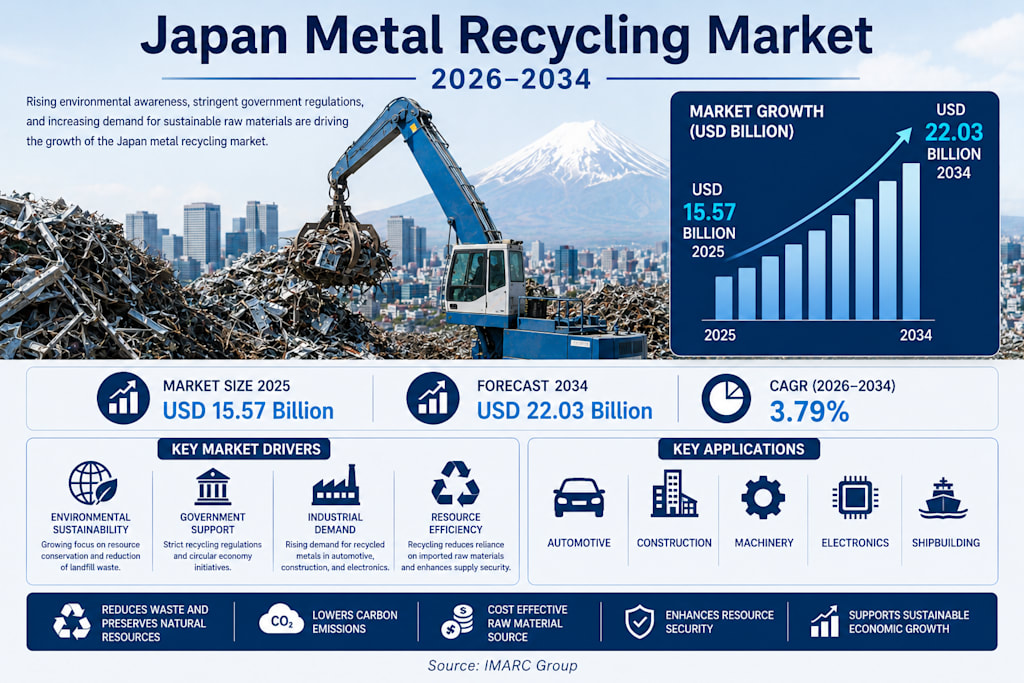
The Japan metal recycling market size, valued at USD 15.57 Billion in 2025, is projected to reach USD 22.03 Billion by 2034, growing at a CAGR of 3.79% from 2026-2034. Market growth is being supported by rising demand for sustainable raw materials, advancements in recycling technologies, and increasing adoption of circular economy practices across major industries.
Request PDF Sample for more detailed market insights:
Role of Technology in Market Development
- Advancements in Metal Sorting and Processing Technologies
Technological innovations are significantly improving the efficiency and accuracy of metal recycling operations. Advanced sorting systems utilizing artificial intelligence, robotics, sensor-based detection, and automated separation technologies enable recyclers to recover valuable metals more effectively while reducing contamination and processing costs. These advancements are enhancing overall recycling productivity and material quality.
- Growth of Sustainable Manufacturing Practices
Manufacturers are increasingly incorporating recycled metals into production processes to reduce environmental impact and improve resource efficiency. Recycled steel, aluminum, and copper require less energy during processing compared to primary metal production, making them attractive alternatives for industries seeking to achieve sustainability goals and reduce carbon emissions.
- Digitalization of Recycling Operations
The integration of digital technologies into recycling facilities is improving operational visibility and efficiency. Data analytics, automation platforms, and smart monitoring systems are helping recyclers optimize collection, sorting, and processing activities while improving material traceability and resource management throughout the recycling value chain.
Japan Metal Recycling Industry Trends and Drivers
- Increasing Focus on Circular Economy Principles
Japan’s commitment to circular economy development is one of the primary factors driving the metal recycling market. Industries are increasingly adopting resource recovery and material reuse strategies to minimize waste generation and reduce dependence on virgin raw materials. This transition is supporting long-term growth opportunities for recycling companies.
- Rising Demand from Construction and Automotive Industries
The construction and automotive sectors represent major consumers of recycled metals in Japan. Growing infrastructure development projects, vehicle production activities, and demand for sustainable building materials are increasing the consumption of recycled steel, aluminum, and copper across these industries.
- Environmental Regulations and Sustainability Goals
Government initiatives promoting waste reduction, carbon neutrality, and sustainable resource management are encouraging higher recycling rates. Regulatory support and environmental awareness are motivating businesses to invest in advanced recycling infrastructure and adopt responsible material sourcing practices, further strengthening market growth.
- Japan Metal Recycling Market Segmentation
Metals Covered
• Steel
• Copper
• Aluminum
• Others
Sectors Covered
• Construction
• Automotive
• Consumer Goods
• Industrial Goods
Regions Covered
• Kanto Region
• Kansai/Kinki Region
• Central/Chubu Region
• Kyushu-Okinawa Region
• Tohoku Region
• Chugoku Region
• Hokkaido Region
• Shikoku Region
The segmentation highlights the broad application of recycled metals across key industrial sectors and regional markets throughout Japan.
Competitive Landscape
The Japan metal recycling market includes recycling companies, scrap collection operators, metal processing firms, waste management organizations, and industrial material suppliers. Competition is driven by processing efficiency, recycling capacity, technological capabilities, and sustainability performance. Companies are investing in advanced recovery technologies, automation systems, and environmentally responsible recycling practices to strengthen their market position.
Market Outlook
The Japan metal recycling market is expected to experience steady growth over the coming years, supported by increasing adoption of circular economy practices, rising industrial demand for recycled materials, and continued investments in sustainable manufacturing. Advancements in recycling technologies, automation, and resource recovery systems will continue to improve operational efficiency and material quality. As industries prioritize environmental responsibility and resource conservation, metal recycling will remain a key pillar of Japan’s sustainable industrial development strategy.
About IMARC Group
IMARC Group is a leading market research and consulting company that provides management strategy and market research services worldwide. The company offers industry analysis, market forecasting, business consulting, feasibility studies, and data-driven intelligence solutions across a broad range of industries and global markets.
About the Creator
David Michel
David Michel brings precision and depth to the world of market research. By uncovering trends, analyzing data, and delivering meaningful insights, he helps businesses navigate opportunities with confidence.
Enjoyed the story? Support the Creator.
Subscribe for free to receive all their stories in your feed.
Comments
There are no comments for this story
Be the first to respond and start the conversation.