
Japan Laundry Appliances Market Size and Forecast 2025–2033: Smart Innovation, Urban Living, and Premium Upgrades Drive Future Growth
As Japanese consumers embrace connected appliances, energy-efficient technologies, and compact living solutions, the laundry appliances market is poised for steady growth through 2033.

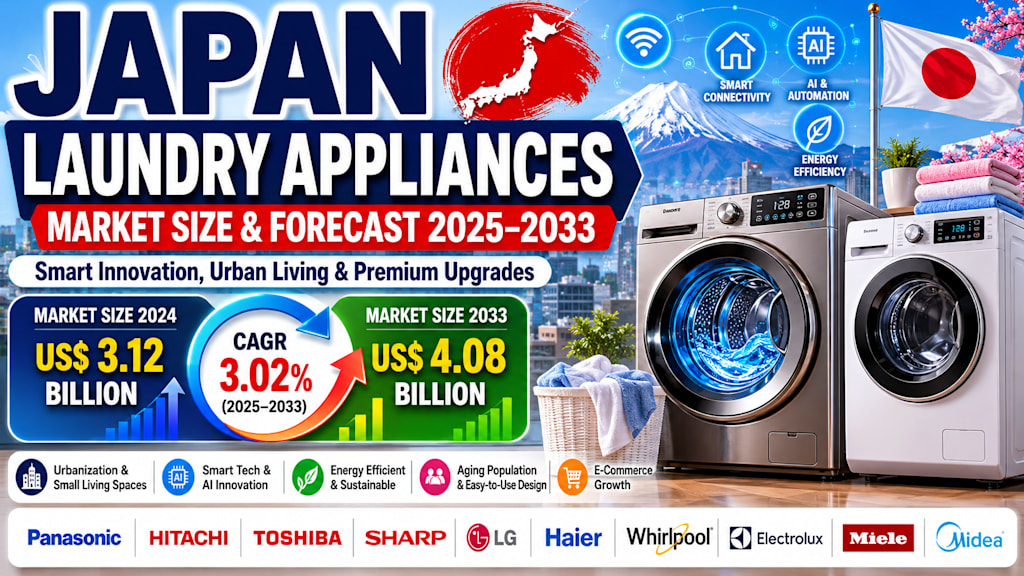
Japan Laundry Appliances Market Size and Forecast 2025–2033
The Japan Laundry Appliances Market is projected to reach US$ 4.08 billion by 2033, rising from US$ 3.12 billion in 2024, registering a CAGR of 3.02% during the forecast period from 2025 to 2033. Market growth is being fueled by continuous technological innovation, increasing adoption of smart home ecosystems, growing consumer preference for energy-efficient appliances, and the demand for compact yet high-performance laundry solutions.
Japan has long been recognized as one of the world's most technologically advanced consumer appliance markets. The country's laundry appliance sector reflects this reputation through a strong focus on innovation, reliability, convenience, and sustainability. While the market is mature with high household penetration rates, manufacturers continue to create opportunities for growth by introducing premium products featuring artificial intelligence, IoT connectivity, enhanced hygiene functions, and eco-friendly technologies.
A Mature Market Driven by Product Upgrades
Unlike emerging economies where first-time appliance ownership fuels growth, Japan's laundry appliance market is primarily driven by replacement purchases and premium upgrades. Household penetration of washing machines remains close to saturation, estimated between 95% and 100%, indicating that nearly every household already owns a laundry appliance.
Annual washing machine sales in Japan are approximately 2.68 million units, highlighting a replacement-driven market. Consumers increasingly seek appliances that deliver better performance, greater convenience, lower utility costs, and enhanced fabric care.
This trend is encouraging manufacturers to focus on value-added features rather than competing solely on price. Premium models equipped with smart sensors, AI-powered washing cycles, and advanced drying systems continue to gain popularity among households willing to invest in long-term convenience and efficiency.
Urbanization Continues to Shape Consumer Preferences
Japan's densely populated urban centers, particularly Tokyo, Osaka, and Yokohama, significantly influence appliance design and purchasing behavior.
Limited living space in apartments has increased demand for compact laundry appliances that maximize functionality without occupying excessive floor space. Washer-dryer combination units have become especially popular among urban residents who lack dedicated laundry rooms or outdoor drying areas.
Consumers increasingly prefer:
- Compact front-loading washing machines
- Integrated washer-dryer combinations
- Space-saving built-in appliances
- Stackable laundry systems
- Quiet and vibration-free operation
Manufacturers are responding by developing sleek, multifunctional appliances specifically designed for urban living environments.
The trend toward smaller households and nuclear families further supports demand for compact yet efficient laundry solutions. As urbanization continues across Japan, space optimization will remain a critical factor influencing product innovation.
Smart Technology Revolutionizing Laundry Care
Technological innovation remains one of the strongest growth drivers in the Japan laundry appliances market.
Today's consumers increasingly expect appliances to integrate seamlessly into their connected lifestyles. Smart laundry appliances equipped with Wi-Fi connectivity, smartphone controls, and AI-powered automation are becoming mainstream.
Modern laundry appliances now offer features such as:
Remote operation through mobile applications
- Automatic detergent dispensing
- AI-based fabric recognition
- Load optimization systems
- Predictive maintenance alerts
- Energy consumption monitoring
- Voice assistant compatibility
These innovations improve convenience while helping consumers reduce water and electricity usage.
Japan's widespread adoption of smart home technologies provides an ideal environment for continued growth in connected laundry appliances. As households increasingly embrace home automation, manufacturers are investing heavily in intelligent product ecosystems that enhance user experience.
The integration of artificial intelligence into laundry management is expected to become a key differentiator among premium appliance brands over the next decade.
Sustainability and Energy Efficiency Gain Importance
Environmental awareness is playing an increasingly important role in consumer purchasing decisions across Japan.
Japanese consumers are highly conscious of energy consumption, water usage, and environmental impact. This has encouraged manufacturers to develop appliances that align with national sustainability goals and consumer expectations.
Energy-efficient laundry appliances provide several advantages:
- Reduced electricity consumption
- Lower water usage
- Smaller environmental footprint
- Long-term cost savings
Compliance with environmental regulations
Many manufacturers are also incorporating recyclable materials into production processes and improving product durability to reduce waste.
Government initiatives promoting energy-efficient appliances are expected to further support demand for eco-friendly laundry solutions during the forecast period.
As sustainability becomes a major purchasing criterion, brands that successfully combine environmental responsibility with premium performance are likely to gain market share.
Aging Population Creates New Product Opportunities
Japan's demographic transformation presents both challenges and opportunities for appliance manufacturers.
The country has one of the world's oldest populations, creating demand for appliances designed specifically for elderly users. Seniors increasingly seek products that simplify household chores while minimizing physical effort.
Manufacturers are responding with features such as:
- Large digital displays
- Intuitive control panels
- Ergonomic loading doors
- Automatic operation modes
- Voice control functionality
- Self-cleaning systems
- Low-maintenance designs
These user-friendly features improve accessibility while enhancing overall convenience.
As the aging population continues to grow, appliances that combine simplicity with advanced technology will become increasingly important in attracting and retaining customers.
Hygiene and Health Awareness Influence Purchasing Decisions
Consumer awareness regarding hygiene and cleanliness has risen significantly in recent years.
Laundry appliances equipped with steam cleaning, allergen removal, antibacterial washing programs, and sanitization technologies are attracting growing interest among households.
Families with children, elderly members, or allergy sufferers particularly value advanced hygiene functions that help maintain healthier living environments.
Manufacturers are introducing specialized washing programs designed to eliminate bacteria, viruses, and allergens while preserving fabric quality.
The emphasis on hygiene is expected to remain a key market driver throughout the forecast period, particularly in the premium appliance segment.
E-Commerce Expands Market Reach
Digital retail channels are transforming how consumers purchase laundry appliances in Japan.
While specialty stores continue to dominate appliance sales due to the importance of product demonstrations and after-sales support, e-commerce platforms are gaining traction.
Online channels offer several advantages:
- Wider product selection
- Competitive pricing
- Customer reviews and ratings
- Convenient delivery options
- Detailed product comparisons
Younger consumers are increasingly comfortable researching and purchasing major appliances online.
Manufacturers are strengthening their digital presence through direct-to-consumer platforms, online promotions, and virtual product demonstrations. The continued growth of e-commerce is expected to enhance accessibility and support market expansion over the coming years.
Challenges Facing the Market
Market Saturation Limits Volume Growth
One of the most significant challenges facing the Japan laundry appliances industry is market saturation.
With nearly universal appliance ownership, opportunities for first-time purchases are extremely limited. Growth therefore depends heavily on replacement cycles and technological upgrades.
Convincing consumers to replace functioning appliances can be difficult unless meaningful innovations offer clear benefits. As a result, manufacturers must continuously invest in research and development to maintain consumer interest.
This highly competitive environment places pressure on companies to differentiate their products while managing development and marketing costs.
Demographic Decline Restrains Long-Term Demand
Japan's declining birth rate and shrinking population create structural challenges for long-term market growth.
Fewer new households reduce demand for first-time appliance purchases. Additionally, smaller household sizes often require lower-capacity machines, limiting opportunities for volume expansion.
The aging demographic profile may also slow adoption of some advanced technologies among certain consumer segments.
To overcome these challenges, manufacturers must balance innovation with simplicity, ensuring products appeal to both younger technology enthusiasts and older consumers seeking ease of use.
Market Segmentation Overview
By Type
- Freestanding Laundry Appliances
- Built-in Laundry Appliances
By Product
- Washing Machines
- Dryers
- Electric Smoothing Irons
- Others
By Technology
- Automatic
- Semi-Automatic/Manual
- Others
By Distribution Channel
- Specialty Stores
- Supermarkets and Hypermarkets
- Department Stores
- E-Commerce
- Others
Among these segments, automatic washing machines continue to dominate due to convenience, efficiency, and strong consumer preference for advanced functionality.
Competitive Landscape
Japan's laundry appliances market remains highly competitive, featuring both established domestic manufacturers and international brands.
Leading companies continue to invest heavily in product innovation, energy efficiency, smart technology integration, and premium customer experiences.
Major market participants include:
- Hitachi
- Panasonic
- Toshiba
- Sharp
- Whirlpool Corporation
- Electrolux Group
- Miele
- Haier Inc.
- LG Electronics
- Midea Group Co.
Domestic brands maintain strong consumer trust due to their reputation for quality, reliability, and understanding of Japanese household needs. However, international competitors continue to expand their presence through innovative smart appliance offerings and competitive pricing strategies.
Recent Developments by Leading Companies
1. Panasonic
Panasonic expanded its AI-powered washing machine portfolio with enhanced fabric recognition technology that automatically adjusts wash settings for optimal cleaning and garment protection.
2. Hitachi
Hitachi introduced advanced heat-pump drying systems aimed at reducing energy consumption while maintaining superior drying performance.
3. Toshiba
Toshiba launched upgraded smart laundry appliances featuring smartphone monitoring and remote control functionality for greater user convenience.
4. Sharp
Sharp enhanced its hygiene-focused appliance lineup by incorporating advanced sterilization and antibacterial technologies into selected washing machine models.
5. LG Electronics
LG continued strengthening its premium appliance portfolio through expanded ThinQ smart home integration and AI-based laundry management capabilities.
6. Haier
Haier introduced compact washer-dryer combinations targeting urban consumers living in apartments with limited space.
7. Miele
Miele expanded its premium laundry appliance offerings with energy-efficient models designed for luxury residential customers seeking superior fabric care.
8. Electrolux Group
Electrolux invested in sustainable appliance development initiatives focused on reducing water and electricity consumption across product lines.
9. Whirlpool Corporation
Whirlpool strengthened its connected appliance ecosystem by improving mobile application functionality and remote diagnostic capabilities.
10. Midea Group
Midea expanded research and development efforts related to smart home compatibility and next-generation energy-efficient laundry solutions.
Future Outlook
The future of Japan's laundry appliances market will be defined by innovation rather than volume growth. As household ownership approaches full saturation, manufacturers must focus on creating compelling reasons for consumers to upgrade.
Smart connectivity, artificial intelligence, sustainability, hygiene enhancement, and user-friendly design will remain central to future product development strategies.
The growing adoption of connected homes, combined with increasing demand for convenience and energy efficiency, provides a strong foundation for steady market expansion. While demographic challenges and market maturity may limit rapid growth, premiumization trends and technological advancements are expected to support long-term value creation.
With the market projected to reach US$ 4.08 billion by 2033, Japan's laundry appliances industry is positioned to remain one of the world's most innovative and technologically sophisticated appliance sectors.
Final Thoughts
Japan's laundry appliances market demonstrates how innovation can sustain growth even in highly mature industries. Consumer demand is shifting beyond basic washing functionality toward intelligent, connected, environmentally responsible solutions that fit modern lifestyles.
Manufacturers that successfully combine advanced technology, sustainability, accessibility, and convenience will be best positioned to capture future opportunities. As Japanese households continue upgrading to smarter and more efficient appliances, the industry is set to experience stable and sustainable growth throughout the forecast period ending in 2033.
About the Creator
Enjoyed the story? Support the Creator.
Subscribe for free to receive all their stories in your feed.
Comments
There are no comments for this story
Be the first to respond and start the conversation.