
Japan Industrial Dehumidifiers Market Size, Share, Trends, and Growth Outlook
How Industrial Automation, Air Quality Control, and Manufacturing Demand Are Driving Growth in Japan Industrial Dehumidifiers Market

Market Overview
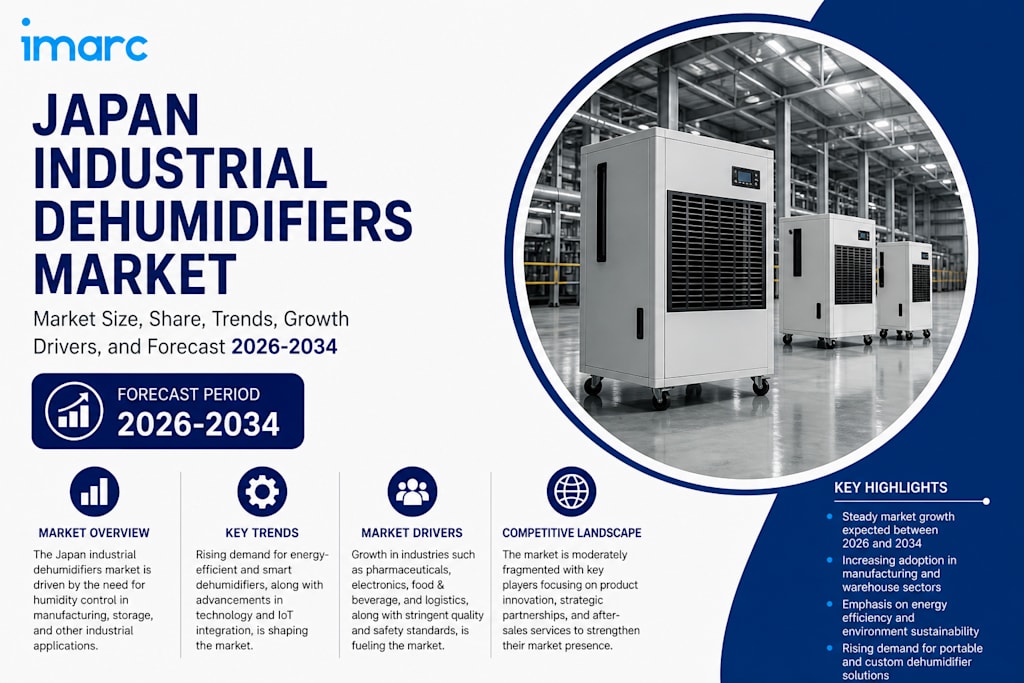
The industrial dehumidifiers market in Japan is evolving steadily, driven by the increasing need for precise humidity control across manufacturing and industrial environments. The market includes applications such as food processing, pharmaceuticals, electronics, and warehousing, where moisture regulation is critical for product quality and operational efficiency. Japan’s strong industrial base and focus on quality control are key factors contributing to market growth.
According to market analysis, the broader Japan dehumidifier market reached approximately USD 128.7 million in 2025 and is expected to grow significantly in the coming years, supported by increasing industrial demand and technological advancements.
This growth is driven by rising awareness of air quality, increasing automation in manufacturing, and strict regulatory standards for humidity control. Industries are investing in advanced dehumidification systems to improve productivity and reduce operational risks.
As industrial production continues to expand, the market is growing across multiple end-use sectors in Japan.
Key Drivers Fueling Market Growth
Rising Demand from Manufacturing and Industrial Sectors
Industries such as electronics, pharmaceuticals, and food processing require controlled environments, driving demand for industrial dehumidification solutions.
Increasing Focus on Air Quality and Product Safety
Maintaining optimal humidity levels helps prevent contamination, corrosion, and product degradation in sensitive industrial applications.
Growth of Automation and Smart Factories
The adoption of automated production systems is increasing the need for stable environmental conditions, supporting market growth.
Role of Innovation and Consumer Experience
Advancements in Dehumidification Technologies
Technologies such as desiccant systems and energy-efficient compressors are improving performance and operational efficiency.
Integration with Smart Monitoring Systems
IoT-enabled systems allow real-time monitoring and control of humidity levels in industrial facilities.
Energy Efficiency and Sustainability Focus
Modern systems are designed to reduce energy consumption while maintaining high performance standards.
Japan Industrial Dehumidifiers Industry Trends & Drivers
The market is strongly influenced by Japan’s advanced manufacturing ecosystem and strict quality standards. Increasing demand for precision-controlled environments is supporting steady market growth.
The expansion of industries such as semiconductors, pharmaceuticals, and food processing is further driving demand for industrial dehumidification systems.
Additionally, technological advancements, including smart sensors and automated climate control systems, are enhancing system efficiency and expanding application areas.
Japan Industrial Dehumidifiers Market Segmentation
By Product Type
- Refrigerant Dehumidifiers
- Desiccant Dehumidifiers
- Others
By Application
- Food and Beverage
- Pharmaceuticals
- Electronics
- Warehousing and Storage
- Others
Competitive Landscape
The Japan industrial dehumidifiers market includes equipment manufacturers, HVAC solution providers, and industrial technology companies.
Competition is driven by product efficiency, technological innovation, reliability, and pricing strategies. Companies focusing on energy-efficient and smart solutions are gaining a competitive advantage.
Strategic partnerships, product innovation, and expansion of industrial applications are shaping the competitive landscape.
Market Outlook
The Japan industrial dehumidifier market is expected to witness steady growth through 2034, supported by increasing industrialization and demand for controlled environments.
As industries continue to prioritize quality, efficiency, and regulatory compliance, the adoption of advanced dehumidification solutions will rise.
In the coming years, the market will evolve toward more energy-efficient, automated, and smart environmental control systems, making it an important segment within Japan’s industrial equipment industry.
About the Creator
Haruto Leo
Haruto Leo is an enthusiastic content writer who enjoys exploring market trends and transforming data into meaningful insights. His work focuses on delivering valuable knowledge in a simple and engaging way.
Enjoyed the story? Support the Creator.
Subscribe for free to receive all their stories in your feed.
Comments
There are no comments for this story
Be the first to respond and start the conversation.