
Japan Electric Welding Equipment Market: Size, Share and Forecast
How Automation, Sustainability, and Smart Connectivity Are Transforming Japan's Welding Industry

Market Overview
The electric welding equipment sector forms a cornerstone of Japan's advanced manufacturing ecosystem, serving critical industries including automotive, aerospace, shipbuilding, construction, and energy. These machines represent essential technology for joining metal components with precision and reliability. Despite navigating challenges such as labor shortages and the need for operational efficiency improvements, Japan's electric welding equipment market continues to modernize through automation, energy-efficient innovations, and intelligent monitoring systems. Increasing emphasis is being placed on robotic integration, eco-friendly technologies, and digital connectivity features that enhance manufacturing quality and productivity.
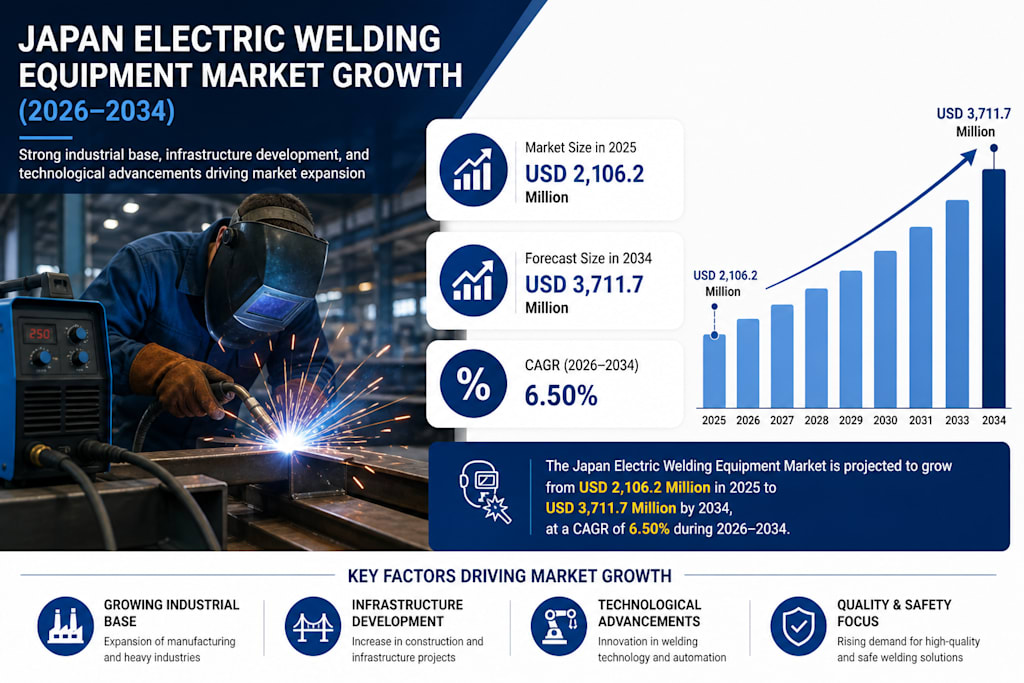
The Japan electric welding equipment market size reached USD 2,106.2 Million in 2025, reflecting sustained demand from high-precision manufacturing sectors. Looking ahead, the market is projected to reach USD 3,711.7 Million by 2034, exhibiting a growth rate (CAGR) of 6.50% during 2026-2034. This growth trajectory is driven by rising manufacturing automation, particularly in automotive and aerospace sectors requiring high-precision welding, alongside advancements in energy-efficient inverter-based systems and the growing integration of Internet of Things (IoT) connectivity for real-time monitoring and optimization.
Request PDF Sample for more detailed market insights:
Role of Innovation in Market Development
Advancements in Automation and Robotics Integration
The Japanese electric welding equipment market is experiencing a transformative shift toward advanced automation and robotic integration that fundamentally enhances manufacturing capabilities. Robotic arms and artificial intelligence-based systems are revolutionizing welding techniques across automotive, electronics, and aerospace industries. These automated solutions deliver consistent weld quality, enhance workplace safety, reduce labor costs, and accomplish complex welding operations with unprecedented precision. Adaptive welding technologies that automatically adjust to various materials and configurations are gaining widespread adoption. This transition not only accelerates production speed but also minimizes defects and errors, making it ideal for high-precision manufacturing environments. Leading manufacturers continue investing substantially in research and development to create advanced automated welding solutions and maintain competitive advantage in an evolving market.
Shift Towards Energy-Efficient and Eco-Friendly Equipment
Japan's commitment to sustainability is driving significant demand for energy-efficient and environmentally responsible welding equipment. Government initiatives, including the Top Runner Program designed to reduce power consumption by 35% compared to standard levels, are catalyzing this transition. Manufacturers are increasingly adopting inverter-based devices that deliver superior energy efficiency, reduced power consumption, and cleaner emissions. This shift aligns perfectly with Japan's ambitious targets for carbon neutrality and environmental protection. Additionally, welding equipment manufacturers are transitioning to recyclable materials and implementing design improvements that minimize waste during production. This transformation is influenced by both regulatory standards and consumer preference for sustainable solutions, making energy-efficient welding equipment increasingly essential across diverse industrial applications.
Customization and Smart Connectivity Features
The market is witnessing increased customization and smart connectivity capabilities tailored to specific industry requirements. Manufacturers now provide customized welding solutions designed for unique needs across aerospace, automotive, and shipbuilding sectors. Modern welding equipment increasingly incorporates smart connectivity options supporting remote monitoring and real-time diagnostics. Internet of Things (IoT) integration enables operators to continuously monitor performance metrics, weld parameters, and receive automated maintenance notifications. This connectivity enhances operational efficiency, minimizes unexpected downtime, and maintains consistently high quality standards. These technological advances are revolutionizing welding operations management, providing manufacturers with greater control, reliability, and competitive advantage.
Japan Electric Welding Equipment Market Trends and Drivers
Rising Demand from Automotive and Aerospace Manufacturing
Japan's automotive and aerospace industries are major drivers of welding equipment demand, requiring increasingly sophisticated and reliable equipment. As these sectors advance toward electric vehicles, autonomous systems, and lighter composite materials, demand for specialized welding solutions continues escalating. The need for precision welding in battery pack construction for electric vehicles and complex assemblies in aerospace applications creates sustained equipment demand.
Labor Shortage Catalyzing Automation Adoption
Japan faces significant labor shortages in manufacturing sectors, particularly among skilled welders. This demographic challenge is accelerating automation adoption and robotics integration. Companies are prioritizing automated welding solutions to maintain production capacity and quality despite workforce constraints.
Government Support for Industrial Modernization
Japan's government actively promotes manufacturing sector modernization through incentive programs and collaborative initiatives. Public support for automation technology adoption and sustainable manufacturing practices creates favorable conditions for welding equipment market expansion.
Japan Electric Welding Equipment Market Segmentation
By Equipment Type
• Arc Welding
• MIG/MAG Welding
• TIG Welding
• Resistance Welding
• Laser Welding
By Technology
• Conventional Welding
• Automated Welding
• Robotic Welding
By Application
• Automotive
• Construction
• Shipbuilding
• Energy
• Aerospace
By Region
• Kanto Region
• Kansai/Kinki Region
• Central/Chubu Region
• Kyushu-Okinawa Region
• Tohoku Region
• Chugoku Region
• Hokkaido Region
• Shikoku Region
This comprehensive segmentation demonstrates the diverse structure of Japan's welding equipment market, spanning multiple equipment types, technological approaches, industrial applications, and geographic regions.
Competitive Landscape
Japan's electric welding equipment market comprises established equipment manufacturers, technology innovators, system integrators, and specialized solution providers. Competitive positioning is shaped by technological capability, equipment reliability, customization offerings, after-sales support, and ability to integrate advanced automation features. Organizations providing integrated solutions combining cutting-edge equipment, robotics integration, software platforms, and comprehensive technical support are strengthening their market presence and building long-term customer partnerships.
Market Outlook
The Japan electric welding equipment market is positioned for sustained growth as manufacturing automation, sustainability initiatives, and smart connectivity technologies continue reshaping the sector. Continuous investments in robotic systems, energy-efficient technologies, and IoT-enabled equipment will remain critical for improving manufacturing efficiency, quality, and environmental performance. The welding equipment sector will continue playing a vital role in supporting Japan's advanced manufacturing competitiveness and industrial leadership.
About IMARC Group
IMARC Group is a leading market research and consulting firm providing strategy development, industry analysis, feasibility studies, and data-driven insights across global markets. The firm supports businesses, investors, and governments in making informed decisions through reliable and actionable research.
About the Creator
Yoshio
Market Research Analyst with 5+ years of experience in consumer insights and market segmentation. Skilled in data analysis and qualitative research.
Enjoyed the story? Support the Creator.
Subscribe for free to receive all their stories in your feed.
Comments
There are no comments for this story
Be the first to respond and start the conversation.