
Japan Electric Commercial Vehicle Market: Size, Share and Forecast 2026-2034
How Fleet Electrification, Smart Logistics, and Sustainable Transportation Are Transforming Japan’s Commercial Mobility Industry

Market Overview
The Japan electric commercial vehicle market represents a rapidly growing segment within the country’s automotive and sustainable transportation industry, encompassing battery-electric trucks, buses, delivery vans, and other commercial mobility solutions designed to reduce emissions and improve operational efficiency. Electric commercial vehicles (ECVs) are increasingly being adopted across logistics, public transportation, e-commerce delivery, construction, and industrial applications due to their lower operating costs, environmental benefits, and compatibility with evolving carbon neutrality goals.
Japan’s electric commercial vehicle industry benefits from strong automotive manufacturing capabilities, government support for clean transportation, expanding EV charging infrastructure, and increasing demand for sustainable logistics operations. Fleet operators and transportation companies are increasingly transitioning toward electric mobility to reduce fuel costs, comply with environmental regulations, and improve long-term operational sustainability. The market includes automotive manufacturers, battery producers, charging infrastructure providers, telematics companies, and logistics operators supporting the country’s commercial vehicle electrification ecosystem.
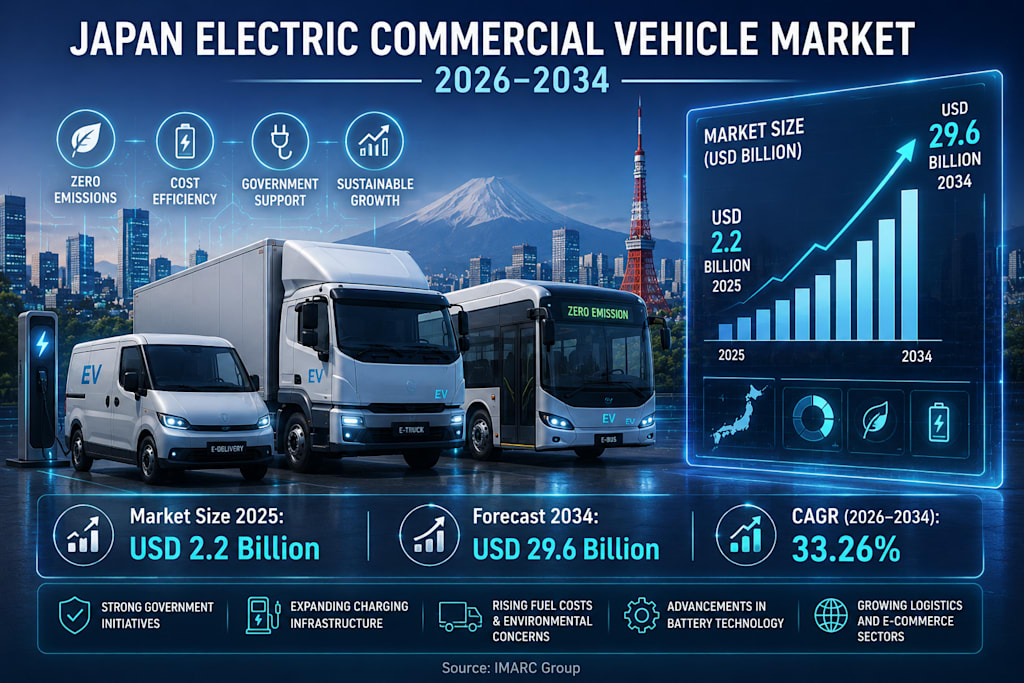
The Japan electric commercial vehicle market size reached USD 2.2 Billion in 2025. Looking forward, IMARC Group expects the market to reach USD 29.6 Billion by 2034, exhibiting a compound annual growth rate (CAGR) of 33.26% during 2026-2034. Market growth is driven by advancements in battery technology, rising adoption of zero-emission transportation, increasing e-commerce logistics demand, and growing investment in smart fleet infrastructure.
Request PDF Sample for more detailed market insights:
Role of Innovation in Market Development
- Advanced Battery Technology and Charging Infrastructure
Innovations in lithium-ion batteries, solid-state batteries, and fast-charging systems are significantly improving the performance and efficiency of electric commercial vehicles. Higher energy density, faster charging speeds, and extended driving range are enabling broader adoption of electric trucks and delivery vans across commercial applications.
- Smart Fleet Management and Connected Mobility
Fleet operators are increasingly integrating telematics, AI-powered route optimization, and predictive maintenance systems into electric commercial vehicle operations. Connected mobility technologies improve logistics efficiency, reduce downtime, and optimize energy consumption for commercial transportation networks.
- Expansion of Electric Delivery Vans and Urban Logistics
The rapid growth of e-commerce and urban delivery services is accelerating demand for compact electric commercial vehicles and delivery vans. Automotive manufacturers are introducing electric kei vans and lightweight delivery vehicles optimized for urban logistics and last-mile transportation.
- Growing Demand for Sustainable Transportation
Japan Electric Commercial Vehicle Market Trends and Drivers
Businesses and government organizations are increasingly prioritizing low-emission transportation systems to support carbon reduction goals and environmental sustainability initiatives. Electric commercial vehicles help reduce greenhouse gas emissions and improve urban air quality.
- Expansion of E-Commerce and Logistics Networks
Rapid growth in e-commerce and parcel delivery services is increasing demand for efficient and sustainable commercial transportation solutions. Electric delivery vehicles are becoming essential for urban logistics operations.
- Government Support and EV Incentives
Government subsidies, tax incentives, and infrastructure investments are encouraging commercial fleet electrification across Japan. Supportive policies are helping businesses adopt electric transportation technologies more rapidly.
- Strategic Partnerships and Automotive Innovation
Automotive manufacturers are forming strategic alliances to accelerate electric commercial vehicle development and strengthen competitiveness in global markets. Collaborations focused on hydrogen technologies, autonomous driving, and EV manufacturing are reshaping Japan’s commercial vehicle industry.
- Japan Electric Commercial Vehicle Market Segmentation
Analysis by Vehicle Type
• Electric Trucks
• Electric Buses
• Electric Vans
• Others
Analysis by Propulsion Type
• Battery Electric Vehicles (BEVs)
• Plug-In Hybrid Electric Vehicles (PHEVs)
• Fuel Cell Electric Vehicles (FCEVs)
Analysis by Application
• Logistics and Freight Transportation
• Public Transportation
• Construction and Industrial Applications
• Municipal Services
• Others
Analysis by Battery Type
• Lithium-Ion Batteries
• Solid-State Batteries
• Others
Analysis by Region
• Kanto Region
• Kansai / Kinki Region
• Chubu Region
• Kyushu–Okinawa Region
• Tohoku Region
• Chugoku Region
• Hokkaido Region
• Shikoku Region
This comprehensive segmentation highlights the diversity of Japan’s electric commercial vehicle market, covering multiple vehicle categories, propulsion technologies, fleet applications, and regional transportation ecosystems.
Competitive Landscape
The Japan electric commercial vehicle market comprises automotive manufacturers, battery technology companies, fleet management providers, logistics firms, and charging infrastructure developers. Competitive positioning is influenced by battery efficiency, driving range, charging speed, fleet connectivity, sustainability initiatives, and technological innovation.
Companies are increasingly investing in electric truck platforms, hydrogen-powered commercial vehicles, smart logistics systems, and AI-enabled transportation technologies. Businesses offering scalable and energy-efficient commercial mobility solutions are strengthening market leadership.
Market Outlook
The Japan electric commercial vehicle market is positioned for substantial long-term growth as transportation electrification accelerates, battery technologies improve, and sustainable logistics become a strategic priority across industries. Continued investment in charging infrastructure, smart fleet systems, autonomous mobility technologies, and low-emission transportation policies will remain essential for supporting market expansion and competitive differentiation.
As businesses increasingly transition toward sustainable and intelligent transportation systems, electric commercial vehicles are expected to play a central role in shaping the future of Japan’s logistics and commercial mobility ecosystem.
About IMARC Group
IMARC Group is a leading market research and consulting firm providing strategy development, industry analysis, feasibility studies, and data-driven insights across global markets. The firm supports businesses, investors, and governments in making informed decisions through reliable and actionable research.
About the Creator
David Michel
David Michel brings precision and depth to the world of market research. By uncovering trends, analyzing data, and delivering meaningful insights, he helps businesses navigate opportunities with confidence.
Enjoyed the story? Support the Creator.
Subscribe for free to receive all their stories in your feed.
Comments
There are no comments for this story
Be the first to respond and start the conversation.