
Japan Distributed Energy Resources Market: Size, Share and Growth Outlook 2026-2034
How Renewable Energy Integration, Microgrid Innovation, and Government Incentives Are Driving Japan's Energy Transition

Market Overview
Distributed Energy Resources (DER) represent a fundamental shift in how Japan generates, stores, and distributes electricity. This market encompasses solar photovoltaic (PV) systems, wind energy installations, biomass and biogas facilities, energy storage systems, combined heat and power (CHP) units, and advanced microgrids. As Japan navigates energy security challenges, aging infrastructure, and commitments to carbon neutrality, the distributed energy resources sector has become central to the country's clean energy strategy.
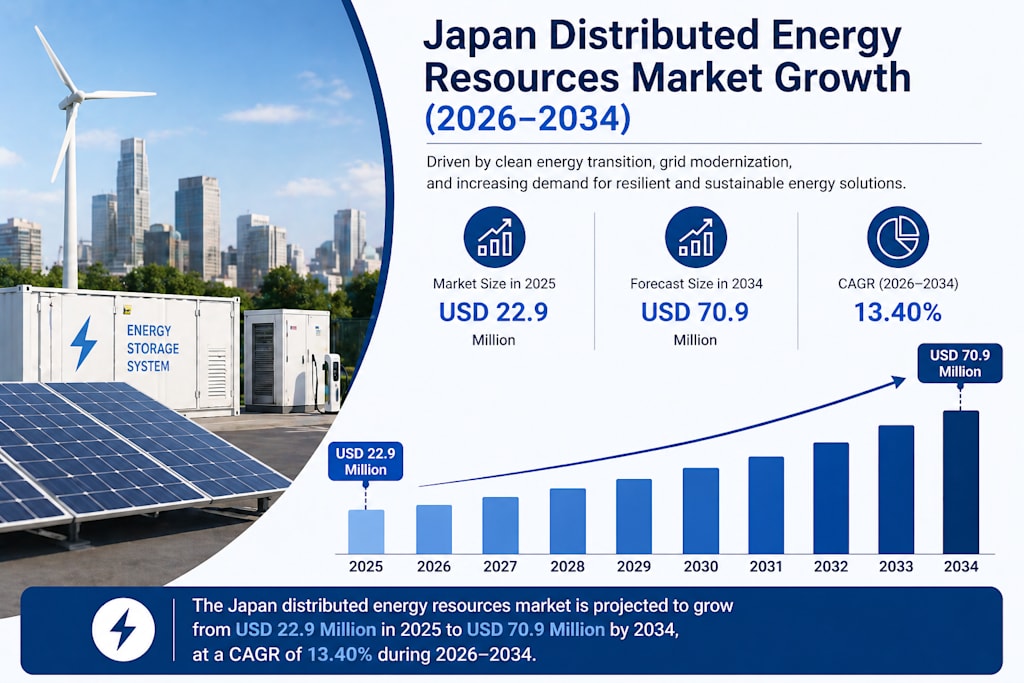
The Japan distributed energy resources market size reached USD 22.9 Million in 2025, with projections to reach USD 70.9 Million by 2034, exhibiting a growth rate of 13.40% during 2026-2034. This robust expansion reflects increasing investments in renewable energy infrastructure, technological advancement, and the growing adoption of decentralized energy solutions across residential, commercial, industrial, agricultural, and government sectors.
Request PDF Sample for more detailed market insights:
Role of Innovation in Market Development
• Solar PV and Renewable Energy Systems
Solar photovoltaic technology dominates Japan's renewable energy landscape, offering scalable solutions for residential rooftops and large-scale installations. Modern solar systems are becoming increasingly efficient and affordable, making them accessible to diverse consumer segments. Advanced panel designs and integrated inverter technologies are enhancing energy conversion rates while reducing installation costs, driving broader market adoption.
• Energy Storage Systems and Battery Integration
Energy storage systems (ESS) are critical enablers of renewable energy reliability. Battery technology innovations—including lithium-ion systems and emerging next-generation solutions—allow consumers and businesses to store excess energy for later use. This capability addresses intermittency challenges associated with solar and wind energy, ensuring consistent power supply and grid stability.
• Smart Grid and IoT Integration
Digital transformation through smart grid technology and Internet of Things (IoT) sensors enables real-time monitoring and optimization of distributed energy resources. Data-driven insights allow operators to balance supply and demand dynamically, reduce transmission losses, and improve overall system efficiency. Smart grid integration supports demand response technologies that empower consumers to participate actively in energy management.
Japan Distributed Energy Resources Market Trends and Drivers
• Policy Support and Government Incentives
Japan's commitment to achieving carbon neutrality by 2050 has catalyzed supportive policy frameworks and financial incentives. Government subsidies for renewable energy installations, feed-in tariff programs, and tax credits are encouraging both individual consumers and corporations to invest in distributed energy resources. Regulatory reforms promoting decentralized energy production continue to facilitate market growth.
• Rising Energy Costs and Grid Resilience Concerns
Escalating electricity costs and the need for enhanced energy resilience are motivating Japanese consumers and businesses to adopt distributed energy solutions. On-grid, off-grid, and hybrid systems provide flexibility and cost savings, particularly for commercial and industrial end-users seeking to reduce energy expenses and improve operational resilience.
• Technological Maturity and Cost Reduction
Declining costs of solar panels, battery systems, and related infrastructure have made distributed energy resources economically competitive. Ongoing technological improvements continue to enhance system performance, expand product lifespans, and improve return on investment timelines, making DER adoption more attractive across all market segments.
Japan Distributed Energy Resources Market Segmentation
By Type
• Solar PV
• Wind Energy
• Biomass and Biogas
• Energy Storage Systems (ESS)
• Combined Heat and Power (CHP)
• Microgrids
By Connectivity
• On-Grid
• Off-Grid
• Hybrid Systems
By Technology
• Distributed Generation
• Distributed Storage
• Demand Response Technologies
• Smart Grid and IoT Integration
By End-User
• Residential
• Commercial & Industrial (C and I)
• Agricultural
• Government & Public Sector
By Region
• Kanto
• Kansai / Kinki
• Chubu
• Kyushu–Okinawa
• Tohoku
• Chugoku
• Hokkaido
• Shikoku
This comprehensive segmentation reflects the diversity of applications and technological solutions within Japan's distributed energy resources ecosystem, spanning consumer-level installations to large-scale industrial deployments.
Competitive Landscape
The Japan distributed energy resources market features equipment manufacturers, renewable energy developers, energy storage solution providers, and smart grid technology companies. Competitive success depends on technological innovation, system reliability, integration capabilities, and alignment with Japan's sustainability objectives. Organizations offering comprehensive solutions—combining generation, storage, and management technologies—are strengthening market positions and customer loyalty.
Market Outlook
The Japan distributed energy resources market is positioned for sustained growth as the nation accelerates its energy transition. Continued investments in renewable generation capacity, battery storage advancement, and smart grid modernization will remain essential for achieving climate targets while enhancing grid resilience. Distributed energy resources will increasingly serve as a cornerstone of Japan's pathway toward energy independence and environmental sustainability.
About IMARC Group
IMARC Group is a leading market research and consulting firm providing strategy development, industry analysis, feasibility studies, and data-driven insights across global markets. The firm supports businesses, investors, and governments in making informed decisions through reliable and actionable research.
About the Creator
Yoshio
Market Research Analyst with 5+ years of experience in consumer insights and market segmentation. Skilled in data analysis and qualitative research.
Enjoyed the story? Support the Creator.
Subscribe for free to receive all their stories in your feed.
Comments
There are no comments for this story
Be the first to respond and start the conversation.