
Japan Dishwasher Market Value & Growth Forecast 2025–2033: Smart Kitchens, Urban Lifestyles, and Hygiene Trends Fuel Industry Expansion
As Japanese households embrace convenience, compact living solutions, and advanced home appliances, the dishwasher market is steadily expanding toward a US$ 2 Billion opportunity by 2033.

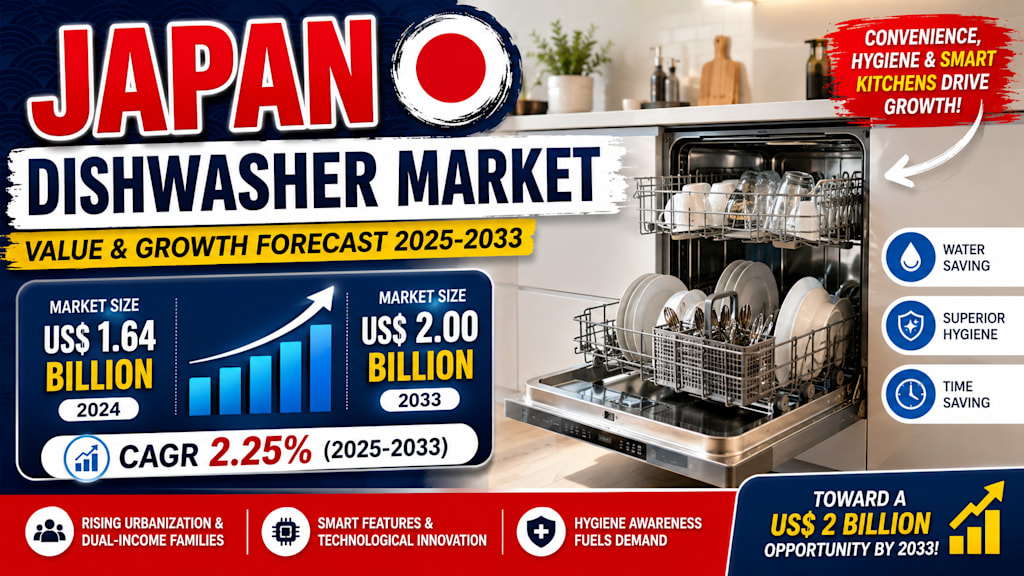
Japan Dishwasher Market Set for Steady Growth Through 2033
Japan's dishwasher industry is entering a new phase of transformation as consumers increasingly prioritize convenience, cleanliness, and efficiency in everyday life. Once considered a luxury appliance, dishwashers are gradually becoming an essential kitchen solution for modern households and commercial establishments throughout the country.
According to Renub Research, the Japan Dishwasher Market is projected to grow from US$ 1.64 billion in 2024 to US$ 2.00 billion by 2033, expanding at a CAGR of 2.25% between 2025 and 2033.
The market's growth is closely tied to changing lifestyles, urbanization, labor shortages, technological innovation, and rising awareness regarding hygiene. As Japanese consumers seek practical ways to reduce household workloads while maintaining high standards of cleanliness, dishwasher adoption continues to gain momentum.
Understanding the Role of Dishwashers in Modern Japanese Homes
A dishwasher is an automated appliance designed to clean dishes, cookware, cutlery, and kitchen utensils using water, detergent, and heat. Unlike traditional handwashing, dishwashers provide consistent cleaning performance while minimizing manual effort.
In Japan, where efficiency and technology are deeply integrated into daily life, dishwashers align perfectly with consumer expectations. Modern models offer features such as:
Energy-efficient operation
Water-saving technologies
Smart sensors
AI-powered washing cycles
Noise reduction systems
Compact designs for small kitchens
These innovations have transformed dishwashers from convenience products into practical necessities for many households.
Urban Lifestyles Are Driving Dishwasher Adoption
One of the strongest factors supporting market growth is Japan's highly urbanized population.
More than 92% of Japan's population resides in urban areas, where fast-paced lifestyles often leave limited time for household chores. Working professionals and dual-income families increasingly prefer appliances that reduce time spent on repetitive tasks.
Dishwashers provide a valuable solution by allowing users to automate one of the most time-consuming kitchen activities.
The trend is particularly noticeable in major metropolitan regions such as Tokyo, Osaka, Yokohama, and Nagoya, where apartment living and demanding work schedules encourage the adoption of labor-saving household technologies.
As work-life balance becomes a growing priority among Japanese consumers, dishwashers are expected to become even more attractive.
Dual-Income Households Strengthen Market Demand
Japan continues to witness growth in households where both partners participate in the workforce.
These families often have limited time available for domestic responsibilities and are increasingly investing in appliances that improve household efficiency.
Dishwashers offer several advantages:
Reduced daily cleaning effort
Improved kitchen organization
Consistent sanitation
Time savings for working families
The growing number of working women and changing household structures are creating long-term opportunities for dishwasher manufacturers targeting convenience-focused consumers.
Technological Innovation Is Reshaping Consumer Expectations
Japanese consumers are known worldwide for their appreciation of advanced technology, and dishwasher manufacturers are responding with increasingly sophisticated products.
Modern dishwashers now include:
Smart connectivity
Mobile app controls
AI-assisted washing programs
Automatic detergent dispensing
Water optimization systems
Eco-friendly operation modes
Consumers are also seeking appliances that align with environmental sustainability goals. Manufacturers are therefore investing heavily in technologies that reduce water and electricity consumption while maintaining cleaning effectiveness.
A notable example came in July 2023 when Hoshizaki introduced its smallest commercial dishwasher model, expanding options for businesses with limited installation space.
Innovation remains one of the strongest competitive drivers across Japan's dishwasher landscape.
Hygiene Awareness Continues to Support Growth
Consumer attitudes toward cleanliness have changed significantly over recent years.
Japanese households increasingly recognize the hygiene benefits associated with dishwasher use. Unlike handwashing, dishwashers can utilize high-temperature wash cycles that help eliminate bacteria and improve sanitation levels.
This advantage is particularly important for:
Families with children
Elderly household members
Healthcare-conscious consumers
Food service businesses
Japan's aging population also contributes to this trend. By September 2024, the country's elderly population exceeded 36 million people, representing nearly one-third of the national population.
For many older consumers, dishwashers reduce physical strain while ensuring a high standard of cleanliness, making them an increasingly attractive household appliance.
Market Challenge: High Initial Costs
Despite positive growth prospects, several barriers continue to impact market expansion.
The most significant challenge remains the relatively high upfront cost associated with dishwasher purchases.
Although dishwashers can generate savings through reduced water consumption and labor efficiency over time, many consumers still focus heavily on initial purchase expenses.
Price sensitivity is especially evident among:
Middle-income households
Rural consumers
First-time appliance buyers
Premium models equipped with smart features and advanced technologies often carry higher price tags, limiting accessibility for some segments of the population.
Manufacturers are therefore exploring affordable product offerings and financing options to attract broader consumer groups.
Limited Kitchen Space Remains a Key Obstacle
Japan's residential architecture presents another unique challenge.
Many urban apartments and older homes feature compact kitchen layouts with limited appliance space.
Even consumers interested in dishwasher ownership may struggle to accommodate full-sized units.
To address this issue, manufacturers have introduced:
Countertop dishwashers
Portable dishwashers
Slim-profile models
Compact built-in systems
While these solutions have expanded accessibility, space limitations remain one of the most significant factors restricting wider market penetration.
Built-in Dishwashers Gain Popularity in Modern Housing
The built-in dishwasher segment continues to grow alongside new residential construction and kitchen remodeling projects.
Built-in models offer several advantages:
Seamless kitchen integration
Space optimization
Modern aesthetics
Advanced functionality
Premium housing developments increasingly include built-in dishwashers as standard kitchen features.
Consumers purchasing newly constructed apartments often prefer integrated appliances that complement contemporary interior designs.
As Japan's smart-home ecosystem continues to evolve, built-in dishwasher installations are expected to rise steadily throughout the forecast period.
Residential Dishwasher Market Shows Consistent Expansion
Residential users represent the largest consumer segment within Japan's dishwasher industry.
Growing awareness regarding hygiene, convenience, and sustainability is encouraging more households to adopt automated dishwashing solutions.
Particularly strong demand exists for:
Compact family models
Countertop dishwashers
Energy-efficient units
Affordable entry-level products
Environmental consciousness is also influencing purchasing behavior. Consumers increasingly seek appliances that reduce water usage and support sustainable living practices.
As manufacturers continue introducing compact and affordable models, residential demand is likely to remain the primary growth engine for the market.
Commercial Sector Increasingly Relies on Automation
Commercial dishwashers play an essential role across Japan's hospitality and food service industries.
Restaurants, cafes, hotels, catering businesses, and institutional kitchens depend on dishwashers to maintain hygiene standards while improving operational efficiency.
The commercial segment benefits from several trends:
Labor shortages
Rising hygiene regulations
Increased restaurant activity
Growing tourism recovery
High-capacity commercial dishwashers enable businesses to process large volumes of dishes while reducing labor requirements and ensuring consistent sanitation.
As workforce shortages persist throughout Japan, automation investments are expected to increase further.
Offline Retail Continues to Lead Sales
Although e-commerce is growing, traditional retail channels remain dominant within Japan's dishwasher market.
Consumers often prefer purchasing major appliances through:
Electronics retailers
Specialty appliance stores
Department stores
Home improvement centers
Physical stores allow shoppers to:
Compare models directly
Receive expert guidance
View product demonstrations
Access installation support
For higher-value purchases such as dishwashers, in-person shopping remains an important component of the customer journey.
Online Sales Are Expanding Rapidly
The online distribution channel is experiencing strong growth as Japanese consumers become increasingly comfortable purchasing appliances digitally.
E-commerce platforms provide several advantages:
Extensive product selection
Competitive pricing
Customer reviews
Convenient home delivery
Online sales are especially attractive for compact dishwasher models that require minimal installation complexity.
As digital shopping habits continue evolving, online channels are expected to capture a larger share of future dishwasher sales.
Regional Spotlight: Tokyo Leads National Demand
Tokyo remains the largest and most influential dishwasher market in Japan.
The city benefits from:
High population density
Strong purchasing power
Technology-focused consumers
Extensive apartment living
Demand for compact and built-in dishwashers is particularly strong among Tokyo residents seeking efficient use of limited kitchen space.
The city's thriving hospitality sector also supports substantial commercial dishwasher demand.
Saitama Emerging as a Fast-Growing Residential Market
Saitama is becoming an increasingly attractive market due to its expanding middle-class population and growing number of dual-income households.
Consumers are showing strong interest in:
Budget-friendly dishwashers
Countertop models
Compact installations
Modern housing developments across the prefecture are further encouraging adoption of integrated kitchen appliances.
Aichi Demonstrates Balanced Residential and Commercial Demand
Aichi Prefecture, home to Nagoya and numerous industrial centers, represents one of Japan's most promising regional markets.
Growth is supported by:
Urban development
Rising household incomes
Expanding hospitality businesses
New residential construction
Both residential and commercial dishwasher segments are performing strongly, creating diverse opportunities for manufacturers.
10 Recent Developments from Leading Dishwasher Companies
1. Panasonic
Expanded its smart home appliance ecosystem, integrating connected kitchen technologies and energy-efficient dishwasher solutions for Japanese households.
2. Electrolux AB
Continued investment in sustainable appliance manufacturing and launched models emphasizing reduced water and energy consumption.
3. Whirlpool Corporation
Enhanced its premium dishwasher lineup with advanced cleaning technologies and improved drying performance.
4. Robert Bosch GmbH
Introduced new quiet-operation dishwasher models targeting urban apartment users seeking low-noise appliances.
5. Samsung Electronics
Expanded AI-powered home appliance capabilities, incorporating intelligent washing programs and smart connectivity features.
6. Siemens
Focused on premium built-in dishwasher innovations designed for modern kitchen integration and smart-home compatibility.
7. LG Electronics
Strengthened its smart appliance portfolio through enhanced energy efficiency and app-enabled dishwasher management systems.
8. Haier Group
Expanded affordable dishwasher offerings aimed at budget-conscious households and first-time buyers.
9. Hoshizaki Corporation
Launched its smallest commercial dishwasher model in 2023, targeting businesses with limited installation space.
10. Bosch Home Appliances
Advanced sustainable manufacturing initiatives while introducing dishwashers with improved water-saving performance.
Competitive Landscape
Major participants operating within Japan's dishwasher market include:
Electrolux AB
Panasonic
Whirlpool Corporation
Robert Bosch GmbH
Samsung Electronics
Siemens
LG Electronics
Haier Group
These companies continue investing in innovation, sustainability, compact designs, and smart technologies to strengthen their positions in Japan's evolving dishwasher market.
Final Thoughts
Japan's dishwasher market may not be growing at the explosive pace seen in some emerging appliance categories, but its long-term outlook remains highly positive. Rising urbanization, aging demographics, busy lifestyles, increasing hygiene awareness, and continuous technological innovation are steadily expanding dishwasher adoption across households and commercial establishments.
With the market expected to reach US$ 2.00 billion by 2033, manufacturers that successfully combine compact design, energy efficiency, affordability, and smart functionality will be best positioned to capitalize on future opportunities. As Japanese consumers continue embracing convenience-driven living, dishwashers are set to become an increasingly indispensable component of the modern kitchen.
About the Creator
Enjoyed the story? Support the Creator.
Subscribe for free to receive all their stories in your feed.
Comments
There are no comments for this story
Be the first to respond and start the conversation.