
Interactive Whiteboard Market Growth Accelerates as Digital Learning and Hybrid Work Reshape Communication
Rising adoption of smart classrooms, collaborative workplace technologies, and advanced touchscreen innovations is driving strong growth across the global Interactive Whiteboard industry.

Interactive technology has transformed the way people learn, communicate, and collaborate. In classrooms, boardrooms, training centers, and corporate offices, traditional whiteboards are increasingly being replaced by digital solutions that offer greater interactivity, flexibility, and engagement. Among these innovations, interactive whiteboards have emerged as one of the most valuable tools for modern education and workplace collaboration.
As organizations continue embracing digital transformation, the demand for technologies that facilitate real-time interaction and content sharing has grown substantially. Interactive whiteboards provide users with the ability to write, draw, annotate, display multimedia content, and collaborate on projects using touch-enabled interfaces. Their versatility has made them an essential component of smart classrooms, hybrid workplaces, and technology-driven learning environments.
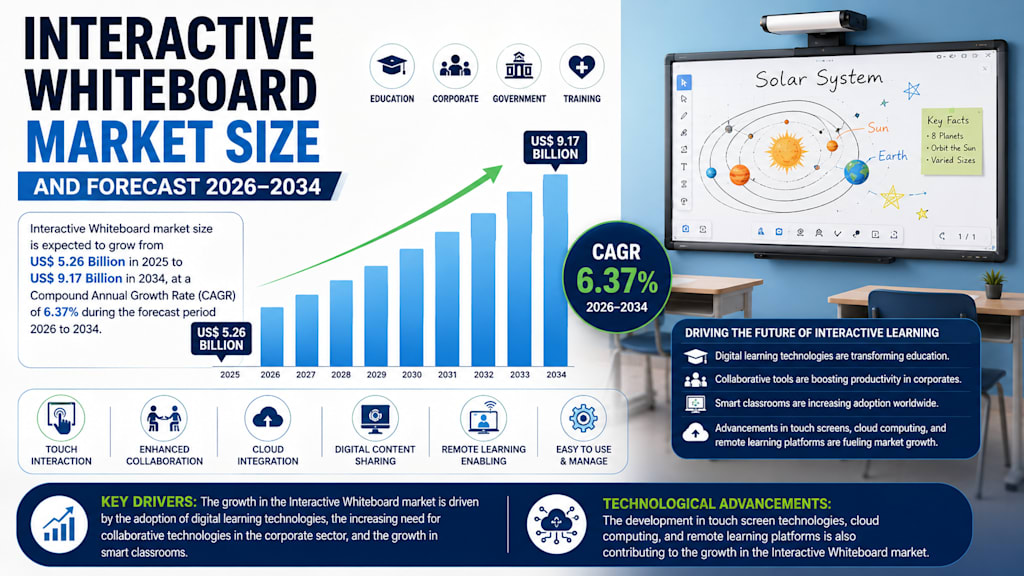
According to Renub Research, the global Interactive Whiteboard Market is projected to increase from US$ 5.26 billion in 2025 to US$ 9.17 billion by 2034, growing at a compound annual growth rate (CAGR) of 6.37% between 2026 and 2034. The market's growth is being fueled by expanding digital learning initiatives, increasing demand for collaborative workplace technologies, and continuous advancements in touchscreen and cloud-based technologies.
Interactive Whiteboards Are Revolutionizing Learning and Collaboration
Interactive whiteboards are electronic display systems that allow users to interact directly with digital content through touch, stylus pens, or other input devices. Connected to computers, projectors, and cloud-based applications, these systems enable users to write, draw, move objects, and access multimedia content on a large digital display.
Unlike traditional whiteboards, interactive whiteboards create a dynamic environment where information can be edited, saved, shared, and accessed remotely. These capabilities make them particularly valuable in educational institutions and business environments where communication and collaboration are essential.
Modern interactive whiteboards support presentations, videos, digital learning platforms, online collaboration tools, and cloud-based applications. Their ability to integrate multiple forms of content into a single platform has transformed how information is delivered and consumed.
As digital transformation continues across industries, interactive whiteboards are becoming increasingly important tools for enhancing productivity and engagement.
Digital Learning Is Driving Significant Market Expansion
One of the most important factors contributing to market growth is the widespread adoption of digital learning technologies.
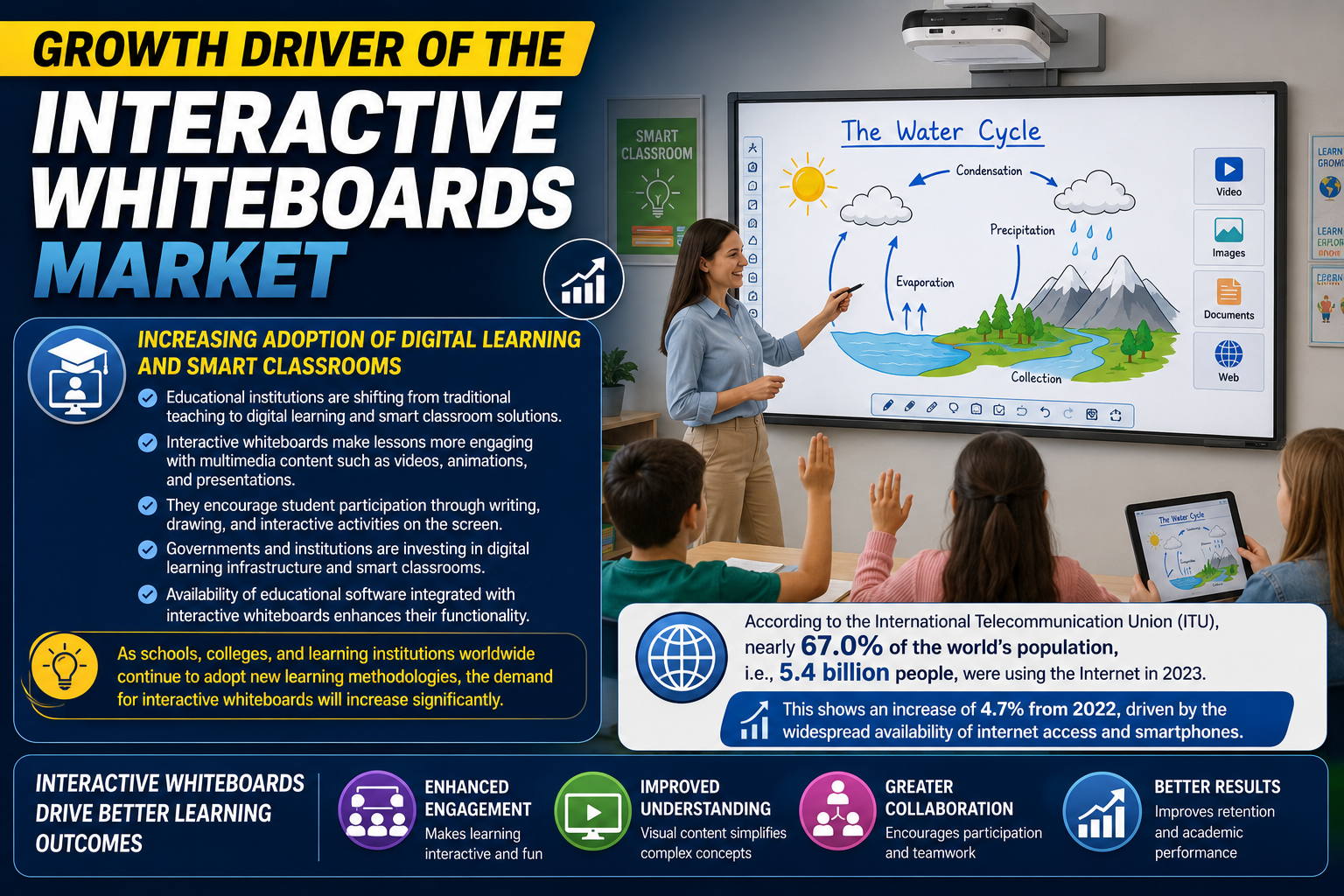
Educational institutions around the world are increasingly moving away from traditional teaching methods and embracing technology-enhanced learning experiences. Interactive whiteboards support this transition by enabling teachers to deliver engaging lessons through videos, animations, presentations, simulations, and interactive exercises.
Students can actively participate in classroom activities by writing on the screen, solving problems, annotating content, and interacting with educational applications. This interactive approach helps improve engagement, comprehension, and knowledge retention.
Governments and educational organizations are investing heavily in smart classroom infrastructure to improve learning outcomes and prepare students for technology-driven environments. Interactive whiteboards are often at the center of these initiatives because they combine multiple teaching tools into a single platform.
The continued expansion of digital education programs is expected to remain a major driver of market growth throughout the forecast period.
Global Internet Expansion Supports Adoption
The rapid growth of internet connectivity worldwide is creating favorable conditions for the interactive whiteboard market.
According to the International Telecommunication Union (ITU), approximately 5.4 billion people, representing nearly 67% of the global population, were using the internet in 2023. This growing digital connectivity is accelerating the adoption of online learning platforms, cloud-based collaboration tools, and connected educational technologies.
Interactive whiteboards benefit directly from this trend because they rely on internet access for many of their advanced features, including cloud storage, remote collaboration, online content access, and virtual learning integration.
As internet infrastructure continues improving globally, educational institutions and businesses are gaining greater access to the digital resources necessary to support interactive learning and communication technologies.
Corporate Collaboration Is Becoming More Digital
The growing need for efficient workplace communication is another major factor driving demand for interactive whiteboards.
Modern organizations increasingly rely on collaboration technologies to improve productivity and support distributed workforces. Interactive whiteboards enable teams to brainstorm, share ideas, annotate documents, and collaborate on projects using a single digital platform.
These systems are particularly valuable in hybrid work environments where employees may be working from multiple locations. Interactive whiteboards facilitate real-time collaboration between remote and in-office participants, helping organizations maintain effective communication regardless of physical location.
Meeting rooms, training centers, conference facilities, and innovation hubs are increasingly incorporating interactive whiteboards into their technology infrastructure. The ability to support presentations, video conferencing, and collaborative planning sessions makes these systems highly attractive to businesses seeking to improve operational efficiency.
As hybrid work models become more common, demand for advanced collaboration technologies is expected to continue rising.
Technological Advancements Are Enhancing User Experiences
Continuous innovation in touchscreen technology is significantly improving the performance of interactive whiteboards.
Modern systems offer high-resolution displays, ultra-responsive touch functionality, multi-touch capabilities, and improved user interfaces. These advancements create smoother, more intuitive experiences for users across educational and professional environments.
Many interactive whiteboards now support simultaneous touch interactions, allowing multiple users to engage with content at the same time. This capability enhances collaborative learning and teamwork by encouraging active participation.
Wireless connectivity has also become a standard feature in many products. Users can connect laptops, smartphones, tablets, and other devices directly to the whiteboard without requiring complex wiring or external hardware.
Cloud integration further expands functionality by enabling users to save content, access files remotely, and collaborate across multiple locations. As technology continues evolving, interactive whiteboards are becoming increasingly powerful tools for communication and knowledge sharing.
Artificial Intelligence Is Creating New Possibilities
Artificial intelligence is emerging as an important innovation within the interactive whiteboard market.
AI-powered features can assist users with content organization, handwriting recognition, automated note-taking, language translation, and presentation management. These capabilities enhance productivity while simplifying the user experience.
Educational institutions are particularly interested in AI-enhanced solutions because they can personalize learning experiences and improve classroom engagement. Corporate users benefit from intelligent collaboration tools that streamline meetings and facilitate information sharing.
Recent product launches demonstrate the growing importance of AI within the industry. Technology companies continue introducing interactive displays equipped with advanced software solutions designed to support modern learning and collaborative environments.
As artificial intelligence becomes more integrated into digital communication technologies, interactive whiteboards are expected to become even more versatile and efficient.
Fixed Interactive Whiteboards Continue to Dominate
Fixed interactive whiteboards remain one of the most widely used product categories in the market.
These systems are permanently installed in classrooms, conference rooms, training facilities, and meeting spaces where regular access to collaborative technology is required. Their stable installation and compatibility with other infrastructure make them particularly attractive for long-term use.
Educational institutions frequently choose fixed interactive whiteboards because they provide reliable daily access to digital learning tools. Businesses also favor these systems for conference rooms and collaborative workspaces where presentations and meetings occur regularly.
The growing investment in smart classrooms and modern office environments is expected to support continued demand for fixed interactive whiteboards.
Infrared Technology Maintains Strong Market Presence
Infrared interactive whiteboards remain popular due to their durability, flexibility, and affordability.
These systems use infrared sensors to detect touch inputs from fingers, pens, or other objects. Because they support multiple input methods and allow several users to interact simultaneously, infrared whiteboards are widely used in schools, training centers, and corporate environments.
The technology offers a cost-effective solution for organizations seeking interactive capabilities without investing in more expensive display technologies. Its reliability and ease of use continue to make it an important segment within the broader market.
As educational institutions and businesses seek practical collaboration tools, infrared-based systems are expected to maintain strong market demand.
Education Remains the Largest Application Segment
The education sector continues to represent the largest market for interactive whiteboards.
Schools, colleges, universities, and training centers worldwide are increasingly investing in technology-enhanced learning environments. Interactive whiteboards help educators create engaging lessons that combine text, images, videos, animations, and interactive exercises.
Students benefit from greater participation opportunities, while teachers gain access to versatile instructional tools that support diverse learning styles. Digital lesson storage and content sharing capabilities further enhance the educational experience.
Government-backed digital education initiatives continue supporting adoption across developed and emerging markets alike. As schools modernize their infrastructure, interactive whiteboards are expected to remain central components of smart classroom strategies.
Regional Markets Continue Expanding
United States
The United States remains one of the most significant markets for interactive whiteboards. High technology adoption rates, widespread use of digital learning platforms, and growing demand for hybrid workplace solutions continue supporting market growth. Educational institutions and corporate organizations alike are investing in advanced interactive display technologies.
United Kingdom
The United Kingdom is witnessing steady growth due to ongoing investments in educational modernization and digital communication technologies. Schools and businesses increasingly rely on interactive whiteboards to support collaborative learning and flexible work environments.
India
India represents one of the fastest-growing markets due to government initiatives promoting digital education, expanding internet connectivity, and growing investments in smart classrooms. The increasing number of private educational institutions and training centers is further supporting adoption.
Saudi Arabia
Saudi Arabia is experiencing growing demand for interactive whiteboards as part of broader efforts to modernize educational infrastructure and support digital transformation initiatives. Smart schools, universities, and corporate facilities are increasingly incorporating interactive display technologies.
Challenges Facing the Market
Despite strong growth prospects, the interactive whiteboard market faces several challenges.
One of the primary barriers is the relatively high initial investment required for deployment. Interactive whiteboards often require supporting hardware, software, internet connectivity, and maintenance services, increasing overall ownership costs.
Training requirements can also slow adoption. Teachers, employees, and administrators may need time to become familiar with advanced features and digital workflows. Organizations frequently invest in training programs to maximize system effectiveness.
However, as technology becomes more user-friendly and affordable, these challenges are expected to diminish over time.
Market Forecast: Strong Growth Through 2034
According to Renub Research, the global Interactive Whiteboard Market is forecast to grow from US$ 5.26 billion in 2025 to US$ 9.17 billion by 2034, expanding at a CAGR of 6.37% during the period from 2026 to 2034.
Growth will be driven by increasing digital learning adoption, expanding smart classroom initiatives, rising demand for collaborative workplace technologies, and continuous innovation in touchscreen displays, cloud computing, wireless connectivity, and artificial intelligence.
As educational institutions and businesses continue embracing digital transformation, interactive whiteboards are expected to play an increasingly important role in communication, collaboration, and knowledge sharing.
Final Thoughts
The Interactive Whiteboard Market is entering an exciting phase of growth as organizations worldwide embrace smarter and more connected ways of learning and working. From classrooms and universities to corporate boardrooms and training centers, interactive whiteboards are transforming how information is presented, shared, and understood.
With Renub Research forecasting growth from US$ 5.26 billion in 2025 to US$ 9.17 billion by 2034, the market is positioned for sustained expansion. The convergence of digital education, hybrid work environments, cloud technology, and artificial intelligence will continue shaping the industry's future.
About the Creator
Enjoyed the story? Support the Creator.
Subscribe for free to receive all their stories in your feed.
Comments
There are no comments for this story
Be the first to respond and start the conversation.