
Infant Phototherapy Devices Are Improving Newborn Care Through Safer and More Effective Jaundice Treatment
Rising Neonatal Jaundice Cases, Advancements in LED Technology, and Expanding Neonatal Healthcare Infrastructure Are Driving Market Growth

The first days of life are among the most critical stages of human development. During this period, newborns require close medical monitoring to ensure a healthy transition into life outside the womb. One of the most common conditions affecting newborn babies is neonatal jaundice, a condition characterized by elevated bilirubin levels that cause yellowing of the skin and eyes. While jaundice is often treatable, delayed intervention can lead to severe complications, including neurological damage.
To address this challenge, healthcare providers around the world increasingly rely on infant phototherapy devices, specialized medical systems designed to safely reduce bilirubin levels and prevent long-term complications. These devices have become essential tools in neonatal intensive care units, maternity wards, pediatric hospitals, and even home-care environments.
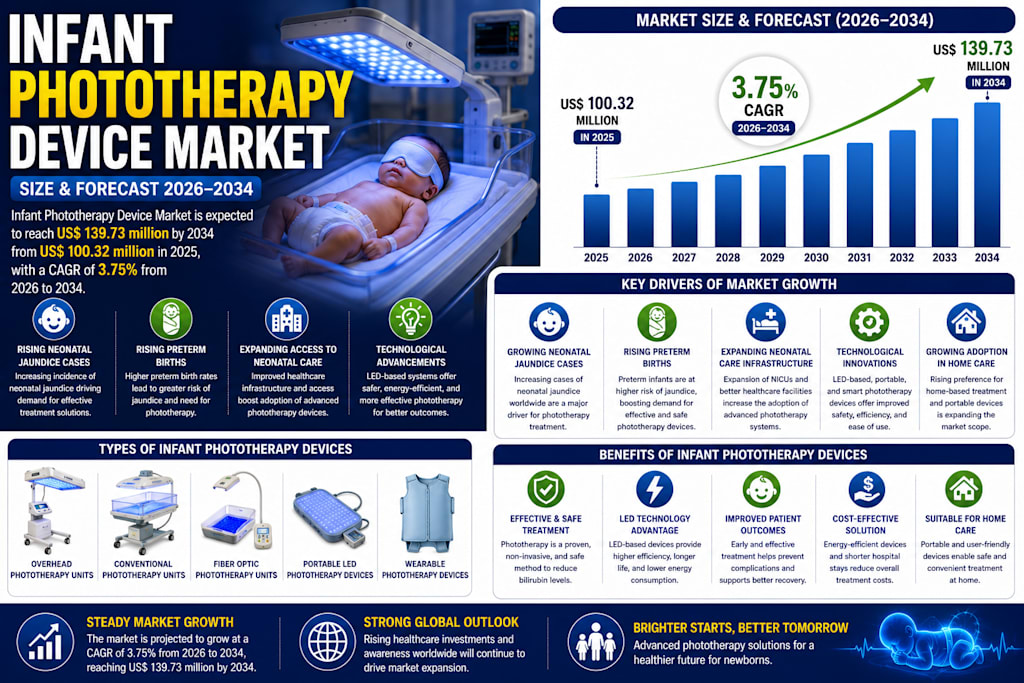
According to Renub Research, the Infant Phototherapy Device Market is projected to grow from US$ 100.32 million in 2025 to US$ 139.73 million by 2034, registering a CAGR of 3.75% between 2026 and 2034. Growing neonatal jaundice prevalence, increasing preterm birth rates, expanding neonatal healthcare infrastructure, and technological improvements in phototherapy systems are driving market expansion worldwide.
As healthcare systems place greater emphasis on maternal and infant health, phototherapy devices are becoming increasingly important in ensuring safe and effective newborn care.
Understanding Neonatal Jaundice and Phototherapy Treatment
Neonatal jaundice occurs when excess bilirubin accumulates in a newborn's bloodstream. Bilirubin is a yellow pigment produced during the natural breakdown of red blood cells. Because newborns often have immature liver function, they may struggle to eliminate bilirubin efficiently during the first days after birth.
If bilirubin levels rise excessively, serious complications can occur. One of the most severe outcomes is kernicterus, a form of brain damage caused by bilirubin toxicity.
Phototherapy is considered one of the safest and most effective treatments for neonatal jaundice.
Infant phototherapy devices emit specific wavelengths of blue light that convert bilirubin into water-soluble compounds that can be eliminated naturally through urine and stool. This non-invasive treatment allows healthcare providers to manage jaundice effectively while minimizing discomfort and risk to the infant.
Modern phototherapy systems include LED devices, fiber-optic blankets, portable treatment units, and advanced bassinets specifically designed for neonatal care.
Rising Preterm Birth Rates Are Increasing Demand
One of the strongest growth drivers for the infant phototherapy device market is the increasing number of preterm births worldwide.
Premature infants are particularly vulnerable to jaundice because their liver function is often not fully developed. As a result, these newborns face a significantly higher risk of hyperbilirubinemia and require close monitoring and treatment.
Healthcare providers are responding by investing in advanced phototherapy systems capable of delivering more precise and effective treatment.
Government health programs, newborn screening initiatives, and expanded neonatal care services are helping improve early diagnosis rates and treatment accessibility.
As healthcare systems continue focusing on reducing infant mortality and preventing neonatal complications, demand for phototherapy devices is expected to increase steadily.
LED Technology Is Transforming Phototherapy Treatment
Technological innovation has become one of the most important factors shaping the future of infant phototherapy.
Traditional fluorescent phototherapy systems have gradually been replaced by LED-based devices that offer superior performance and efficiency.
LED phototherapy units provide consistent wavelength delivery, lower energy consumption, longer operating lifespans, and significantly reduced heat generation.
These advantages improve treatment safety while reducing operating costs for healthcare facilities.
Unlike older systems that sometimes caused excessive heat exposure, LED devices offer a more comfortable treatment environment for newborns.
Healthcare providers also benefit from reduced maintenance requirements and improved treatment reliability.
As hospitals continue modernizing neonatal care infrastructure, LED technology is expected to remain the dominant segment within the market.
Fiber-Optic Devices Improve Comfort and Flexibility
Fiber-optic phototherapy systems have emerged as another important innovation in neonatal care.
Unlike traditional overhead phototherapy units, fiber-optic blankets and pads allow infants to receive treatment while remaining comfortably wrapped and close to their parents.
This approach helps maintain parent-infant bonding during treatment while minimizing disruption to feeding and caregiving routines.
Fiber-optic devices also support greater mobility and flexibility, making them particularly attractive for both hospital and home-care environments.
Their growing popularity reflects broader healthcare trends emphasizing patient comfort and family-centered care.
As awareness of these benefits increases, demand for fiber-optic phototherapy solutions is expected to grow steadily.
Expansion of Neonatal Healthcare Infrastructure Supports Growth
Healthcare infrastructure investments are playing a major role in market development.
Governments and healthcare organizations around the world continue investing in neonatal intensive care units, maternity centers, and pediatric healthcare facilities.
These investments are designed to improve infant survival rates, reduce complications, and strengthen early-stage healthcare delivery.
Many countries have implemented screening programs that encourage routine bilirubin testing for newborns, increasing detection rates and treatment demand.
International healthcare organizations also support neonatal care initiatives through funding programs, equipment donations, and training programs aimed at improving treatment accessibility in underserved regions.
As neonatal healthcare infrastructure expands, phototherapy devices are becoming increasingly available across a wider range of healthcare settings.
Home-Based Phototherapy Is Becoming More Popular
One of the most significant trends in the infant phototherapy device market is the growing adoption of home-based treatment solutions.
Advancements in portable phototherapy technology have made it possible for certain newborns to receive jaundice treatment outside traditional hospital environments.
Portable LED units and fiber-optic blankets enable healthcare providers to safely monitor treatment while reducing hospital stays.
Home-based therapy offers several advantages.
Families experience greater convenience, healthcare systems reduce inpatient burdens, and treatment costs can be lowered significantly.
As healthcare providers continue exploring outpatient care models, home-based phototherapy solutions are expected to gain wider acceptance.
Hospitals Remain the Largest End Users
Hospitals continue to represent the largest end-user segment within the infant phototherapy device market.
Neonatal intensive care units and maternity wards rely heavily on phototherapy systems because jaundice remains one of the most common newborn conditions requiring medical intervention.
Hospitals increasingly prefer advanced LED systems because of their effectiveness, safety profile, and long-term cost efficiency.
Modern phototherapy equipment often includes integrated digital monitoring systems that help clinicians track treatment duration, irradiance levels, and patient progress more accurately.
The continued expansion of neonatal healthcare services ensures that hospitals will remain the primary consumers of phototherapy devices throughout the forecast period.
Mobile Devices Are Expanding Accessibility
Mobile phototherapy devices are becoming increasingly important as healthcare providers seek flexible treatment solutions.
Portable systems are particularly valuable in rural healthcare settings, community clinics, and home-care environments where access to specialized neonatal facilities may be limited.
Battery-powered units and compact designs allow treatment to continue even in locations with inconsistent electrical infrastructure.
This flexibility improves treatment accessibility while supporting healthcare initiatives aimed at reducing disparities in neonatal care.
As manufacturers continue improving portability and usability, mobile devices are expected to gain market share.
Regional Markets Driving Industry Growth
The United States remains one of the most advanced markets for infant phototherapy devices.
Strong healthcare spending, sophisticated neonatal care infrastructure, widespread bilirubin screening programs, and high adoption of LED and fiber-optic technologies contribute to market leadership. Home-based phototherapy solutions are also gaining traction as outpatient care becomes more common.
Germany benefits from universal healthcare coverage, strict neonatal care protocols, and strong investments in NICU infrastructure. High awareness of neonatal jaundice and advanced medical device adoption continue supporting market growth.
China represents one of the fastest-growing markets due to expanding neonatal healthcare infrastructure, increasing awareness of jaundice complications, and government programs focused on maternal and child health. Domestic manufacturers also contribute by producing cost-effective phototherapy devices for hospitals and community clinics.
Saudi Arabia continues investing heavily in neonatal and maternity healthcare services under Vision 2030 initiatives. Expanded access to advanced medical technologies and growing emphasis on infant health are supporting demand for modern phototherapy systems.
Challenges Facing the Market
Despite positive growth prospects, several challenges continue affecting market development.
One major concern involves limited access to advanced neonatal care in low-resource regions.
Many rural healthcare facilities still rely on outdated phototherapy systems or lack sufficient equipment, trained personnel, and infrastructure to provide optimal treatment. The higher upfront cost of LED-based systems can also restrict adoption in resource-constrained environments.
Another challenge involves maintaining consistent treatment quality.
Improper device positioning, inadequate monitoring, inconsistent irradiance levels, and poor maintenance practices can reduce treatment effectiveness. In some markets, low-quality or counterfeit devices may also compromise patient safety and clinical outcomes.
Addressing these challenges will require continued investment in training, quality standards, and healthcare infrastructure.
Recent Industry Innovation Highlights
Innovation continues to drive improvements within the infant phototherapy device market.
In January 2026, Kaiyan Medical introduced a new medical-grade Infant Jaundice Phototherapy Chamber featuring narrow-band blue LED therapy operating within the 450–475 nm wavelength range. The system incorporates large-area exposure capabilities, temperature control functions, and vitality monitoring features. Manufactured under ISO 13485 quality standards and supported by FDA 510(k) clearance, the device reflects the industry's continued commitment to improving neonatal care outcomes.
Such innovations are expected to further enhance treatment effectiveness, safety, and accessibility.
Final Thoughts
Infant phototherapy devices have become indispensable tools in modern neonatal healthcare, helping millions of newborns receive safe and effective treatment for jaundice.
According to Renub Research, the Infant Phototherapy Device Market is expected to grow from US$ 100.32 million in 2025 to US$ 139.73 million by 2034, supported by rising preterm birth rates, increasing awareness of neonatal health, expanding healthcare infrastructure, and ongoing technological innovation.
As healthcare providers continue prioritizing early diagnosis, safer treatment methods, and improved infant outcomes, phototherapy devices will remain at the center of neonatal care strategies worldwide.
The future of newborn healthcare depends on technologies that are safe, effective, accessible, and family-centered—and infant phototherapy devices are playing a vital role in delivering that future.
About the Creator
Enjoyed the story? Support the Creator.
Subscribe for free to receive all their stories in your feed.
Comments
There are no comments for this story
Be the first to respond and start the conversation.