
Industrial Robotics Is Transforming Manufacturing: Why the Market Could Reach Nearly $60 Billion by 2034
Rising automation demand, smart factories, and labor shortages are accelerating the global adoption of industrial robots across industries.

For decades, manufacturing success depended largely on human labor, mechanical equipment, and efficient production processes. Today, however, a new force is reshaping factories worldwide: industrial robotics.
From automotive assembly lines and electronics manufacturing plants to food processing facilities and metal fabrication workshops, robots are becoming indispensable tools for modern industry. They work around the clock, deliver consistent quality, reduce operational costs, and help manufacturers remain competitive in an increasingly demanding global economy.
What was once considered an advanced technology reserved for large corporations is now becoming a mainstream solution for businesses of all sizes. Advances in artificial intelligence, machine learning, sensors, computer vision, and connected manufacturing systems are enabling robots to perform more sophisticated tasks than ever before.
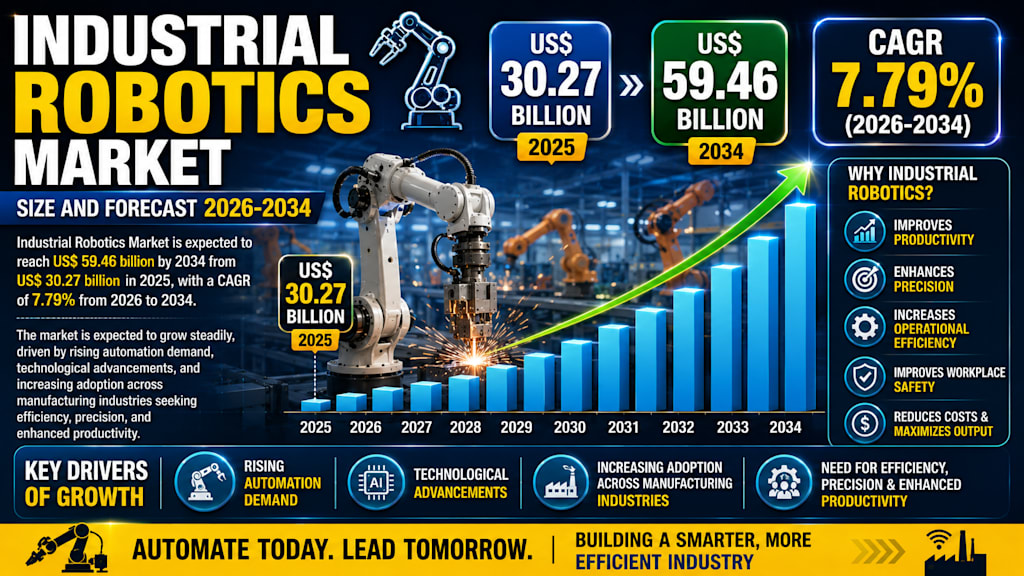
According to Renub Research, the global Industrial Robotics Market is expected to grow from US$ 30.27 billion in 2025 to US$ 59.46 billion by 2034, registering a compound annual growth rate (CAGR) of 7.79% during 2026–2034. This growth reflects the increasing demand for automation, productivity improvements, and smarter manufacturing systems worldwide.
As industries continue their transition toward digital transformation and smart manufacturing, industrial robotics is emerging as one of the defining technologies of the next decade.
Why Industrial Robotics Has Become Essential
Industrial robots are programmable machines designed to perform manufacturing and production tasks with speed, accuracy, and consistency.
Today, robots are commonly used for:
- Assembly operations
- Welding
- Painting
- Material handling
- Inspection and quality control
- Packaging
- Machine tending
- Sorting and logistics
These systems help manufacturers increase production efficiency while reducing human exposure to repetitive, physically demanding, or hazardous tasks. As global competition intensifies, businesses are increasingly relying on automation to maintain profitability and meet rising customer expectations.
The role of robotics has evolved significantly over the years. Rather than replacing human workers entirely, modern robots often complement human capabilities, creating safer and more productive working environments.
This shift is transforming manufacturing operations across nearly every major industry.
Industry 4.0 Is Driving a New Wave of Automation
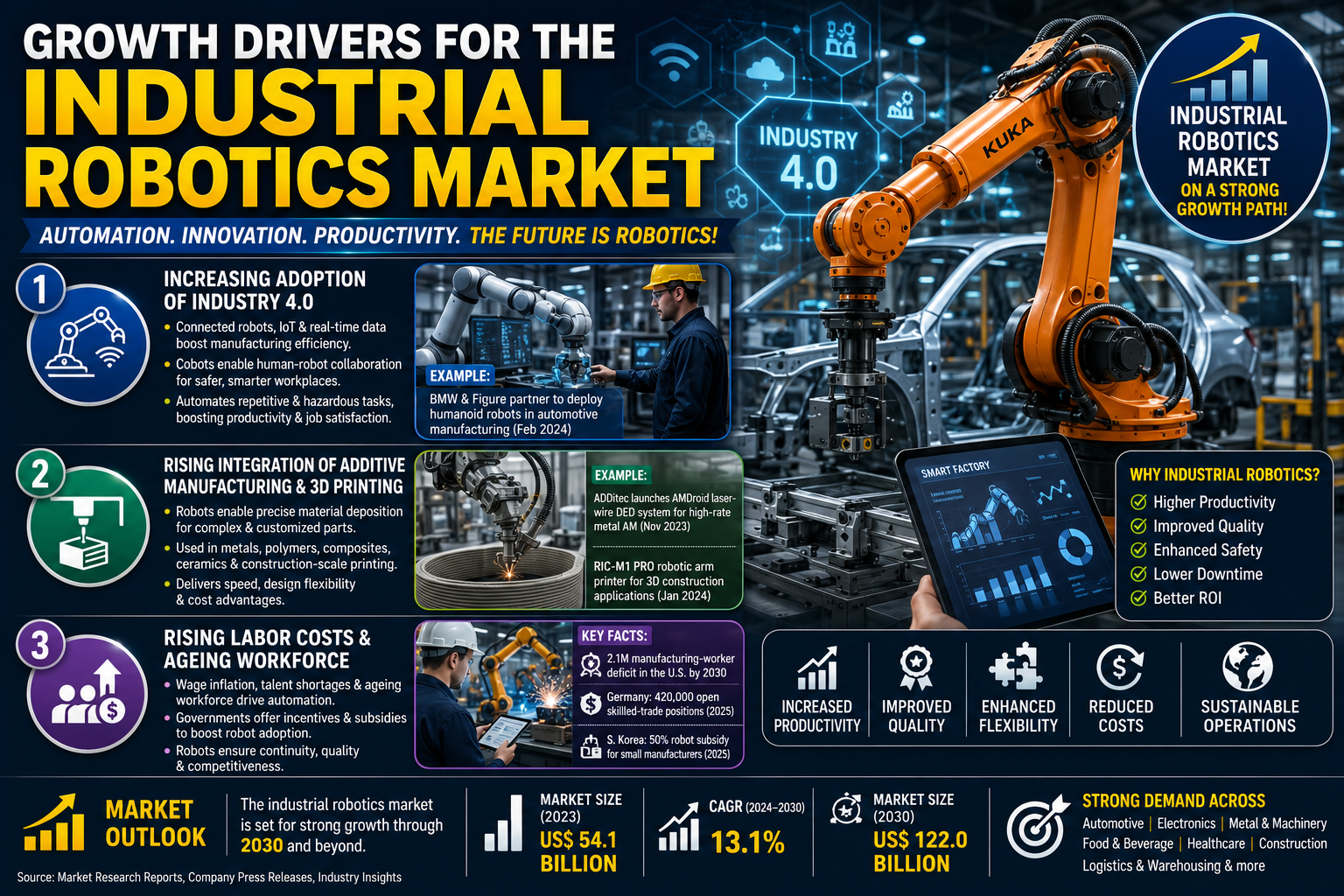
One of the most significant growth drivers for the industrial robotics market is the rise of Industry 4.0.
Industry 4.0 refers to the integration of advanced technologies such as artificial intelligence, the Internet of Things (IoT), cloud computing, data analytics, and automation into manufacturing operations.
Industrial robots play a central role in this transformation.
Unlike traditional machines, modern robotic systems can communicate with sensors, production equipment, software platforms, and enterprise systems in real time. This connectivity allows manufacturers to monitor operations, optimize performance, and respond quickly to changing production requirements.
Industry 4.0 also promotes greater flexibility within manufacturing environments. Production lines can adapt more easily to new products, customized orders, and fluctuating demand levels.
As a result, robotics is no longer simply a productivity tool—it has become a strategic component of digital manufacturing ecosystems.
The Rise of Collaborative Robots
One of the most exciting developments in industrial automation is the growth of collaborative robots, commonly known as cobots.
Unlike traditional industrial robots that operate inside isolated safety cages, cobots are designed to work safely alongside human employees. Advanced sensors, safety systems, and intelligent software enable these machines to detect human presence and adjust their behavior accordingly.
This capability opens new possibilities for manufacturing operations.
Human workers can focus on problem-solving, quality improvement, and complex decision-making while robots handle repetitive or physically demanding tasks.
A notable example emerged when BMW Manufacturing partnered with robotics company Figure to deploy autonomous humanoid robots within automotive production facilities. These robots are intended to automate challenging and repetitive activities while enhancing productivity and workplace safety.
The growing popularity of cobots is expanding robotics adoption beyond large-scale manufacturers and into smaller businesses seeking flexible automation solutions.
Artificial Intelligence Is Making Robots Smarter
Technological advancements are dramatically increasing the capabilities of industrial robots.
Artificial intelligence, machine learning, computer vision, and advanced sensor technologies now allow robots to perform tasks that previously required human judgment and adaptability.
Modern robotic systems can:
- Recognize objects
- Inspect product quality
- Adapt to changing environments
- Learn from operational data
- Predict maintenance requirements
- Optimize workflow performance
These capabilities help manufacturers improve accuracy, reduce waste, and minimize downtime.
As AI technologies continue to evolve, robots are becoming increasingly intelligent and autonomous, allowing them to tackle more complex manufacturing challenges.
Additive Manufacturing Is Creating New Opportunities
Another major growth driver for industrial robotics is the increasing integration of additive manufacturing and 3D printing technologies.
Industrial robots equipped with specialized extrusion and deposition systems can produce highly complex components layer by layer using materials such as metals, composites, ceramics, and thermoplastics.
This approach offers several advantages:
- Reduced material waste
- Greater design flexibility
- Faster prototyping
- Customized production
- Lower manufacturing costs
In 2023, advanced manufacturing company ADDitec introduced a deployable robotic system designed for laser-wire directed energy deposition, highlighting the growing role of robotics in next-generation manufacturing processes.
Robotic 3D printing is also gaining attention in construction, where automated systems are being used to create building components and even entire structures with greater speed and efficiency.
Labor Challenges Are Accelerating Automation
Global labor market trends are creating additional incentives for robotics adoption.
Manufacturers across many countries are facing persistent labor shortages, rising wages, and difficulties recruiting skilled workers.
Between 2020 and 2025, manufacturing wage inflation in OECD economies exceeded consumer-price growth by approximately 1.8 percentage points annually. These rising labor costs are encouraging businesses to invest in automation technologies that can improve productivity while controlling expenses.
Several countries illustrate this challenge:
- Japan's working-age population continues to decline.
- Germany reported hundreds of thousands of unfilled skilled-trade positions.
- The United States faces projections of significant manufacturing workforce shortages by 2030.
- South Korea has expanded support programs encouraging automation adoption among smaller manufacturers.
Industrial robots offer a practical solution by helping companies maintain production capacity despite workforce constraints.
Recent Investments Highlight Market Confidence
Major robotics companies continue making substantial investments that demonstrate confidence in long-term market growth.
Recent developments include:
- ABB beginning construction of a USD 40 million robot-controller facility in Sweden.
- ABB committing USD 180 million to expand collaborative robotics production capacity in Shanghai.
- FANUC partnering with Siemens to integrate collaborative robots into advanced predictive maintenance platforms.
- Yaskawa acquiring a majority stake in a German robotics integrator to strengthen its European service network.
- These investments reflect increasing demand for robotic solutions across multiple industries and geographic regions.
Manufacturers are clearly positioning themselves to capture future growth opportunities as automation adoption accelerates.
China Continues to Lead Global Robot Adoption
China remains the world's largest industrial robotics market by a considerable margin.
In 2024, approximately 295,000 industrial robots were installed in China, representing roughly 54% of global deployments. The country also surpassed an operational stock of two million industrial robots, the largest installed base worldwide.
Several factors contribute to China's leadership:
- Massive manufacturing sector
- Strong government support
- Growing domestic robotics industry
- Rising labor costs
- Continued industrial modernization
Analysts expect China's robotics demand to continue expanding steadily through the remainder of the decade.
Other Key Markets Are Expanding
Japan
Japan remains the second-largest industrial robotics market globally. With approximately 44,500 robot installations in 2024 and a large operational robot base, the country continues to play a critical role in robotics development and adoption.
United States
The United States accounted for roughly 68% of robot installations throughout the Americas in 2024, totaling approximately 34,200 units. Demand remains strong across automotive, electronics, logistics, and advanced manufacturing sectors.
Republic of Korea
South Korea continues to rank among the world's leading robotics markets, with over 30,000 annual installations and significant adoption across electronics and automotive manufacturing industries.
India
India is emerging as one of the fastest-growing robotics markets globally. The country recorded approximately 9,100 robot installations in 2024, representing a new record. Growth is being driven by manufacturing expansion, automotive investments, and increasing Industry 4.0 adoption.
Challenges Still Facing the Industry
Despite strong growth prospects, industrial robotics adoption is not without obstacles.
High Initial Investment Costs
Purchasing, installing, integrating, and maintaining robotic systems often requires substantial upfront investment.
For small and medium-sized businesses, these costs can present significant barriers, even when long-term productivity benefits are clear.
Financing options, leasing models, and lower-cost robotic solutions may help address this challenge in the future.
Skills Gap and Integration Complexity
Successful robotics implementation requires specialized expertise.
Many organizations struggle with:
- System integration
- Robot programming
- Maintenance requirements
- Workforce training
- Compatibility with legacy systems
The shortage of qualified robotics professionals remains a concern across many industries. Companies must invest in employee training and technical education to maximize the value of automation investments.
The Future of Industrial Robotics
The next generation of industrial robotics will be smarter, more connected, and more adaptable than ever before.
Future innovations are expected to focus on:
- Artificial intelligence integration
- Advanced machine vision
- Autonomous decision-making
- Predictive maintenance
- Human-robot collaboration
- Cloud-connected manufacturing systems
As smart factories become increasingly common, robotics will serve as the foundation of highly automated production environments capable of operating with unprecedented efficiency and flexibility.
The convergence of AI, IoT, cloud computing, and robotics is likely to redefine manufacturing across virtually every industry.
Final Thoughts
Industrial robotics has evolved from a specialized automation technology into a critical driver of global manufacturing competitiveness.
Faced with rising labor costs, increasing quality expectations, and growing pressure to improve efficiency, manufacturers are embracing robotic solutions at an unprecedented pace. Advances in artificial intelligence, collaborative robotics, and Industry 4.0 technologies are further expanding the possibilities for automation.
With the global Industrial Robotics Market projected to grow from US$ 30.27 billion in 2025 to US$ 59.46 billion by 2034, the industry is positioned for substantial long-term expansion.
For manufacturers, technology providers, and investors, industrial robotics represents more than an automation trend—it represents the future of intelligent production. As factories become smarter and more connected, robots will continue playing an increasingly central role in shaping the next generation of manufacturing.
About the Creator
Enjoyed the story? Support the Creator.
Subscribe for free to receive all their stories in your feed.
Comments
There are no comments for this story
Be the first to respond and start the conversation.