
Industrial Coatings Market Set to Reach US$130.53 Billion by 2033 as Smart and Sustainable Coating Technologies Transform Global Industries
From Corrosion Protection to Smart Surfaces, Industrial Coatings Are Becoming Essential for the Future of Manufacturing, Infrastructure, and Clean Energy

Industrial coatings rarely make headlines, yet they play a crucial role in nearly every modern industry. From protecting bridges against corrosion and extending the lifespan of aircraft components to enhancing the durability of vehicles and industrial machinery, these specialized coatings are quietly supporting the world's infrastructure and manufacturing ecosystem.
As industries increasingly seek longer-lasting, environmentally friendly, and technologically advanced solutions, the industrial coatings market is undergoing a major transformation. Innovations such as self-healing coatings, antimicrobial surfaces, nanotechnology-enabled formulations, and smart coatings integrated with digital monitoring capabilities are redefining how industries approach surface protection and performance.
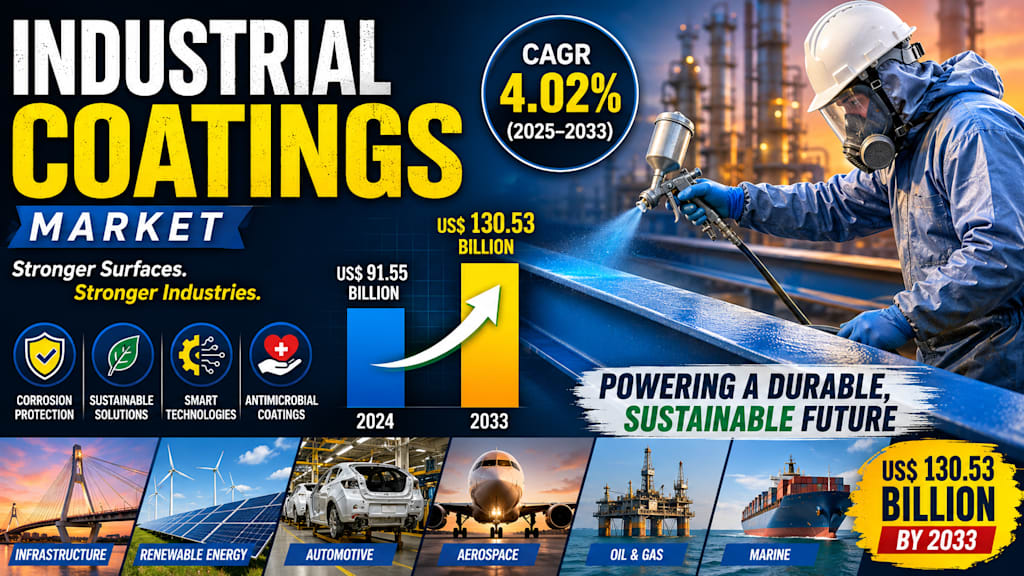
According to Renub Research, the Global Industrial Coatings Market is projected to grow from US$ 91.55 Billion in 2024 to US$ 130.53 Billion by 2033, expanding at a CAGR of 4.02% during the forecast period from 2025 to 2033. This growth reflects the rising demand for advanced coating technologies across manufacturing, construction, automotive, aerospace, electronics, marine, and renewable energy sectors.
Why Industrial Coatings Matter More Than Ever
Industrial coatings serve multiple purposes beyond aesthetics. Their primary function is to protect surfaces against harsh environmental conditions, corrosion, chemicals, moisture, abrasion, and temperature fluctuations.
Without protective coatings, industrial assets would deteriorate much faster, resulting in higher maintenance costs, reduced operational efficiency, and shorter equipment lifespans.
Modern industrial coatings are commonly used on:
Manufacturing equipment
Automotive components
Marine vessels
Oil and gas infrastructure
Aerospace structures
Electronic devices
Wind turbines
Solar energy systems
Bridges and public infrastructure
As global infrastructure spending continues to increase and industrial production expands across emerging economies, the demand for reliable and durable coating solutions is rising rapidly.
Infrastructure Expansion Creating Massive Opportunities
Urbanization remains one of the strongest drivers behind industrial coating demand worldwide.
Governments and private investors are pouring billions into transportation systems, smart cities, industrial parks, airports, railways, ports, and energy infrastructure. Every new bridge, highway, airport terminal, and industrial facility requires extensive coating applications to ensure long-term durability.
In developing economies such as India, China, Indonesia, and Vietnam, rapid industrialization is generating substantial demand for corrosion-resistant coatings capable of withstanding challenging environmental conditions.
At the same time, aging infrastructure in developed nations is creating opportunities for maintenance and refurbishment coatings that help extend the lifespan of existing assets.
Smart Coatings Are Revolutionizing Surface Protection
One of the most exciting developments in the industry is the rise of smart coatings.
Unlike traditional coatings that simply protect surfaces, smart coatings can respond dynamically to environmental changes such as temperature, humidity, pressure, or physical damage.
These advanced coatings can:
Detect structural damage
Monitor corrosion levels
Enable predictive maintenance
Respond to environmental changes
Provide real-time performance feedback
The increasing adoption of Industry 4.0 technologies and Internet of Things (IoT) systems has accelerated interest in smart coatings across industrial sectors.
In aerospace applications, smart coatings help identify structural stress and material fatigue before catastrophic failures occur. In manufacturing facilities, they support predictive maintenance programs that reduce downtime and improve operational efficiency.
As industries continue their digital transformation journeys, smart coatings are expected to become an integral part of connected industrial ecosystems.
Self-Healing Coatings Gain Momentum
Imagine a coating that repairs minor scratches and surface damage automatically without requiring maintenance intervention.
This concept is becoming a reality through self-healing coating technologies.
Self-healing coatings contain specialized materials capable of restoring damaged areas when exposed to external triggers such as heat, light, or moisture.
The automotive industry has become one of the leading adopters of this technology. Vehicle manufacturers increasingly seek coatings that maintain appearance while reducing maintenance costs for consumers.
Beyond automotive applications, self-healing coatings are finding uses in aerospace, electronics, marine, and industrial equipment sectors where durability and reliability are critical.
As research advances and production costs decline, self-healing technologies could become a standard feature in next-generation industrial coatings.
Nanotechnology Unlocking New Performance Levels
Nanotechnology is another powerful force reshaping the industrial coatings landscape.
Nanocoatings manipulate materials at the molecular and nanoscale level, enabling manufacturers to achieve remarkable improvements in coating performance.
Benefits of nanocoatings include:
Enhanced corrosion resistance
Superior scratch protection
Improved hardness
Better chemical resistance
Reduced coating thickness
Lightweight protection solutions
Industries such as aerospace and electronics particularly benefit from nanocoatings because they require high-performance protection without adding excessive weight.
Healthcare and food processing facilities are also increasingly adopting nanotechnology-based coatings due to their antimicrobial and contamination-resistant properties.
The ability to deliver superior performance while minimizing material usage makes nanotechnology a valuable innovation for future coating development.
Sustainability Driving Industry Transformation
Environmental sustainability has become one of the most influential trends affecting industrial coatings worldwide.
Historically, many industrial coatings contained high levels of volatile organic compounds (VOCs), which contribute to air pollution and environmental concerns.
Today, governments and regulatory agencies across North America, Europe, and Asia are implementing stricter environmental standards.
As a result, manufacturers are accelerating development of:
Low-VOC coatings
Waterborne coatings
Powder coatings
Bio-based coating technologies
Sustainable raw material solutions
Customers increasingly prefer environmentally responsible products, creating strong incentives for coating manufacturers to adopt greener technologies.
The transition toward sustainability is no longer simply a compliance requirement—it has become a major competitive differentiator within the market.
Healthcare Sector Boosting Demand for Antimicrobial Coatings
The healthcare industry has emerged as an important growth segment for industrial coatings.
Hospitals, clinics, laboratories, and medical device manufacturers increasingly rely on antimicrobial coatings to reduce microbial growth on frequently touched surfaces.
The heightened focus on infection prevention and hygiene management following global health crises has accelerated adoption of antimicrobial technologies.
These coatings help maintain cleaner environments while supporting infection-control strategies in healthcare settings.
As healthcare infrastructure expands worldwide, demand for specialized antimicrobial coating solutions is expected to continue growing steadily.
Renewable Energy Sector Creating New Growth Avenues
The global transition toward renewable energy is opening significant opportunities for industrial coating manufacturers.
Wind turbines, solar farms, energy storage systems, and supporting infrastructure all require advanced protective coatings capable of withstanding harsh environmental conditions.
For wind energy installations, coatings help prevent corrosion, reduce maintenance requirements, and extend operational lifespan.
Similarly, solar panels depend on protective coatings to improve durability and maintain performance over extended periods.
As countries continue investing in clean energy projects, industrial coatings will play a critical role in supporting the reliability and efficiency of renewable energy infrastructure.
Key Challenges Facing the Market
Despite strong growth prospects, the industry faces several challenges.
Raw Material Price Volatility
One of the biggest concerns for manufacturers is fluctuating raw material costs.
Industrial coatings rely heavily on:
Resins
Pigments
Solvents
Additives
Specialty chemicals
Supply chain disruptions, geopolitical tensions, trade policies, and changing demand patterns frequently impact raw material pricing.
These fluctuations can reduce profit margins and create uncertainty for coating producers attempting to maintain competitive pricing.
Rising Innovation Costs
Developing advanced coating technologies requires substantial investment in research and development.
Smart coatings, nanotechnology-enabled formulations, and self-healing solutions involve sophisticated manufacturing processes and specialized expertise.
While large multinational corporations can absorb these costs more easily, smaller manufacturers often struggle to keep pace with innovation demands.
This may contribute to increased consolidation within the industry over the coming years.
Regional Market Outlook
Asia-Pacific Leads Global Growth
Asia-Pacific remains the largest and fastest-growing industrial coatings market.
China and India continue to dominate regional demand due to expanding manufacturing industries, urban development projects, automotive production, and infrastructure investments.
Growing industrial activity across Southeast Asia further strengthens the region's market position.
North America Maintains Strong Demand
The United States remains a major consumer of industrial coatings.
Demand is supported by aerospace manufacturing, automotive production, infrastructure maintenance, and technological innovation.
The region also leads in the development of sustainable and high-performance coating technologies.
Europe Focuses on Sustainability
European markets continue emphasizing environmentally friendly coating solutions.
Stringent environmental regulations are accelerating adoption of low-VOC, waterborne, and powder coating systems throughout the region.
Middle East and Emerging Markets
Large-scale industrial projects and infrastructure investments are fueling demand across the Middle East.
Countries pursuing economic diversification initiatives are increasingly investing in manufacturing facilities, industrial cities, and renewable energy projects that require advanced protective coatings.
Competitive Landscape
The industrial coatings market remains highly competitive, featuring a combination of global leaders and regional specialists.
Major industry participants include:
BASF SE
Akzo Nobel N.V.
Nippon Paint Holdings Co., Ltd.
PPG Industries Inc.
The Sherwin-Williams Company
Kansai Paint Co. Ltd.
Jotun
Axalta Coating Systems Ltd.
Wacker Chemie AG
Chugoku Marine Paints Ltd.
These companies continue investing heavily in sustainable technologies, smart coating innovations, and strategic acquisitions to strengthen their market positions.
10 Recent Developments Shaping the Industry
1. BASF Expands Renewable Energy Usage
BASF announced that all energy used for automotive OEM coating production would come from renewable sources, supporting its carbon reduction goals.
2. Kansai Paint Acquires Railway Coatings Assets
Kansai Paint strengthened its global presence through the acquisition of Beckers Group's railway coatings business assets.
3. AkzoNobel Launches Interpon D Stone Effect
AkzoNobel introduced a powder coating solution capable of delivering natural stone-like finishes on metal surfaces.
4. Increased Investment in Smart Coatings
Major manufacturers are accelerating development of sensor-enabled coating systems.
5. Growth in Self-Healing Technologies
Automotive-focused coating innovations continue expanding across multiple industries.
6. Expansion of Waterborne Coating Capacity
Companies are investing heavily in environmentally friendly waterborne production facilities.
7. Rising Demand for Antimicrobial Solutions
Healthcare infrastructure projects are increasing adoption of specialized antimicrobial coatings.
8. Nanocoating Research Accelerates
Manufacturers continue exploring advanced nanoscale materials for improved performance.
9. Renewable Energy Applications Expand
Coating suppliers are developing solutions tailored for wind and solar infrastructure.
10. Sustainability Becomes Core Strategy
Leading companies increasingly align product development with global environmental objectives.
Final Thoughts
Industrial coatings may not receive the same public attention as electric vehicles, artificial intelligence, or renewable energy technologies, but they remain fundamental to modern industrial progress. Every bridge, aircraft, automobile, wind turbine, factory, and industrial asset depends on advanced coatings to maintain performance, safety, and durability.
As industries pursue sustainability, digitalization, and greater operational efficiency, coating technologies are evolving from simple protective layers into intelligent performance-enhancing systems.
With the market expected to grow from US$91.55 billion in 2024 to US$130.53 billion by 2033, the future of industrial coatings appears remarkably promising. Companies that successfully combine sustainability, innovation, and advanced material science will be best positioned to lead the next generation of industrial protection solutions.
About the Creator
Enjoyed the story? Support the Creator.
Subscribe for free to receive all their stories in your feed.
Comments
There are no comments for this story
Be the first to respond and start the conversation.