
Industrial Automation and Control Systems Market to Reach $466 Billion by 2034 as Smart Manufacturing Accelerates Worldwide
AI, Robotics, Industrial IoT, and Real-Time Analytics Are Reshaping the Future of Global Production

The Industrial Sector Is Entering a New Era
The industrial sector is experiencing a transformation unlike anything seen in previous decades. Across manufacturing plants, energy facilities, chemical processing centers, and logistics hubs, businesses are embracing intelligent technologies that can improve efficiency, reduce operational costs, and deliver higher levels of productivity. What was once considered a long-term vision of automated factories has rapidly become a reality as companies invest heavily in digital transformation initiatives.
At the center of this evolution are Industrial Automation and Control Systems (IACS), a combination of hardware and software technologies that automate, monitor, and optimize industrial processes. These systems are becoming increasingly important as industries seek to remain competitive in an environment where speed, precision, and flexibility are more valuable than ever.
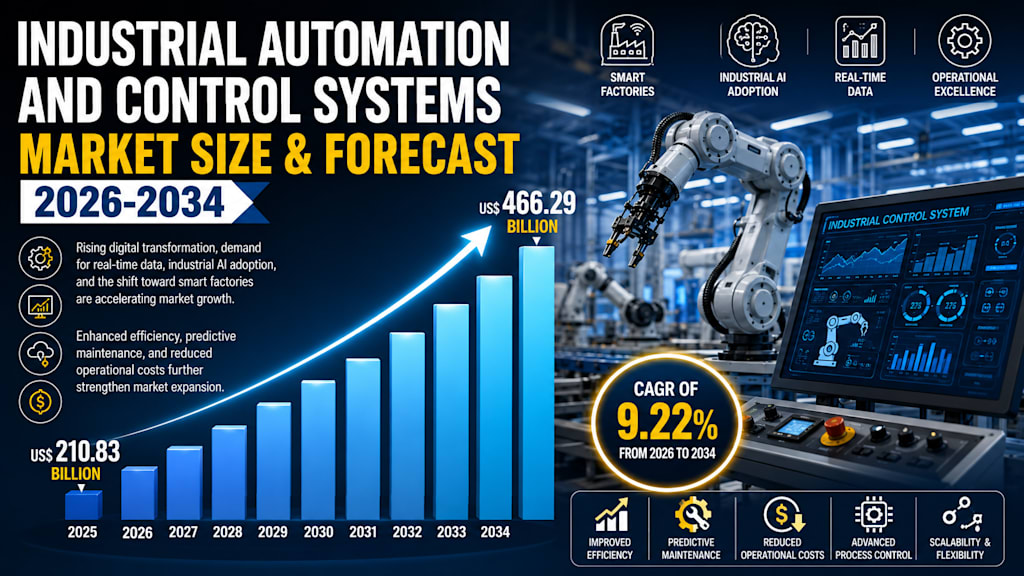
According to Renub Research, the global Industrial Automation and Control Systems Market is projected to expand from US$ 210.83 billion in 2025 to US$ 466.29 billion by 2034, growing at a compound annual growth rate (CAGR) of 9.22% between 2026 and 2034. This impressive forecast demonstrates how automation technologies are moving from optional upgrades to essential business investments across industries worldwide.
What Are Industrial Automation and Control Systems?
Industrial Automation and Control Systems are designed to reduce human intervention while improving operational performance. These systems typically include Programmable Logic Controllers (PLCs), Supervisory Control and Data Acquisition (SCADA) systems, Distributed Control Systems (DCS), Human-Machine Interfaces (HMI), industrial sensors, intelligent controllers, and industrial communication networks.
Together, these technologies allow organizations to monitor production activities in real time, collect operational data, control machinery with precision, and optimize performance across complex industrial environments. From automotive assembly plants and pharmaceutical manufacturing facilities to oil refineries and power generation stations, industrial automation systems are helping organizations achieve greater efficiency and reliability.
Why Businesses Are Investing in Automation
The increasing adoption of automation is being driven by several important factors. One of the most significant is the growing pressure on organizations to improve productivity while controlling costs. Manufacturers face rising labor expenses, global competition, supply chain disruptions, and increasing customer expectations.
In response, many companies are turning to automation solutions that can help streamline operations, eliminate repetitive tasks, and improve consistency in production processes. Another major factor influencing adoption is the growing importance of real-time data. Modern industrial environments generate enormous amounts of information every second. Without advanced automation systems, much of this data remains underutilized.
Automation platforms enable businesses to collect, analyze, and act on information instantly, helping decision-makers identify inefficiencies, predict equipment failures, and optimize production performance.
Smart Factories Are Driving Market Growth
The rise of smart factories has become one of the strongest growth drivers for the market. Unlike traditional manufacturing facilities, smart factories rely on interconnected systems that continuously exchange information and make autonomous adjustments based on changing conditions.
Machines, sensors, software applications, and operational technologies work together to create highly responsive production environments capable of adapting to fluctuations in demand, equipment performance, and resource availability.
Smart factories are a core component of Industry 4.0, the ongoing industrial revolution that combines automation, digital technologies, and advanced analytics. Through the integration of connected devices, cloud computing, artificial intelligence, and Industrial Internet of Things (IIoT) technologies, manufacturers can achieve unprecedented levels of visibility and control over their operations.
Artificial Intelligence Is Transforming Industrial Operations
Artificial intelligence has emerged as one of the most influential technologies shaping the future of industrial automation. Traditional automation systems follow predefined instructions and operate within fixed parameters. AI-powered systems can learn from historical data, identify patterns, and make intelligent decisions without direct human input.
One of the most valuable applications of artificial intelligence is predictive maintenance. Equipment failures often result in costly downtime, production delays, and unexpected repair expenses. AI algorithms analyze machine performance data to detect warning signs of potential failures before they occur.
Artificial intelligence is also transforming quality control processes. Advanced computer vision systems can inspect products at speeds and accuracy levels that are difficult to achieve through manual inspection. These technologies help manufacturers maintain consistent quality standards while minimizing waste and reducing the risk of defective products reaching customers.
The Growing Influence of Industrial IoT
The Industrial Internet of Things has further accelerated automation adoption by enabling seamless connectivity across industrial environments. IIoT devices collect information from machinery, sensors, and equipment, transmitting valuable data to centralized platforms where it can be analyzed and acted upon.
The benefits of IIoT technologies include improved operational transparency, enhanced decision-making capabilities, reduced downtime, better asset management, increased productivity, and lower operating costs. As industries continue investing in connected infrastructure, the role of IIoT within industrial automation ecosystems is expected to grow significantly.
Open Automation and Edge Computing Are Reshaping Industry
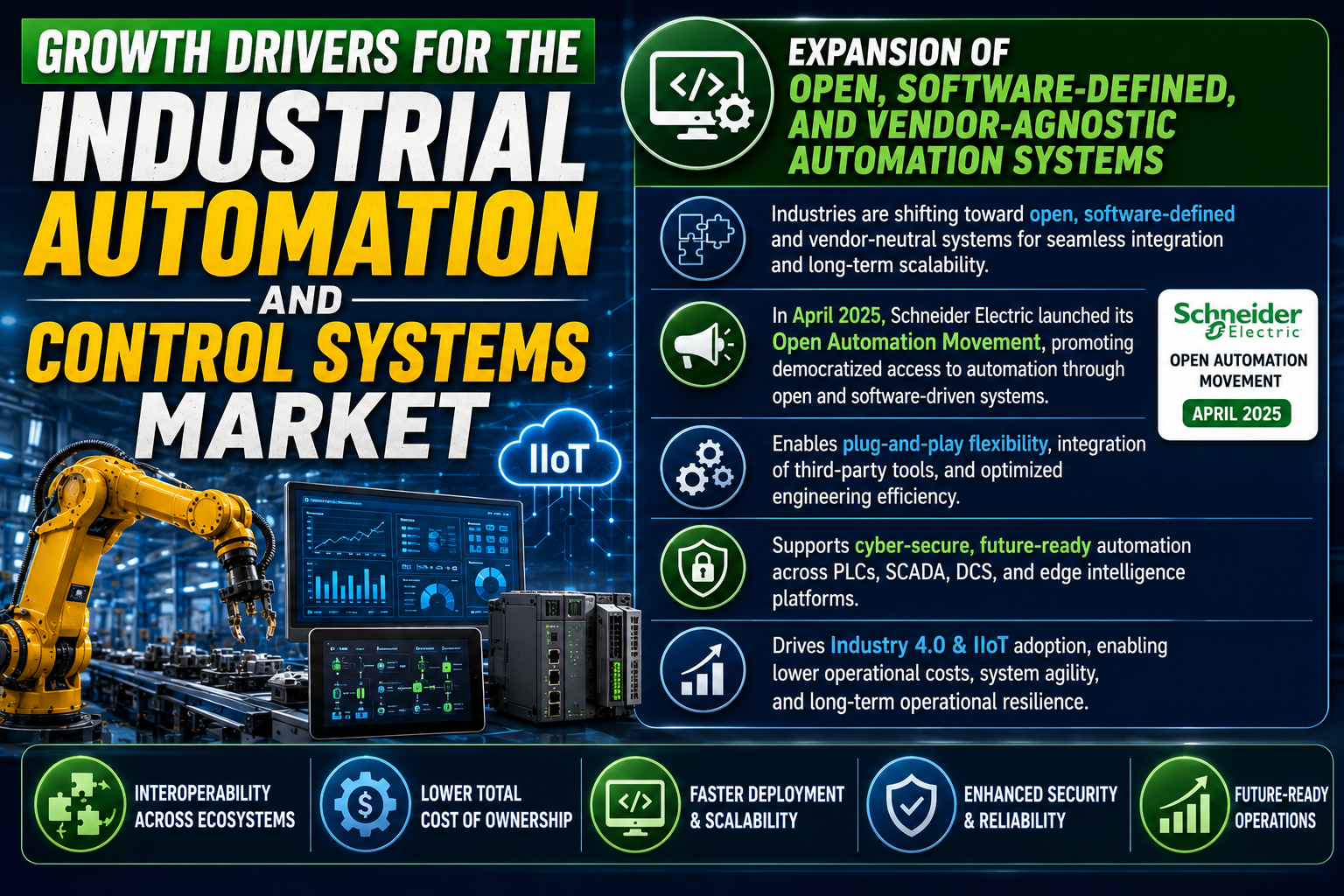
Another notable trend influencing the market is the movement toward open automation systems. Historically, many industrial environments relied on proprietary solutions that limited interoperability and created vendor dependency. Today, organizations increasingly prefer open, software-defined, and vendor-neutral architectures that offer greater flexibility and scalability.
At the same time, edge computing is playing a critical role in modern industrial automation. By processing data closer to where it is generated, organizations can achieve faster response times, lower latency, improved reliability, enhanced cybersecurity, and reduced bandwidth requirements.
These capabilities are especially valuable for robotics, autonomous vehicles, machine control systems, and real-time production monitoring applications.
Challenges Facing the Industrial Automation Market
Despite its many advantages, industrial automation adoption is not without challenges. One of the most significant barriers remains the high initial investment required for implementation. Deploying advanced automation solutions often involves substantial spending on hardware, software, networking infrastructure, engineering services, cybersecurity measures, and workforce training.
Integration with legacy infrastructure presents another challenge. Many industrial facilities continue to operate aging equipment that was not designed to communicate with modern digital systems. Connecting legacy assets with advanced automation platforms often requires specialized engineering expertise and additional investments.
Cybersecurity concerns have also become increasingly important as industrial environments become more connected. Organizations must invest in comprehensive cybersecurity strategies to protect critical infrastructure and operational technology systems.
Regional Markets Leading Global Expansion
The United States remains one of the world's most advanced industrial automation markets, driven by strong investments in artificial intelligence, robotics, smart manufacturing, and industrial IoT solutions.
Germany continues to serve as a global leader in automation and digital manufacturing. Widely recognized as the birthplace of Industry 4.0, Germany has built a reputation for engineering excellence and advanced industrial innovation.
China represents one of the fastest-growing markets for industrial automation worldwide. Rising labor costs, large-scale manufacturing operations, and government-led modernization initiatives are driving significant investments in intelligent control systems and robotics.
Meanwhile, Saudi Arabia is emerging as a major growth market in the Middle East through Vision 2030 initiatives, infrastructure projects, and industrial diversification programs.
Future Outlook: The Road to Intelligent Manufacturing
Looking ahead, the future of industrial automation appears exceptionally promising. Emerging technologies such as digital twins, autonomous robotics, 5G connectivity, generative artificial intelligence, advanced analytics, and intelligent edge computing are expected to redefine industrial operations over the next decade.
Factories will become increasingly autonomous, adaptive, and data-driven, allowing organizations to achieve levels of efficiency and performance that were previously unimaginable.
The projected growth of the Industrial Automation and Control Systems Market to US$ 466.29 billion by 2034 highlights the strategic importance of automation technologies in the modern industrial landscape. Organizations that invest in these capabilities today will be better positioned to navigate future challenges, capitalize on emerging opportunities, and maintain a competitive edge in an increasingly digital world.
Final Thoughts
Industrial Automation and Control Systems are no longer simply tools for improving efficiency—they have become the foundation of modern industrial transformation. As artificial intelligence, Industrial IoT, robotics, and smart manufacturing technologies continue to evolve, businesses across the globe are accelerating automation investments. With the market expected to reach US$ 466.29 billion by 2034, the future of manufacturing will be smarter, faster, safer, and more connected than ever before.
About the Creator
Enjoyed the story? Support the Creator.
Subscribe for free to receive all their stories in your feed.
Comments
There are no comments for this story
Be the first to respond and start the conversation.