
India’s Watch Market Is Rapidly Transforming as Smartwatches, Luxury Timepieces, and Youth Fashion Trends Drive Demand
From affordable smartwatches and premium analog collections to locally manufactured digital wearables, India’s watch industry is evolving quickly alongside rising incomes, fashion awareness, and expanding digital lifestyles.

India’s watch market is entering a dynamic new phase of growth and transformation.
Once dominated primarily by traditional analog watches used for simple timekeeping, the industry has evolved into a highly diversified market where fashion, technology, lifestyle, and status all play major roles in consumer purchasing decisions.
Today, watches in India are no longer viewed merely as functional accessories.
They are increasingly seen as:
- Fashion statements
- Lifestyle products
- Fitness companions
- Technology-driven wearables
- Symbols of social status
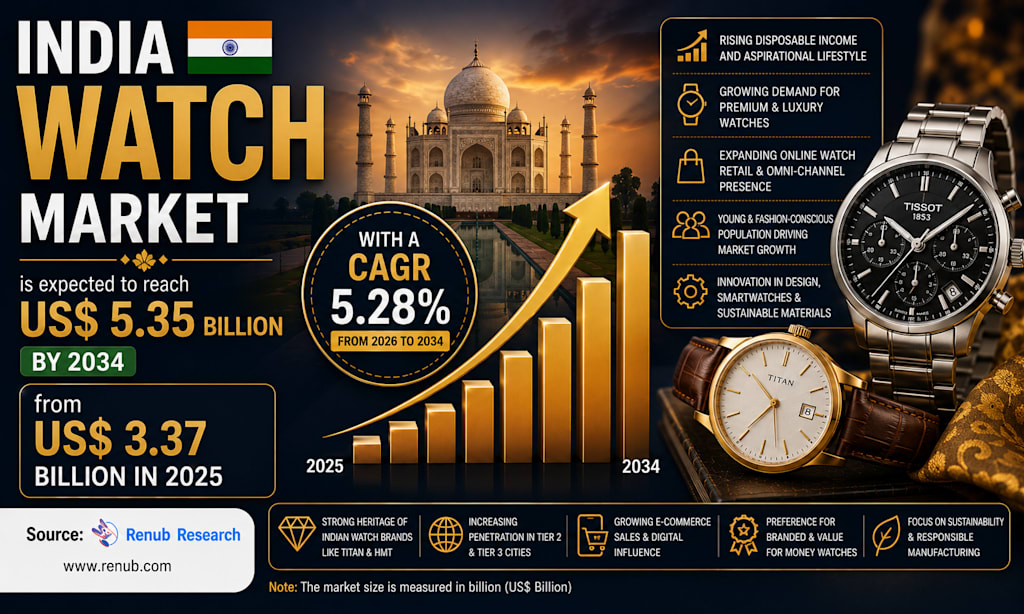
According to Renub Research, the India Watch Market is expected to grow from US$ 3.37 billion in 2025 to US$ 5.35 billion by 2034, expanding at a CAGR of 5.28% between 2026 and 2034. The market’s growth is being driven by rising demand for luxury watches and smartwatches, expanding e-commerce penetration, increasing fashion consciousness, and strong consumer interest in technologically advanced timepieces.
India’s young population, expanding middle class, rising disposable incomes, and rapidly growing digital economy are creating enormous opportunities across both premium and affordable watch segments.
At the same time, local manufacturing initiatives and aggressive competition among domestic and global brands are reshaping the industry landscape.
This transformation is positioning India as one of the world’s most exciting and fast-evolving watch markets.
Young Consumers and Fashion Trends Are Reshaping Demand
One of the biggest drivers behind India’s watch market growth is the increasing influence of younger consumers.
India’s Gen Z and millennial populations are highly fashion-conscious and strongly influenced by:
- Social media trends
- Influencer culture
- Celebrity endorsements
- Music festivals
- Digital lifestyle branding
For younger buyers, watches are no longer simply about telling time.
Instead, they represent individuality, style, and social identity.
Brands increasingly use:
- Limited-edition product launches
- Influencer collaborations
- Social media countdown campaigns
- Experiential marketing
to create excitement and emotional engagement among younger consumers.
Homegrown brands are especially active in targeting youth audiences through affordable fashion-focused collections and digital-first branding strategies.
According to Renub Research, Gen Z consumers in India strongly value authenticity, inclusivity, and community-driven narratives, which is encouraging brands to prioritize emotional storytelling and personalized engagement strategies.
Campaigns such as Timex’s “Waste More Time” initiative and Fire-Boltt’s music festival partnerships demonstrate how experiential marketing is increasingly outperforming traditional celebrity advertising among younger demographics.
This shift is creating a fast-moving and highly trend-driven watch market where viral campaigns can generate immediate spikes in consumer demand.
Smartwatch Adoption Is Expanding Rapidly
The smartwatch segment has become one of the most disruptive forces within India’s watch industry.
Consumers increasingly prefer wearable devices offering multifunctional capabilities such as:
- Fitness tracking
- Health monitoring
- Smartphone connectivity
- GPS functionality
- AI-powered insights
- Notifications and messaging
India’s rapidly growing digital ecosystem and increasing smartphone penetration are accelerating smartwatch adoption across urban and semi-urban markets.
Younger consumers, fitness enthusiasts, students, and working professionals are especially attracted to smartwatches because they combine practicality with modern technology.
Affordable pricing has also played a major role in expanding adoption.
Over the past few years, average smartwatch prices in India have declined significantly due to aggressive local manufacturing and competition among brands.
Domestic companies such as:
- Fire-Boltt
- Noise
- boAt
have strengthened their market presence through affordable yet feature-rich products targeting mass-market consumers.
Manufacturers are increasingly introducing:
- AMOLED displays
- AI-based health analytics
- Advanced fitness tracking
- Voice assistants
- GPS-enabled systems
to attract consumers seeking premium features at accessible prices.
This rapid innovation cycle continues driving strong market momentum across India’s smartwatch segment.
Rising Disposable Income Is Supporting Luxury Watch Growth
India’s expanding affluent population is significantly boosting demand for premium and luxury watches.
Consumers in metropolitan and Tier-I cities increasingly purchase luxury watches as:
- Status symbols
- Fashion accessories
- Investment pieces
- Corporate lifestyle products
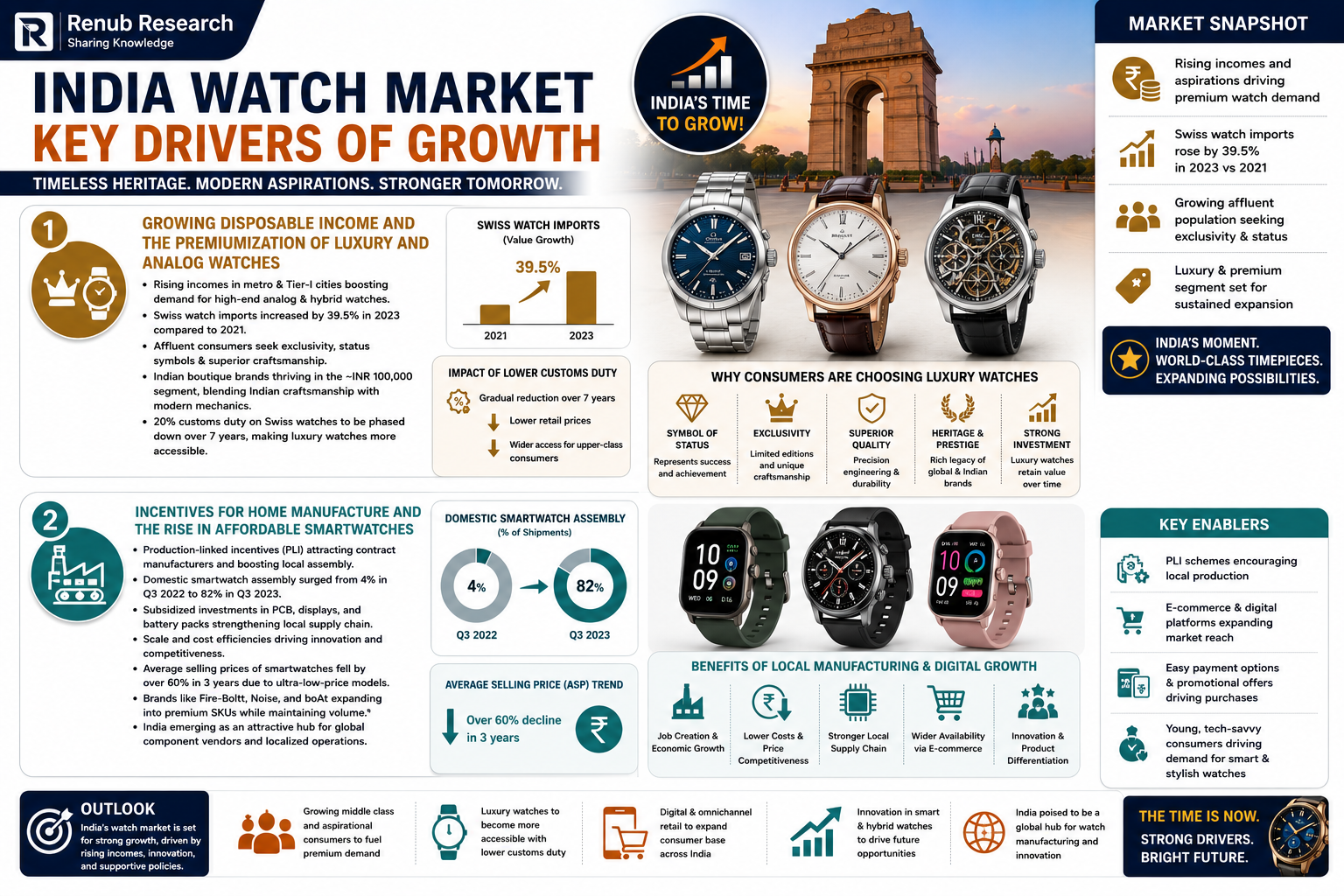
Swiss watch imports increased sharply in recent years, reflecting growing consumer interest in premium international brands.
Affluent consumers increasingly seek:
- Heritage craftsmanship
- Mechanical precision
- Exclusive collections
- Premium materials
Luxury watches are especially popular among business professionals, entrepreneurs, and high-net-worth individuals who view premium timepieces as reflections of success and personal identity.
At the same time, Indian boutique brands are emerging within the premium segment by combining:
- Traditional Indian craftsmanship
- Contemporary aesthetics
- Modern mechanical innovation
Government policies aimed at gradually reducing customs duties on imported Swiss watches may further improve accessibility to luxury timepieces in the coming years.
This premiumization trend is expected to remain one of the market’s strongest long-term growth drivers.
Local Manufacturing Is Transforming the Industry
Government incentives supporting domestic manufacturing are reshaping India’s watch industry.
Production-linked incentive programs have encouraged major expansion in local smartwatch assembly and component manufacturing.
According to Renub Research, domestic smartwatch assembly increased dramatically from just 4% of shipments in Q3 2022 to approximately 82% in Q3 2023.
Local manufacturing growth has been supported by investments in:
- Printed circuit boards
- Battery systems
- Display technologies
- Component supply chains
These developments are helping manufacturers reduce costs, improve supply chain efficiency, and strengthen India’s competitiveness within global wearable technology markets.
At the same time, domestic manufacturing enables brands to respond more quickly to changing consumer preferences and pricing pressures.
Companies increasingly focus on expanding beyond entry-level products into:
- Mid-tier smartwatches
- Premium wearable devices
- Hybrid analog-digital products
This manufacturing ecosystem is expected to continue attracting both domestic and international investment.
E-Commerce Is Expanding Market Accessibility
Digital retail has become one of the most important growth engines for India’s watch market.
Consumers increasingly rely on online platforms to:
- Compare products
- Read customer reviews
- Access discounts
- Explore new brands
- Purchase watches conveniently
E-commerce platforms provide strong accessibility across both urban and smaller regional markets.
Online channels also support:
- Influencer marketing
- Product launches
- Digital advertising
- Personalized shopping experiences
Flash sales, festive discounts, and online-exclusive launches continue driving major sales volumes throughout the year.
Direct-to-consumer strategies are becoming increasingly popular among emerging Indian watch brands seeking stronger customer engagement and improved profit margins.
At the same time, offline retail stores including:
- Malls
- Brand outlets
- Department stores
- Airport retail
continue playing critical roles, especially for premium and luxury watch purchases.
The combination of digital commerce and traditional retail is creating a highly competitive omnichannel environment across the Indian watch industry.
Maharashtra Continues Leading the Indian Market
Maharashtra represents one of India’s largest watch markets due to strong urbanization and high purchasing power.
Cities such as:
Mumbai
Pune
show particularly strong demand for:
- Luxury watches
- Smartwatches
- Branded analog collections
- The state benefits from:
- Corporate culture
- Large working populations
- High digital adoption
- Strong retail infrastructure
Consumers in Maharashtra increasingly seek both premium and technologically advanced watch products.
E-commerce penetration is also especially strong across the region, further supporting market expansion.
Karnataka Is Emerging as a Smartwatch Hub
Karnataka’s watch market is strongly influenced by Bengaluru’s technology-driven consumer base.
Tech-savvy consumers in the state show high demand for:
- Smartwatches
- Fitness-oriented wearables
- Premium digital products
The city’s startup ecosystem and affluent workforce continue supporting strong adoption of multifunctional wearable devices.
Health and fitness awareness also contribute significantly to smartwatch demand across Karnataka.
Online retail channels play a major role in product accessibility and consumer engagement throughout the state.
Tamil Nadu Maintains Strong Demand for Functional Watches
Tamil Nadu’s watch market benefits from a combination of:
- Urban development
- Industrial growth
- Expanding middle-class populations
Cities such as Chennai show steady demand for both traditional watches and smart wearables.
Consumers often prioritize:
- Durability
- Practicality
- Functional design
while younger demographics increasingly embrace technologically advanced wearable products.
Watches also remain highly popular as gifts during festivals and family celebrations, supporting year-round demand across multiple price categories.
Gujarat’s Market Balances Tradition and Modernity
Gujarat’s watch market is supported by strong business activity and rising disposable incomes.
Consumers in cities such as:
- Ahmedabad
- Surat
often view watches as symbols of success and professional identity.
While traditional analog watches continue maintaining strong appeal, younger consumers increasingly shift toward smartwatches and multifunctional wearable devices.
Festivals, weddings, and business gifting traditions further contribute to strong watch demand throughout the state.
Intense Competition Is Creating Industry Challenges
India’s watch market remains highly competitive due to the presence of:
- Global luxury brands
- Domestic smartwatch companies
- Fashion labels
- Traditional analog manufacturers
This intense competition creates strong pricing pressure and forces companies to continuously innovate.
Brands must invest heavily in:
- Product development
- Marketing campaigns
- Influencer partnerships
- Retail expansion
- Technology integration
Smaller companies often struggle to maintain visibility and profitability in such a crowded marketplace.
Rapid product cycles within the smartwatch category also create inventory management and operational challenges.
Maintaining long-term customer loyalty has become increasingly difficult as consumer preferences evolve rapidly.
Traditional Watches Face Pressure From Smart Devices
Another major challenge is the shifting preference toward multifunctional smart devices.
Younger consumers increasingly prioritize:
- Health tracking
- Connectivity
- Digital functionality
- Smart integration
over traditional timekeeping products.
This trend is reducing demand for basic analog and digital watches in certain segments.
Traditional watch manufacturers must therefore adapt by:
- Introducing hybrid products
- Integrating smart features
- Strengthening fashion positioning
- Focusing on luxury craftsmanship
However, developing advanced wearable technology requires substantial investment in research and development.
Brands unable to adapt to changing consumer expectations may struggle to remain competitive over the long term.
Recent Industry Developments Highlight Market Innovation
India’s watch industry continues witnessing rapid innovation and product expansion.
Some notable recent developments include:
In August 2025, Casio India launched a new range of locally manufactured watches to strengthen regional distribution and support local production initiatives.
In July 2025, CMF introduced the Watch 3 Pro featuring a 1.43-inch AMOLED display, dual-band GPS, AI-powered workout insights, and integrated ChatGPT support.
Samsung launched the Galaxy Watch 8 with enhanced Galaxy AI capabilities and improved durability features.
Apple introduced the Apple Watch Series 10 and updated Apple Watch SE with advanced health analytics, faster charging, and sleep apnea detection features.
These launches demonstrate how rapidly the Indian watch market is evolving toward AI-enabled and health-focused wearable technology.
Key Market Segments
By Type
- Quartz Watches
- Electronic Watches
- Mechanical Watches
By Gender
- Men
- Women
- Unisex
By Price Range
- Luxury
- Non-Luxury
By Distribution Channel
- Hypermarket/Supermarket
- Convenience Stores
- Online
Top States
- Maharashtra
- Tamil Nadu
- Karnataka
- Gujarat
- Uttar Pradesh
- West Bengal
- Rajasthan
- Telangana
- Andhra Pradesh
- Madhya Pradesh
Major Companies Operating in the Market
Leading companies in the India watch market include:
- Seiko Holdings Corporation
- Casio Computer Co. Ltd
- Timex Group
- Rolex SA
- Compagnie Financière Richemont S.A
- The Swatch Group Ltd
- Citizen Watch Co. Ltd.
- Fossil Group Inc.
- Google LLC (Fitbit Inc.)
These companies continue investing heavily in digital innovation, premium branding, smartwatch technology, and omnichannel retail expansion.
Final Thoughts
India’s watch market is evolving rapidly as fashion culture, wearable technology, luxury consumption, and digital commerce reshape consumer expectations.
Consumers increasingly seek watches that combine:
- Style
- Functionality
- Connectivity
- Status
- Personal identity
According to Renub Research, the India watch market is projected to grow from US$ 3.37 billion in 2025 to US$ 5.35 billion by 2034, reflecting strong long-term growth potential driven by rising disposable incomes, smartwatch adoption, and expanding digital lifestyles.
About the Creator
Enjoyed the story? Support the Creator.
Subscribe for free to receive all their stories in your feed.
Comments
There are no comments for this story
Be the first to respond and start the conversation.