
India’s Video Surveillance Market Set to Cross $10 Billion as Smart Security Becomes a National Priority
Rising safety concerns, smart city initiatives, and AI-powered surveillance technologies are transforming India’s security landscape

Security in the Digital Age
India is experiencing a profound transformation in the way security is managed across cities, businesses, industries, and residential communities. As urban populations expand and digital technologies become increasingly integrated into everyday life, the demand for smarter and more efficient security solutions is growing at an unprecedented pace.
Video surveillance, once limited to basic CCTV monitoring, has evolved into a sophisticated ecosystem powered by artificial intelligence, cloud computing, analytics, and real-time monitoring capabilities. Today’s surveillance systems do far more than record footage. They help prevent crime, improve public safety, manage traffic, support law enforcement investigations, and provide valuable operational insights for organizations.
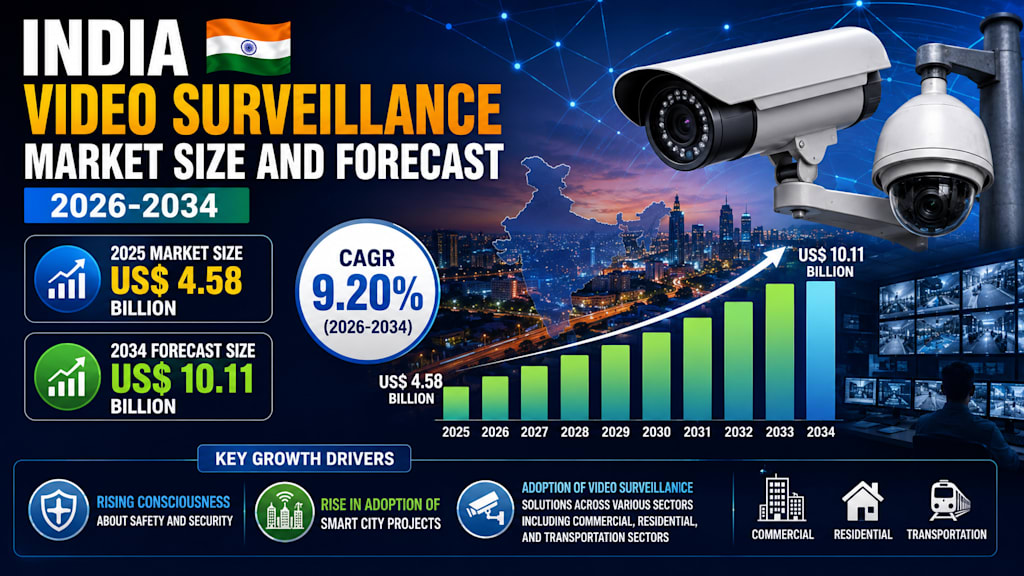
This evolution is creating significant opportunities within India’s security technology sector. According to Renub Research, the India Video Surveillance Market is expected to grow from US$ 4.58 Billion in 2025 to US$ 10.11 Billion by 2034, expanding at a compound annual growth rate (CAGR) of 9.20% between 2026 and 2034. The impressive growth trajectory reflects increasing security awareness, expanding smart city initiatives, and widespread adoption of surveillance technologies across commercial, residential, industrial, and public sectors.
As India continues its journey toward becoming a digitally connected nation, video surveillance is emerging as a critical pillar of modern infrastructure and public safety.
Understanding the Modern Video Surveillance Ecosystem
Video surveillance refers to the use of cameras, recording devices, monitoring platforms, and analytical software to observe, record, and analyze activities in both public and private environments. While traditional surveillance systems primarily focused on capturing footage, modern solutions have evolved into intelligent platforms capable of detecting unusual behavior, recognizing faces, tracking vehicles, and generating real-time alerts.
Contemporary surveillance systems typically incorporate CCTV cameras, IP cameras, network video recorders, cloud storage solutions, and AI-powered analytics platforms. Advanced features such as facial recognition, motion detection, license plate recognition, crowd monitoring, and automated alerts have transformed surveillance from a passive monitoring tool into a proactive security solution.
These technologies are increasingly being deployed across airports, railway stations, highways, government buildings, shopping centers, manufacturing facilities, educational institutions, residential complexes, and healthcare facilities. As organizations seek greater control over security and operations, surveillance systems are becoming indispensable assets rather than optional investments.
Smart City Initiatives Are Driving Massive Adoption
One of the strongest drivers behind the rapid growth of India’s video surveillance market is the government’s commitment to developing smart and secure urban environments.
As cities become larger and more complex, authorities are turning to technology to improve public safety, traffic management, emergency response, and law enforcement efficiency. Video surveillance systems have become central to these efforts because they provide continuous monitoring capabilities while generating valuable data that can support decision-making.
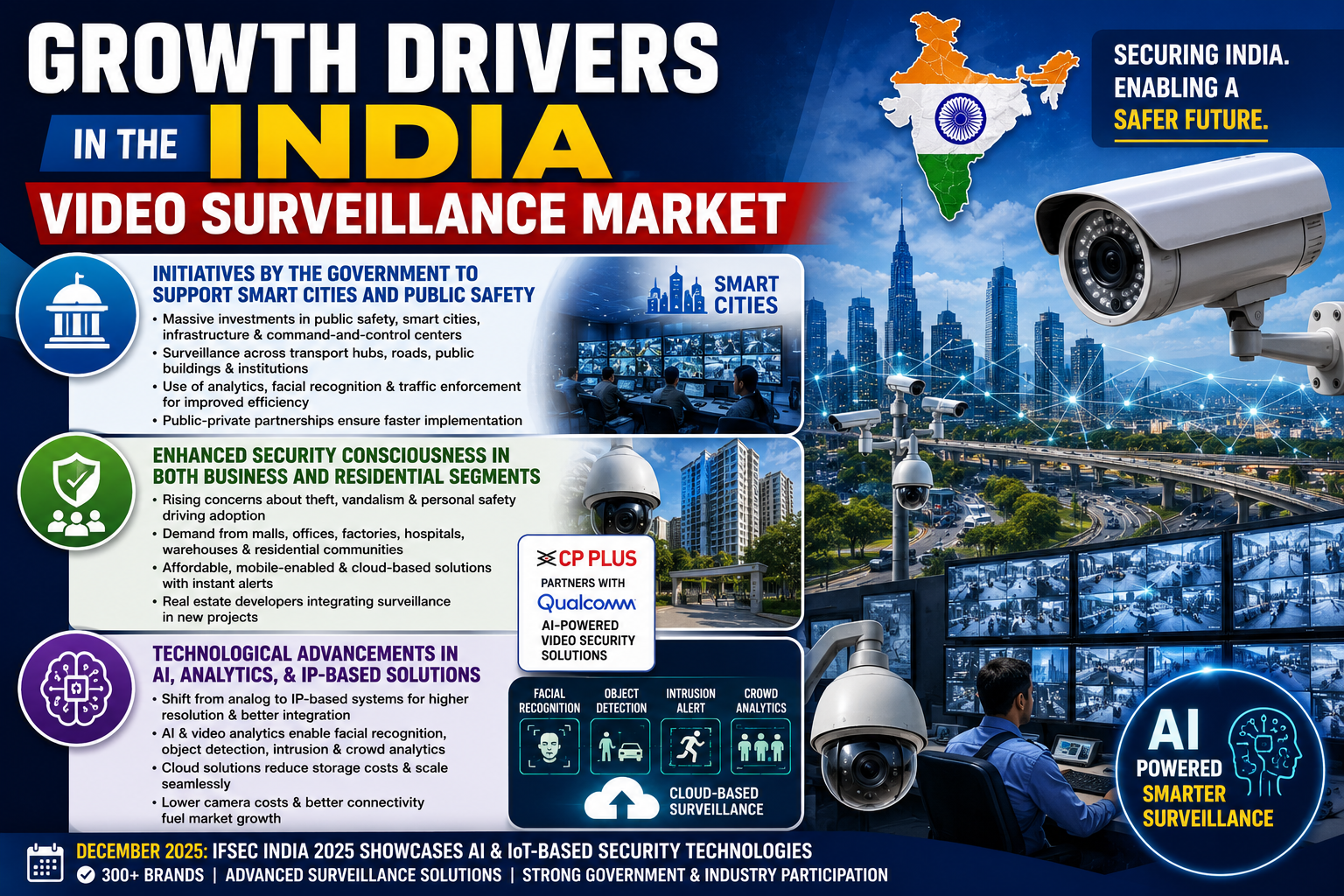
Under various smart city initiatives, surveillance cameras are being installed across public spaces, transportation hubs, educational institutions, roads, and critical infrastructure. Integrated command-and-control centers enable authorities to monitor multiple locations simultaneously, respond quickly to incidents, and coordinate emergency services more effectively.
Government agencies and law enforcement organizations are increasingly utilizing surveillance technologies not only as investigative tools but also as preventive mechanisms designed to reduce criminal activity and improve public confidence. The integration of facial recognition systems, traffic analytics, and automated enforcement capabilities is further enhancing the effectiveness of these deployments.
The result is a growing nationwide network of intelligent surveillance infrastructure that supports both public safety and urban development goals.
Businesses and Homeowners Are Prioritizing Security
The increasing demand for video surveillance is not limited to government projects. Businesses and residential consumers are also contributing significantly to market expansion.
Organizations across retail, banking, healthcare, logistics, manufacturing, and hospitality sectors are investing in surveillance systems to protect assets, reduce theft, monitor operations, and ensure employee safety. Video surveillance has become an important component of risk management strategies, helping organizations maintain compliance while improving operational visibility.
At the same time, residential adoption is accelerating rapidly. Apartment complexes, gated communities, and individual homeowners are embracing surveillance technologies as awareness of personal security continues to rise. The growing affordability of surveillance equipment, combined with smartphone connectivity and cloud-based monitoring capabilities, has made advanced security solutions accessible to a much broader audience.
Real estate developers are increasingly integrating surveillance systems into residential projects from the planning stage, recognizing that security has become a major purchasing consideration for homebuyers. This trend is helping drive sustained demand across the residential segment.
Artificial Intelligence Is Reshaping Surveillance
Artificial intelligence is perhaps the most transformative force shaping the future of video surveillance in India.
Traditional systems required human operators to continuously monitor video feeds, making it difficult to identify threats in real time. AI-powered surveillance solutions have changed this dynamic by automating the detection and analysis of security events.
Modern surveillance platforms can identify suspicious behavior, detect unauthorized access, recognize faces, track vehicle movements, analyze crowd patterns, and generate immediate alerts when unusual activities occur. These capabilities significantly improve response times while reducing the burden on human operators.
AI-driven analytics are also creating opportunities beyond security. Businesses can use surveillance systems to analyze customer behavior, monitor operational efficiency, optimize workflows, and improve resource allocation. This expanded functionality is increasing the value proposition of surveillance investments across multiple industries.
The growing importance of AI was highlighted in December 2025 when IFSEC India showcased hundreds of advanced AI- and IoT-enabled security solutions, demonstrating the increasing role of intelligent surveillance technologies in the country's security ecosystem.
The Rise of IP-Based Surveillance Systems
India’s surveillance industry is witnessing a significant shift from analog systems to IP-based surveillance solutions.
IP cameras offer several advantages over traditional analog systems, including superior image quality, remote accessibility, advanced analytics integration, and enhanced scalability. Organizations can monitor multiple locations from centralized control centers while storing and analyzing large volumes of video data efficiently.
The declining cost of IP cameras has accelerated adoption across both public and private sectors. Smart city projects, transportation networks, corporate campuses, and industrial facilities increasingly prefer IP-based systems because they provide greater flexibility and future-ready capabilities.
As internet infrastructure continues to improve throughout India, IP surveillance is expected to become the dominant surveillance architecture for new installations.
Video Surveillance Software Is Becoming More Intelligent
The software segment is emerging as one of the fastest-growing areas within the surveillance market.
Modern surveillance software enables centralized monitoring, camera management, video analysis, and system integration across multiple sites. AI-powered applications can automatically detect anomalies, identify security threats, read license plates, and perform facial recognition without constant human supervision.
Cloud-based platforms are making these capabilities even more accessible by enabling remote monitoring from virtually any location. Organizations can access surveillance data in real time while reducing infrastructure costs associated with on-premises storage systems.
The increasing sophistication of surveillance software is transforming security operations into data-driven processes that deliver both protection and business intelligence.
Challenges Facing the Industry
Despite strong growth prospects, the Indian video surveillance market faces several challenges that could affect adoption rates.
One major concern involves privacy and data protection. As surveillance systems become more widespread and sophisticated, questions regarding data collection, storage, consent, and misuse have become increasingly important. Public concerns surrounding facial recognition technologies and continuous monitoring have generated ongoing debates about balancing security with individual privacy rights.
Regulatory uncertainty also presents challenges for businesses operating within the surveillance sector. As data protection laws evolve, organizations must ensure compliance while adapting to changing requirements regarding data retention, access controls, and information security.
Infrastructure limitations remain another obstacle. Reliable power supplies, high-speed internet connectivity, and skilled technical personnel are not uniformly available across all regions of India. These limitations can make large-scale deployments more difficult, particularly in rural and semi-urban areas. Additionally, advanced AI-powered surveillance systems often require significant upfront investments, creating affordability concerns for smaller organizations.
Residential Security Is Emerging as a Key Growth Segment
One of the most exciting developments in the Indian market is the rapid growth of residential surveillance solutions.
Urbanization, changing family structures, and increasing security awareness are encouraging homeowners to invest in surveillance technologies. Affordable cameras, smartphone integration, cloud storage, and user-friendly installation processes have made sophisticated security systems accessible to middle-class consumers.
Residential societies are also implementing shared surveillance networks to monitor entrances, parking facilities, recreational areas, and common spaces. These systems improve safety while providing residents with greater peace of mind.
As consumer awareness continues to grow, residential surveillance is expected to remain one of the fastest-expanding segments within the broader market.
Regional Growth Patterns Across India
Different regions of India are contributing to market growth in unique ways.
North India benefits from extensive government infrastructure projects and public security initiatives. Cities such as New Delhi, Jaipur, Chandigarh, Dehradun, and Shimla are expanding surveillance deployments across transportation networks, public institutions, and urban centers.
East India is gradually increasing surveillance adoption through smart city initiatives, industrial development, and enhanced public safety programs. Although infrastructure challenges remain, ongoing investments are creating new opportunities for growth.
South India stands out as the most technologically advanced regional market. Strong IT infrastructure, widespread digital adoption, and thriving commercial sectors have encouraged early deployment of AI-powered surveillance systems. Cities such as Chennai and Bengaluru are actively utilizing advanced analytics and smart monitoring technologies to enhance public safety and urban management.
These regional developments demonstrate the growing importance of surveillance technologies across diverse economic and geographic environments.
Final Thoughts
India’s video surveillance market is entering a period of extraordinary growth driven by technological innovation, urban development, and rising security awareness.
The projected increase from US$ 4.58 Billion in 2025 to US$ 10.11 Billion by 2034 highlights the expanding role of surveillance technologies in modern society. From smart cities and transportation networks to residential communities and industrial facilities, surveillance systems are becoming essential tools for safety, efficiency, and operational intelligence.
While challenges related to privacy, infrastructure, and regulatory compliance remain important considerations, the long-term outlook for the industry remains highly positive. Continued advancements in artificial intelligence, cloud computing, analytics, and IP-based technologies will further strengthen the value and effectiveness of surveillance solutions.
As India accelerates its digital transformation journey, video surveillance will play a crucial role in creating safer cities, smarter businesses, and more secure communities across the country.
About the Creator
Enjoyed the story? Support the Creator.
Subscribe for free to receive all their stories in your feed.
Comments
There are no comments for this story
Be the first to respond and start the conversation.