
India’s Industrial Automation Boom: The Smart Manufacturing Revolution Transforming the Nation
As AI, Robotics, and Industry 4.0 Technologies Gain Momentum, India Is Emerging as a Global Leader in Automated Manufacturing

India's manufacturing sector is experiencing one of the most significant transformations in its history. Across factories, industrial parks, logistics hubs, and production facilities, traditional manufacturing methods are gradually being replaced by intelligent systems powered by automation, artificial intelligence, robotics, and connected technologies.
What was once considered a futuristic concept is now becoming an essential business strategy. Companies are investing heavily in smart manufacturing solutions to improve efficiency, reduce operational costs, enhance product quality, and remain competitive in an increasingly digital global economy.
The rapid adoption of industrial automation is not only changing how products are manufactured but also redefining India's position within global supply chains. As industries embrace digital transformation, automation technologies are helping organizations streamline operations, reduce downtime, and make faster, data-driven decisions.
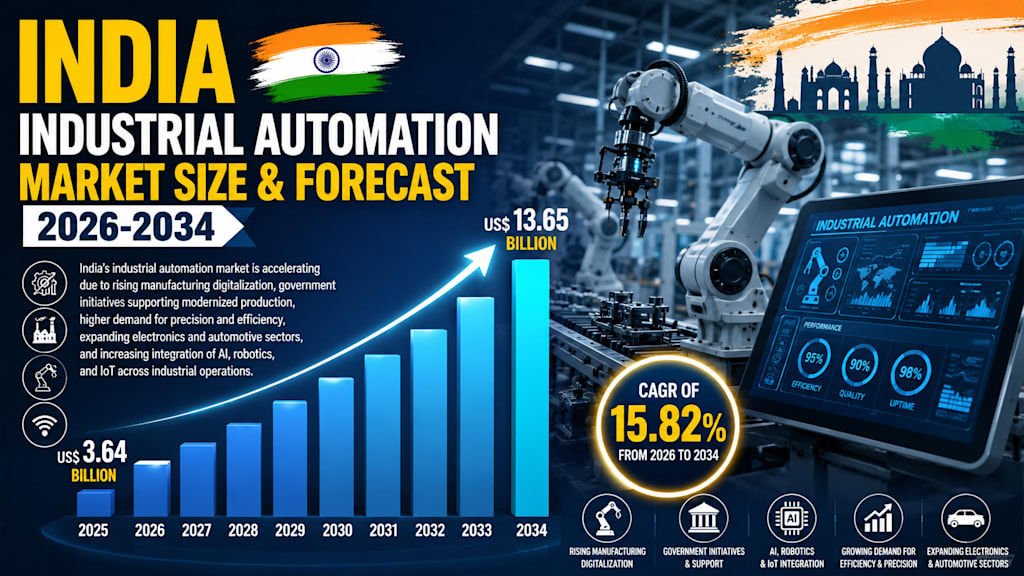
According to Renub Research, the India Industrial Automation Market is expected to grow from US$ 3.64 billion in 2025 to US$ 13.65 billion by 2034, representing an impressive compound annual growth rate (CAGR) of 15.82% between 2026 and 2034. These figures highlight the growing importance of automation in shaping the future of Indian industry and demonstrate the enormous opportunities emerging within this rapidly evolving market.
Why Industrial Automation Matters More Than Ever
Manufacturing has always played a crucial role in India's economic development. However, the challenges facing manufacturers today are far different from those of previous decades. Rising labor costs, increasing customer expectations, global competition, quality requirements, and supply chain uncertainties are forcing businesses to rethink traditional production methods.
Industrial automation offers a practical solution to many of these challenges. By integrating advanced technologies such as robotics, industrial Internet of Things (IIoT) platforms, machine vision systems, sensors, programmable logic controllers, and artificial intelligence-driven software, manufacturers can significantly improve productivity while minimizing human error.
Unlike conventional manufacturing environments that depend heavily on manual labor, automated systems can operate with greater precision, consistency, and efficiency. These systems help organizations achieve higher production output, maintain quality standards, and improve workplace safety.
As businesses seek to remain competitive in both domestic and international markets, automation is becoming a critical investment rather than an optional upgrade.
The Industry 4.0 Movement Is Accelerating Change
One of the biggest drivers behind India's automation growth is the increasing adoption of Industry 4.0 technologies. Often referred to as the fourth industrial revolution, Industry 4.0 focuses on creating interconnected manufacturing ecosystems where machines, software, and people communicate in real time.
Smart factories represent the heart of this transformation. Within these facilities, sensors continuously collect operational data, AI systems analyze production performance, and automated machines respond to changing conditions without requiring constant human intervention.
This interconnected approach allows manufacturers to identify inefficiencies, predict equipment failures, optimize resource utilization, and improve overall productivity.
Indian businesses are increasingly recognizing that Industry 4.0 technologies can provide a significant competitive advantage. As a result, investments in digital manufacturing solutions continue to rise across multiple sectors.
Government Support Is Strengthening Industrial Modernization
Government initiatives have played an important role in accelerating automation adoption throughout the country. Programs such as Make in India, Production Linked Incentive (PLI) schemes, Digital India, and various industrial development policies have encouraged manufacturers to modernize their operations and adopt advanced technologies.
These initiatives are designed to strengthen India's manufacturing capabilities while attracting domestic and foreign investment. As companies expand production capacities and establish new facilities, automation technologies are becoming central components of their long-term growth strategies.
The government's focus on improving industrial competitiveness has created an environment where businesses are increasingly willing to invest in smart manufacturing infrastructure. This trend is expected to continue as India pursues its ambition of becoming one of the world's leading manufacturing destinations.
Semiconductor Manufacturing Is Creating New Automation Opportunities
The emergence of semiconductor manufacturing represents one of the most exciting developments within India's industrial landscape. Semiconductor production requires exceptional levels of precision, cleanliness, and quality control, making automation an essential part of the manufacturing process.
Modern semiconductor facilities rely heavily on robotics, intelligent monitoring systems, automated inspection technologies, advanced process controls, and contamination-free handling equipment. These systems ensure consistency, improve production efficiency, and reduce the risk of costly errors.
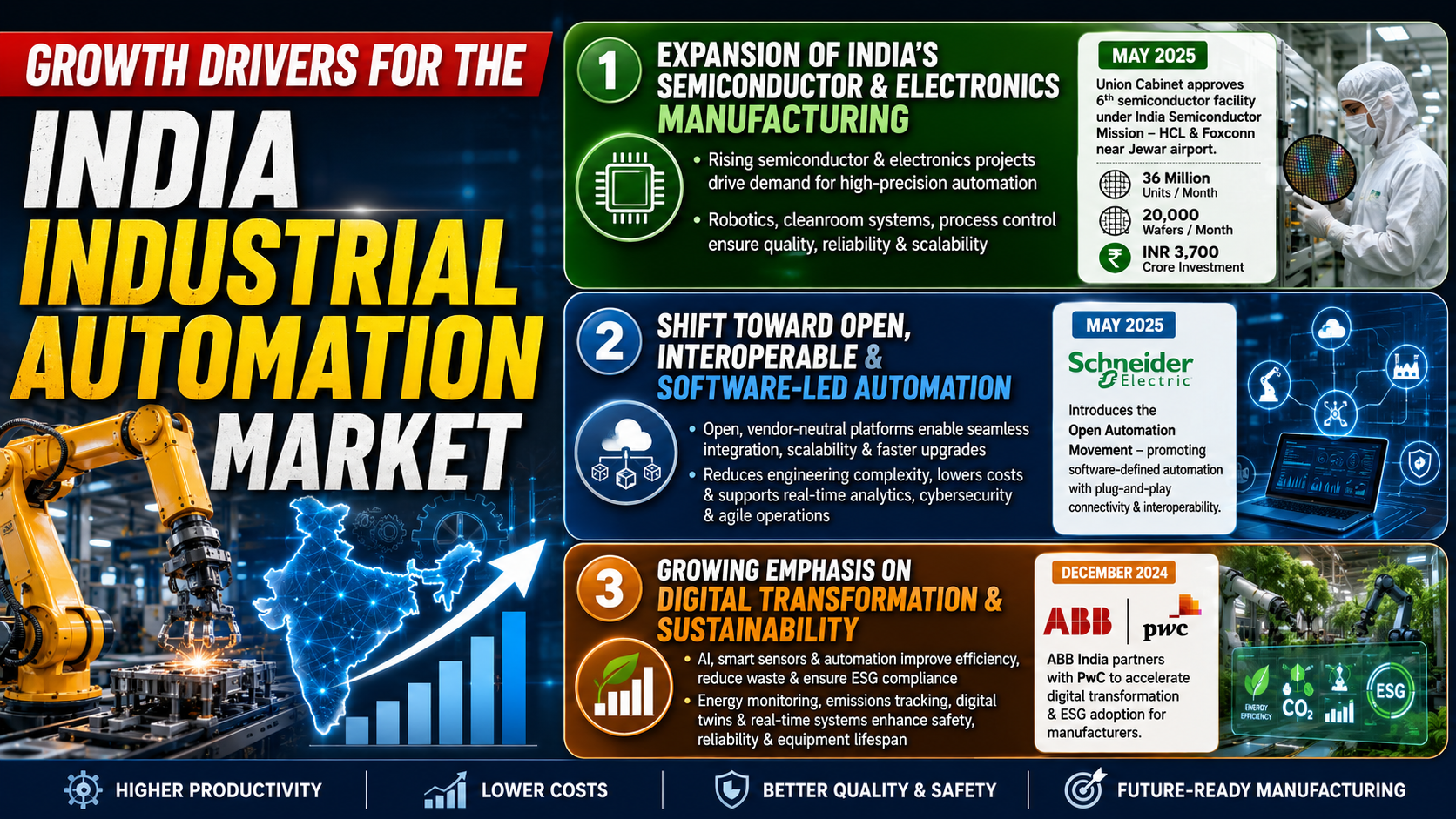
In May 2025, the Union Cabinet approved the establishment of a sixth semiconductor facility under the India Semiconductor Mission through a partnership between HCL and Foxconn near Jewar Airport. The project is expected to manufacture display driver chips and significantly strengthen India's semiconductor ecosystem. Such large-scale facilities depend extensively on automation technologies to achieve production targets while maintaining strict quality standards.
As semiconductor manufacturing expands, demand for automation solutions is likely to increase across both electronics production and supporting industries.
The Shift Toward Open and Flexible Automation Systems
Traditional automation systems often relied on proprietary technologies that limited flexibility and made integration more complicated. Today's manufacturers are increasingly moving toward open, software-driven automation platforms that support interoperability between equipment from different vendors.
This shift is helping organizations create more agile manufacturing environments capable of adapting to changing business requirements. Open automation architectures simplify system upgrades, improve data sharing, reduce engineering complexity, and lower long-term operational costs.
The growing popularity of software-defined automation reflects a broader industry trend toward flexibility and scalability. Manufacturers want solutions that can evolve alongside their business needs without requiring expensive infrastructure replacements.
This movement is particularly important as companies continue investing in digital transformation initiatives and seek greater operational efficiency.
Sustainability Is Driving Technology Investments
Sustainability has become a major priority for manufacturers worldwide, and India is no exception. Companies are increasingly expected to reduce environmental impact while maintaining profitability and operational efficiency.
Industrial automation plays a vital role in helping organizations achieve these objectives. Smart sensors, automated control systems, and AI-powered analytics allow manufacturers to monitor energy consumption, track emissions, optimize equipment performance, and minimize waste.
Predictive maintenance technologies help extend equipment lifespan while reducing unnecessary resource usage. Digital twin solutions enable organizations to simulate production environments and identify opportunities for efficiency improvements before implementing physical changes.
As environmental, social, and governance (ESG) standards become more important to investors, customers, and regulators, automation is emerging as a critical tool for sustainable industrial growth.
Industries Leading the Automation Revolution
Several industries are driving the rapid adoption of industrial automation across India.
The automotive sector remains one of the largest users of automation technologies. Robotic assembly lines, automated welding systems, machine vision inspection tools, and predictive maintenance platforms have become standard features in modern automotive manufacturing facilities.
Electronics manufacturers are also investing heavily in automation to support high-volume production while maintaining precision and quality. The growing demand for consumer electronics, smartphones, and semiconductor components continues to create opportunities for advanced manufacturing technologies.
The pharmaceutical industry is embracing automation to improve compliance, ensure product consistency, and enhance production efficiency. Automated packaging systems, quality control technologies, and digital monitoring platforms are helping companies meet increasingly stringent regulatory requirements.
Food and beverage manufacturers are using automation to improve hygiene, increase production speed, and maintain product quality. Similarly, chemical processing companies rely on automated systems to improve safety and optimize complex industrial operations.
Industries such as aerospace, defense, healthcare, mining, energy, and utilities are also accelerating investments in automation technologies as they pursue greater efficiency and operational excellence.
Regional Markets Driving Growth
Several Indian states have emerged as leaders in industrial automation adoption.
Maharashtra continues to dominate the market due to its strong automotive, pharmaceutical, electronics, and manufacturing sectors. Cities such as Mumbai and Pune have become major centers for smart factory implementation and Industry 4.0 initiatives.
Tamil Nadu is another important automation hub, supported by thriving automotive, electronics, textile, and engineering industries. Manufacturing centers in Chennai, Hosur, and Sriperumbudur are increasingly adopting robotics, automated inspection systems, and advanced production technologies.
Karnataka benefits from its strong technology ecosystem and diverse industrial base. Companies across aerospace, electronics, machine tools, and automotive components are implementing industrial IoT platforms, digital twins, and intelligent manufacturing solutions.
Uttar Pradesh is also witnessing rapid growth, particularly in the Noida and Greater Noida regions, where electronics manufacturing, logistics operations, and industrial development projects are driving increased automation adoption.
Challenges That Still Need Attention
Despite strong growth prospects, the industrial automation market faces several challenges.
One of the biggest obstacles is the high initial investment required for advanced automation systems. Small and medium-sized enterprises often struggle to allocate sufficient resources for robotics, digital infrastructure, software integration, employee training, and cybersecurity enhancements. Since SMEs represent a significant portion of India's manufacturing ecosystem, improving affordability remains essential for broader market adoption.
Another major challenge involves workforce readiness. As automation technologies become more sophisticated, demand for skilled professionals continues to rise. Many organizations face difficulties finding engineers, technicians, and specialists with expertise in robotics, AI systems, industrial software, and predictive maintenance technologies. Limited training opportunities and gaps between academic education and industry requirements further contribute to the talent shortage.
Addressing these challenges will require collaboration between industry leaders, educational institutions, policymakers, and technology providers.
Looking Ahead
The future of industrial automation in India appears exceptionally bright. Growing investments in Industry 4.0 technologies, expanding semiconductor manufacturing capabilities, increasing adoption of AI-powered production systems, sustainability initiatives, and strong government support are creating favorable conditions for long-term growth.
Leading global companies including Siemens, Honeywell, Mitsubishi Electric, Rockwell Automation, Schneider Electric, ABB, and Bharat Heavy Electricals Limited continue to strengthen their presence in the Indian market, reflecting confidence in the country's industrial future.
As automation technologies become more accessible and affordable, adoption is expected to spread beyond large enterprises and reach a broader range of manufacturers. This expansion could significantly enhance productivity, improve product quality, and strengthen India's position as a global manufacturing powerhouse.
Final Thoughts
India stands at the beginning of a transformative industrial era. Automation, artificial intelligence, robotics, and connected technologies are no longer emerging trends—they are becoming fundamental components of modern manufacturing.
The projected growth of the industrial automation market demonstrates the confidence businesses have in these technologies and their ability to deliver measurable value. While challenges related to investment costs and workforce development remain, the momentum behind industrial automation continues to strengthen.
As smart factories become increasingly common and digital transformation accelerates across industries, automation will play a defining role in shaping India's economic future. The companies that embrace this transformation today will be best positioned to lead tomorrow's manufacturing landscape, driving innovation, productivity, and sustainable growth for years to come.
About the Creator
Enjoyed the story? Support the Creator.
Subscribe for free to receive all their stories in your feed.
Comments
There are no comments for this story
Be the first to respond and start the conversation.