
India's Elevator and Escalator Market Is Rising Alongside the Nation's Urban Transformation
Rapid urbanization, smart city initiatives, metro rail expansion, and the construction of high-rise buildings are fueling strong growth in India's elevator and escalator industry.

As urban populations continue expanding and land becomes increasingly scarce in major metropolitan areas, developers are turning to vertical construction to accommodate growing residential, commercial, and industrial needs. Towering apartment complexes, corporate office buildings, shopping malls, hospitals, airports, and metro stations have become defining features of modern India.
At the heart of this transformation lies a critical but often overlooked technology: elevators and escalators.
These systems have evolved far beyond their traditional role as simple transportation tools within buildings. Today, they are essential components of modern infrastructure, enabling safe, efficient, and convenient movement of people and goods across increasingly complex urban environments.
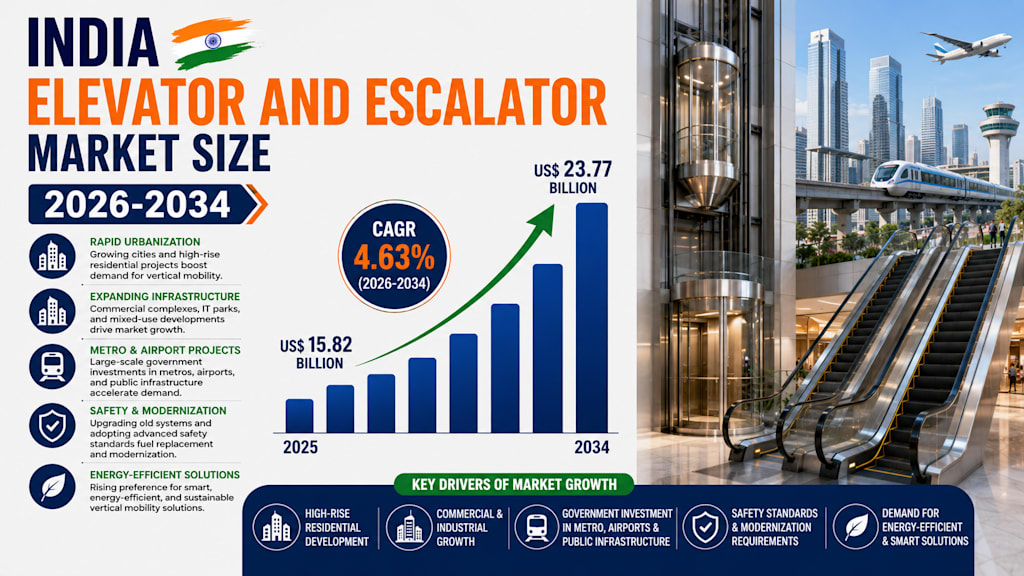
According to Renub Research, the India Elevator and Escalator Market is expected to grow from US$ 15.82 billion in 2025 to US$ 23.77 billion by 2034, expanding at a compound annual growth rate (CAGR) of 4.63% between 2026 and 2034. This growth is being driven by rapid urbanization, rising construction activity, infrastructure modernization, and increasing demand for technologically advanced mobility solutions.
As India continues its journey toward becoming one of the world's largest urban economies, elevators and escalators are emerging as indispensable elements of future-ready infrastructure.
Why Vertical Mobility Matters More Than Ever
Modern cities depend on efficient movement.
As buildings become taller and urban spaces become denser, traditional methods of moving between floors are no longer practical. Elevators and escalators solve this challenge by enabling seamless vertical transportation while improving accessibility, safety, and convenience.
Elevators are particularly essential in high-rise residential towers, office buildings, hotels, hospitals, and mixed-use developments. They allow people and goods to move quickly between floors while maximizing the usability of available space.
Escalators serve a different but equally important purpose. Found primarily in shopping malls, airports, railway stations, metro systems, and public facilities, escalators facilitate the continuous flow of large numbers of people.
Together, these systems help reduce congestion, improve accessibility for elderly and disabled individuals, and enhance the overall functionality of modern buildings.
As India's urban landscape continues evolving, the importance of vertical mobility solutions is becoming increasingly evident.
Urbanization Is Creating Massive Demand
India is undergoing one of the largest urban transitions in human history.
Millions of people migrate to cities every year in search of employment opportunities, education, healthcare, and improved living standards. This rapid urban growth has intensified demand for residential housing, commercial infrastructure, and public transportation systems.
Major cities such as Mumbai, Bengaluru, Delhi NCR, Hyderabad, Chennai, and Pune are witnessing extensive construction activity. High-rise residential towers are becoming increasingly common as developers attempt to maximize land utilization in densely populated areas.
Limited land availability has made vertical construction not only desirable but necessary.
Every new multi-story building requires reliable elevator systems, while large commercial developments often require both elevators and escalators to accommodate high volumes of occupants and visitors.
The urbanization trend is also extending beyond India's largest metropolitan areas. Tier-2 and Tier-3 cities are experiencing significant infrastructure development, creating additional opportunities for elevator and escalator installations.
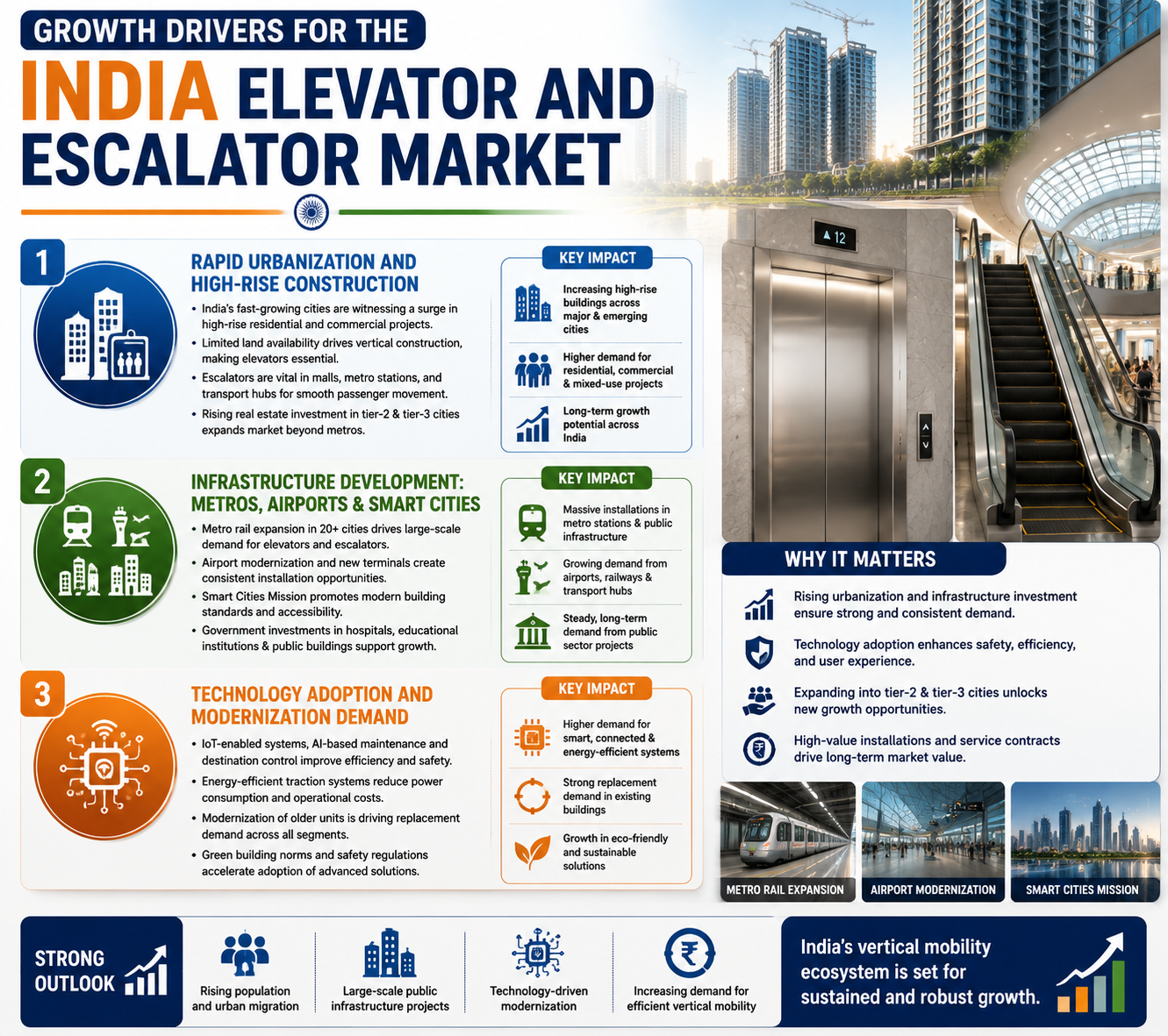
This broad-based urban expansion is expected to remain one of the strongest growth drivers for the industry over the next decade.
Infrastructure Development Is Accelerating Growth
Beyond residential and commercial real estate, infrastructure development is playing a crucial role in expanding the elevator and escalator market.
India has embarked on an ambitious infrastructure modernization program that includes metro rail systems, airport expansions, smart cities, railway station upgrades, healthcare facilities, and educational institutions.
Metro rail projects alone represent a significant source of demand.
Cities such as Pune, Ahmedabad, Chennai, Kanpur, Lucknow, Nagpur, and several others are expanding public transportation networks that require extensive installations of elevators and escalators. These systems are essential for ensuring accessibility, managing passenger flow, and improving commuter experiences.
Airport modernization initiatives are also generating opportunities. New terminals, expanded facilities, and regional connectivity programs require advanced mobility solutions capable of handling large passenger volumes safely and efficiently.
Government-led initiatives such as the Smart Cities Mission are further encouraging the adoption of modern building technologies, accessibility features, and digital infrastructure.
As these long-term projects continue progressing, demand for high-performance elevator and escalator systems is expected to remain strong.
Technology Is Reshaping the Industry
The elevator and escalator industry is undergoing a significant technological transformation.
Today's systems are far more intelligent, efficient, and connected than previous generations. Building owners increasingly prioritize technologies that improve safety, reduce energy consumption, and enhance user experiences.
One of the most important trends is the integration of Internet of Things (IoT) capabilities.
Connected elevators can continuously monitor performance, identify maintenance requirements, and transmit real-time operational data. Predictive maintenance systems help reduce downtime, improve reliability, and lower long-term operating costs.
Artificial intelligence is also influencing the industry through destination control systems that optimize elevator movement based on passenger demand patterns. These systems reduce waiting times and improve traffic flow within buildings.
Energy efficiency has become another major focus area.
Modern elevators increasingly incorporate regenerative drives, energy-efficient motors, and smart power management systems. These innovations support sustainability goals while helping building owners reduce operating expenses.
As demand for smart buildings grows, advanced elevator and escalator technologies are expected to become standard features rather than premium options.
The Rise of Modernization Projects
Not all growth comes from new construction.
Across India, thousands of older buildings continue operating elevators that were installed decades ago. While these systems may still function, they often lack modern safety features, energy efficiency standards, and digital capabilities.
As safety regulations evolve and building owners seek improved performance, modernization projects are becoming increasingly important.
Replacing outdated control systems, upgrading mechanical components, improving energy efficiency, and integrating digital monitoring capabilities allow older elevators to meet contemporary expectations without requiring complete replacement.
Modernization also helps extend equipment lifespan while reducing maintenance costs and improving passenger safety.
This trend is creating a substantial aftermarket opportunity for manufacturers and service providers throughout the country.
Residential Buildings Drive Significant Demand
The residential sector represents one of the largest contributors to market growth.
Rapid population growth, rising incomes, and changing lifestyle preferences have increased demand for modern apartment complexes and gated communities. Elevators have become standard features in multi-story residential developments, even in smaller cities.
Luxury housing projects are driving demand for premium elevator solutions featuring enhanced aesthetics, smart controls, and advanced safety technologies.
At the same time, developers are increasingly focused on energy-efficient systems that align with sustainability goals and green building certifications.
Recent innovations have expanded possibilities even further. Home elevators designed for villas, duplexes, and multi-story residences are gaining popularity among affluent homeowners seeking convenience and accessibility.
As residential construction remains strong, this segment is expected to continue supporting industry growth.
Commercial Infrastructure Continues to Expand
India's commercial real estate sector is another major growth engine.
Office complexes, shopping malls, hotels, hospitals, educational institutions, and entertainment venues all depend heavily on vertical mobility systems.
Corporate campuses require elevators capable of handling large employee populations efficiently. Shopping malls rely on escalators and elevators to enhance customer experiences and improve traffic flow. Hospitals require specialized systems that prioritize reliability, accessibility, and patient transport.
As commercial construction activity continues expanding across major urban centers, demand for advanced mobility solutions is increasing accordingly.
Businesses are also becoming more focused on operational efficiency, sustainability, and user experience, encouraging adoption of higher-end technologies.
These trends are creating opportunities for both equipment manufacturers and service providers.
Regional Markets Leading Growth
Maharashtra remains one of India's largest elevator and escalator markets.
Cities such as Mumbai, Pune, and Nagpur continue experiencing strong demand driven by high-rise residential construction, commercial development, metro rail expansion, and large-scale urban redevelopment projects.
Tamil Nadu has emerged as another key market due to strong industrial activity, IT sector growth, and extensive real estate development in Chennai and Coimbatore. The state also serves as an important manufacturing hub for several elevator companies.
Karnataka's market is largely driven by Bengaluru, where rapid expansion of technology parks, commercial offices, and residential developments continues generating substantial demand for modern mobility solutions.
Uttar Pradesh is also witnessing significant growth, particularly in cities such as Noida, Ghaziabad, Lucknow, and Kanpur. Urbanization, smart city initiatives, metro projects, and growing commercial infrastructure are supporting increased installations throughout the state.
These regional markets collectively highlight the widespread opportunities available across India.
Challenges Facing the Industry
Despite strong growth prospects, the elevator and escalator market faces several challenges.
One of the most significant barriers is cost.
Installing elevators and escalators requires substantial investment in equipment, structural modifications, safety systems, and ongoing maintenance. For smaller developers and older buildings, these costs can be difficult to justify.
Maintenance remains another concern.
Regular inspections, component replacements, and compliance requirements are necessary to ensure safety and reliability. Rising costs associated with maintenance can discourage timely upgrades and modernization efforts.
Regulatory complexity also presents challenges.
Different states often maintain varying requirements regarding inspections, certifications, and licensing procedures. This fragmented regulatory environment can create uncertainty and increase compliance costs for manufacturers and service providers.
Ensuring consistent safety standards across rapidly growing urban markets remains an ongoing priority for the industry.
Looking Ahead
The future of India's elevator and escalator market appears highly promising.
Urbanization will continue creating demand for vertical mobility solutions as cities grow taller and more densely populated. Infrastructure projects, smart city developments, and transportation investments will further strengthen market opportunities.
Technological innovation will play a major role in shaping the industry's next phase. Connected systems, predictive maintenance, artificial intelligence, and energy-efficient designs are expected to become increasingly common.
Sustainability will also influence future purchasing decisions as building owners seek solutions that reduce energy consumption and support environmental goals.
As India advances toward becoming a more urbanized and technologically sophisticated economy, elevators and escalators will remain essential components of modern infrastructure.
Final Thoughts
India's elevator and escalator market reflects the broader transformation occurring across the country's cities and infrastructure networks. Rapid urbanization, rising construction activity, government investments, and technological innovation are creating strong foundations for long-term growth.
With the market projected to expand from US$ 15.82 billion in 2025 to US$ 23.77 billion by 2034, opportunities for manufacturers, service providers, and technology innovators remain substantial.
From high-rise apartments and commercial towers to airports, metro stations, and smart cities, vertical mobility solutions are becoming increasingly important in supporting India's development journey. As buildings continue reaching new heights and infrastructure projects reshape urban landscapes, the elevator and escalator industry will play a critical role in connecting people, spaces, and opportunities throughout the nation.
About the Creator
Enjoyed the story? Support the Creator.
Subscribe for free to receive all their stories in your feed.
Comments
There are no comments for this story
Be the first to respond and start the conversation.