
India Gas Genset Market Expected to Reach USD 420.61 Million by 2034 as Clean Energy Adoption Accelerates
Expansion of natural gas infrastructure, rising industrial energy demand, and stricter environmental regulations are reshaping India’s backup power industry.

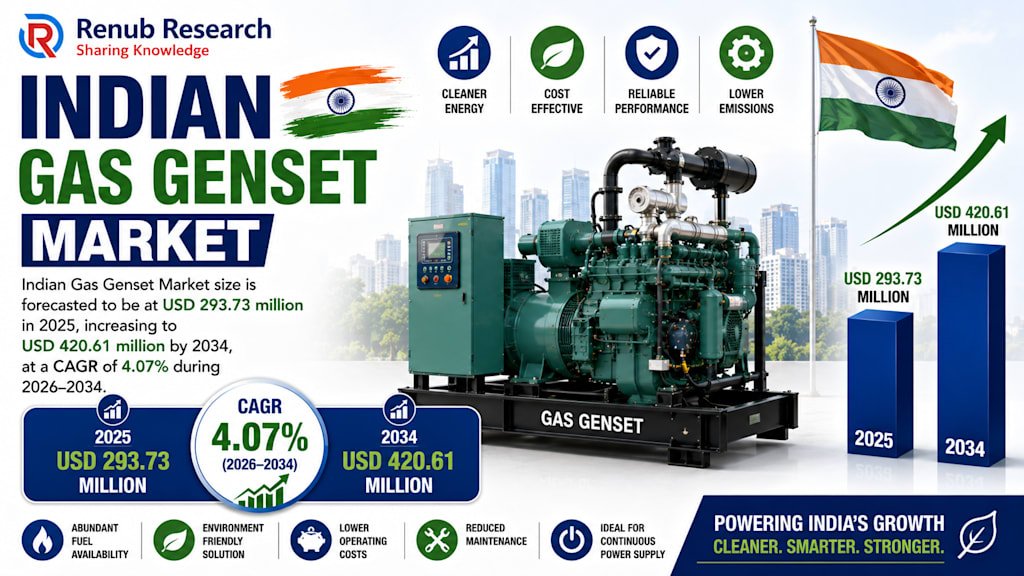
India’s gas genset industry is witnessing steady transformation as businesses and industries increasingly shift toward cleaner and more efficient backup power solutions.
According to Renub Research, the India gas genset market is projected to grow from USD 293.73 million in 2025 to USD 420.61 million by 2034, registering a CAGR of 4.07% between 2026 and 2034.
The market is gaining momentum due to India’s growing focus on cleaner energy alternatives, expanding natural gas infrastructure, and increasing demand for uninterrupted electricity supply across commercial and industrial sectors.
Gas gensets, powered by fuels such as natural gas, LPG, biogas, and compressed natural gas (CNG), are increasingly viewed as environmentally friendlier alternatives to diesel generators because they produce lower emissions, operate more quietly, and often provide lower long-term operating costs.
As India intensifies efforts to reduce pollution and modernize its energy ecosystem, gas-based backup power systems are becoming increasingly important across sectors such as healthcare, IT, manufacturing, hospitality, and data centers.
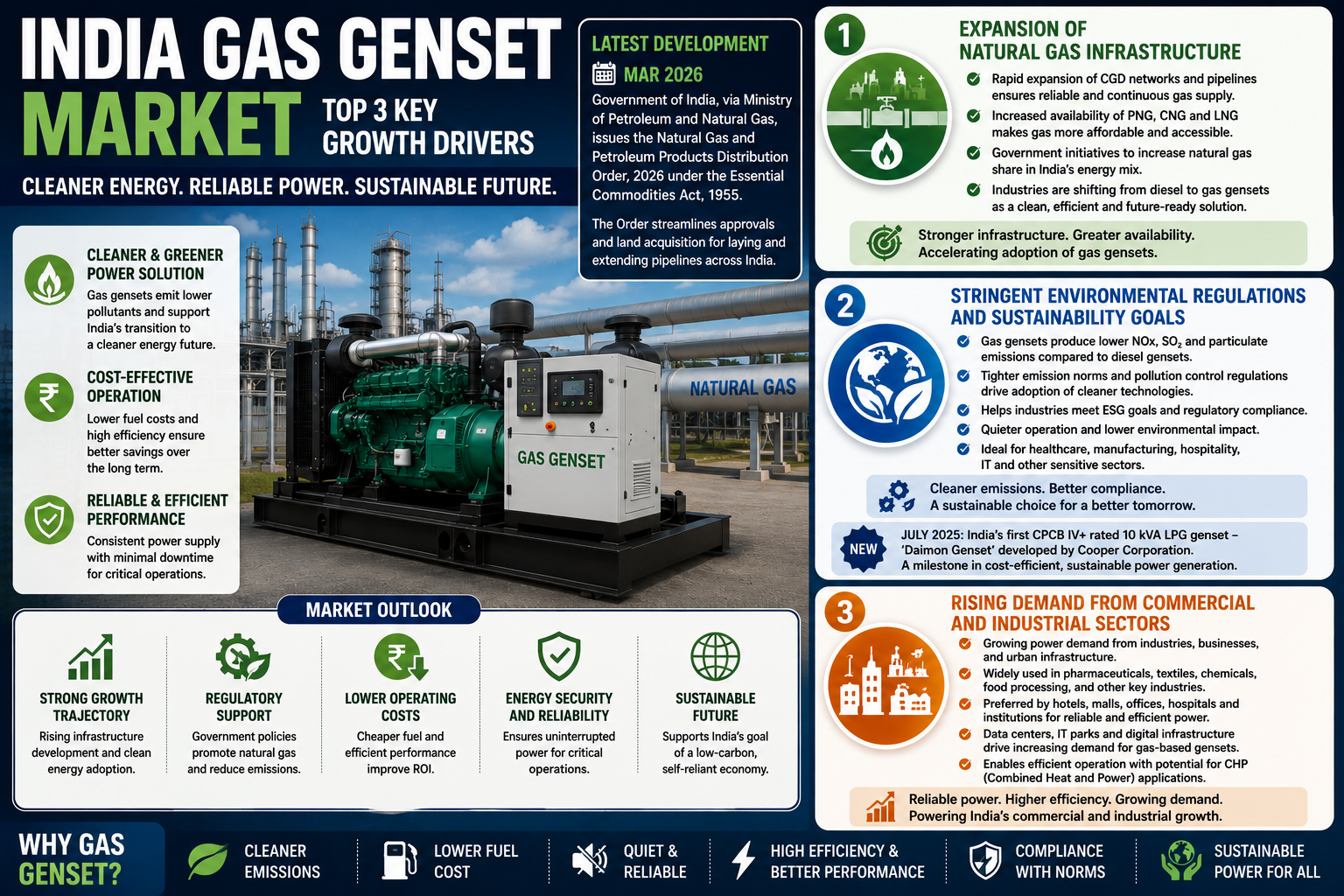
Natural Gas Infrastructure Expansion Is Driving Market Growth
One of the strongest growth drivers for the India gas genset market is the rapid expansion of the country’s natural gas infrastructure.
The Indian government is actively promoting natural gas as part of its long-term clean energy transition strategy. Increasing investments in:
City Gas Distribution (CGD) networks
- LNG terminals
- Natural gas pipelines
- PNG and CNG infrastructure
are improving fuel accessibility across multiple states and urban regions.
The wider availability of piped natural gas (PNG) and compressed natural gas (CNG) is encouraging businesses to replace diesel gensets with cleaner gas-powered alternatives.
In March 2026, the Government of India introduced the Natural Gas and Petroleum Products Distribution Order, 2026, under the Essential Commodities Act to streamline the process for laying and expanding gas pipeline infrastructure nationwide.
The policy aims to reduce delays in land acquisition and approvals, further accelerating infrastructure expansion.
As gas availability improves, industries are expected to increasingly adopt gas gensets because of their operational efficiency and environmental advantages.
Environmental Regulations Are Encouraging Cleaner Power Solutions
India’s stricter environmental regulations and sustainability goals are also accelerating the shift toward gas-based power generation systems.
Compared to diesel generators, gas gensets produce significantly lower levels of:
- Nitrogen oxide emissions
- Sulfur dioxide
- Particulate matter
- Noise pollution
As pollution control standards become stricter across urban areas, industries and commercial establishments are increasingly seeking cleaner backup power technologies that comply with environmental norms.
Gas gensets are especially attractive in metropolitan regions where air quality concerns and emission restrictions are becoming more prominent.
Corporate ESG (Environmental, Social, and Governance) commitments are also influencing energy infrastructure decisions.
Many organizations are investing in gas-based systems to align with sustainability targets while maintaining reliable power backup capabilities.
In July 2025, Cooper Corporation collaborated on the launch of India’s first CPCB IV+ rated 10 kVA LPG genset, marketed under the “Daimon Genset” brand.
The product represents a major step toward cleaner and more sustainable power generation technologies in India.
Commercial and Industrial Sectors Continue Expanding Adoption
The rising need for uninterrupted electricity across commercial and industrial sectors remains a major contributor to market growth.
Industries increasingly rely on gas gensets to ensure operational continuity during power disruptions.
Major industrial users include:
- Pharmaceuticals
- Chemicals
- Food processing
- Cement
- Textiles
- Automotive manufacturing
Commercial establishments such as:
- Hotels
- Shopping malls
- Hospitals
- Office complexes
- Educational institutions
also depend heavily on reliable backup power systems.
The growth of India’s digital economy has further strengthened demand.
Data centers and IT parks require uninterrupted power for:
- Cloud computing operations
- Data protection
- Network reliability
- Digital services infrastructure
Gas gensets are becoming increasingly popular in these applications because of their reliability and lower emissions.
The systems are also well-suited for combined heat and power (CHP) applications, improving overall energy efficiency for industrial users.
Low KVA Gas Gensets Gain Popularity in Urban Areas
The low KVA gas genset segment, particularly units up to 75 kVA, is experiencing growing demand across India’s urban commercial landscape.
These generators are widely used in:
- Small offices
- Restaurants
- Retail stores
- Clinics
- Educational institutions
- Banks
The popularity of low-capacity gas gensets is driven by:
- Compact size
- Quiet operation
- Lower emissions
- Easy fuel access through city gas networks
As urbanization expands across Tier I and Tier II cities, the demand for affordable and environmentally compliant backup power systems is expected to rise steadily.
Small and medium-sized enterprises (SMEs) are also increasingly adopting gas gensets to improve energy reliability while meeting environmental standards.
High KVA Gas Gensets Support Critical Infrastructure
High-capacity gas gensets above 75 kVA are becoming increasingly important for large-scale industrial and commercial applications.
These gensets are commonly used in:
- Data centers
- Airports
- Hospitals
- Factories
- IT parks
- Large commercial complexes
Their ability to deliver uninterrupted power with lower emissions makes them ideal for urban and environmentally sensitive locations.
The growing expansion of LNG infrastructure and city gas distribution systems is expected to further strengthen the high KVA gas genset segment over the coming years.
Industries are also attracted to these systems because of their compatibility with CHP operations, allowing simultaneous electricity and heat generation.
Commercial Market Benefits from Urbanization
India’s commercial gas genset market is witnessing strong momentum due to increasing urbanization and expansion of modern commercial infrastructure.
Commercial users prioritize uninterrupted electricity to maintain essential operations such as:
- HVAC systems
- Lighting
- Elevators
- Security systems
- IT infrastructure
Gas gensets offer important advantages for commercial facilities because they:
- Operate quietly
- Produce fewer emissions
- Provide reliable standby power
The rapid expansion of shopping malls, hotels, hospitals, office parks, and educational institutions across India is supporting sustained demand growth.
The increasing availability of city gas networks in major metropolitan regions is also encouraging businesses to adopt gas-powered systems over diesel alternatives.
Industrial Sector Drives Long-Term Demand
The industrial gas genset market continues to expand as manufacturers seek cost-effective and environmentally sustainable power solutions.
Industries including:
- Chemicals
- Pharmaceuticals
- Food processing
- Cement
- Textiles
- Automotive production
require continuous and reliable electricity to maintain production efficiency.
Gas gensets are especially attractive for industrial operations located near natural gas infrastructure because they often provide lower long-term operational costs than diesel systems.
The push toward industrial decarbonization is also encouraging adoption.
Government initiatives supporting cleaner energy technologies and industrial modernization are expected to further strengthen industrial market demand.
Maharashtra Leads India’s Gas Genset Market
Maharashtra remains one of the strongest regional markets for gas gensets due to its advanced industrial ecosystem and well-developed city gas distribution network.
Major cities such as:
- Mumbai
- Pune
- Nagpur
host large concentrations of industries and commercial establishments requiring reliable power backup solutions.
Industries including:
- Pharmaceuticals
- Automotive manufacturing
- Chemicals
- Information technology
are increasingly adopting gas-based power systems to comply with environmental regulations and improve operational sustainability.
The presence of shopping malls, hotels, hospitals, and data centers further strengthens demand within the state.
Uttar Pradesh Emerges as a High-Growth Market
Uttar Pradesh is rapidly becoming an important growth market for gas gensets because of fast-paced urbanization and expansion of gas infrastructure.
Cities such as:
- Noida
- Ghaziabad
- Lucknow
- Kanpur
are witnessing growing demand from:
- IT parks
- Hospitals
- Educational institutions
- Industrial facilities
- Commercial real estate projects
Government-backed smart city initiatives and infrastructure development programs are also driving genset adoption.
The expansion of city gas distribution systems is making gas gensets more accessible and economical for businesses transitioning away from diesel-powered systems.
Andhra Pradesh and Gujarat Continue Strengthening Demand
Andhra Pradesh is emerging as a promising market due to increasing industrial activity, logistics development, and port-based infrastructure growth.
Cities such as:
- Visakhapatnam
- Vijayawada
- Tirupati
are witnessing growing demand from sectors including:
- Food processing
- Pharmaceuticals
- Electronics
- Cement manufacturing
Meanwhile, Gujarat remains one of India’s most developed gas genset markets because of its highly advanced gas pipeline infrastructure and industrial ecosystem.
Industrial hubs such as Ahmedabad, Surat, Vadodara, and Rajkot rely heavily on gas generators for uninterrupted power supply.
The state’s strong focus on clean energy and sustainable industrial growth further supports market expansion.
Limited Gas Infrastructure and High Costs Remain Key Challenges
Despite strong market potential, several challenges continue affecting the gas genset industry in India.
One of the biggest obstacles is the uneven availability of natural gas infrastructure.
While major urban centers benefit from extensive pipeline networks, many rural and remote industrial regions still lack access to reliable gas supply systems.
This limits widespread adoption across several parts of the country.
The high initial investment associated with gas gensets also remains a concern.
Compared to diesel generators, gas gensets often require:
- Specialized engines
- Pipeline connections
- Storage infrastructure
- Higher installation costs
Fluctuating natural gas prices and dependence on imported LNG can also create operational uncertainty for businesses.
Although gas gensets offer long-term efficiency benefits, upfront capital costs continue discouraging adoption among smaller enterprises.
Major Companies Operating in the Market
Several major companies continue shaping India’s gas genset industry, including:
- Kirloskar Oil Engines
- Mahindra & Mahindra
- Ashok Leyland
- Cummins India Ltd.
- Greaves Cotton Ltd.
- Caterpillar Inc.
- Escorts Limited
- Powerica Ltd.
These companies continue investing in cleaner technologies, advanced engine efficiency, digital monitoring systems, and environmentally sustainable power generation solutions.
Final Thoughts
India’s gas genset market is steadily evolving as businesses and industries increasingly prioritize cleaner, quieter, and more sustainable backup power systems.
The expansion of natural gas infrastructure, rising environmental awareness, and rapid industrial growth are collectively reshaping the future of India’s distributed power generation sector.
Although challenges related to infrastructure availability and high initial costs remain significant, government policies supporting cleaner fuels and industrial decarbonization are expected to sustain long-term market growth.
As India continues balancing energy reliability with sustainability goals, gas gensets are likely to become an increasingly important component of the country’s backup power ecosystem through 2034.
About the Creator
Enjoyed the story? Support the Creator.
Subscribe for free to receive all their stories in your feed.
Comments
There are no comments for this story
Be the first to respond and start the conversation.