
India Elevator and Escalator Market Set for Steady Growth as Urban Infrastructure Expands
Rising high-rise construction, metro projects, airport modernization, and smart mobility demand are reshaping India’s vertical transportation sector.

Introduction
India’s cities are rising—literally. As urban populations surge and land availability shrinks, developers are increasingly building upward rather than outward. This vertical expansion has transformed elevators and escalators from optional conveniences into essential infrastructure. Whether it’s a luxury apartment tower in Mumbai, a corporate office in Bengaluru, or a metro station in Delhi, efficient vertical mobility systems are now at the core of modern construction.
Elevators and escalators are no longer just mechanical installations; they are integral to the design, safety, and efficiency of buildings. As India accelerates toward a more urban and infrastructure-driven economy, the demand for these systems is gaining steady momentum across residential, commercial, and public sectors.
Market Overview
The India elevator and escalator market is experiencing consistent and sustainable growth, driven by strong fundamentals in construction and infrastructure.
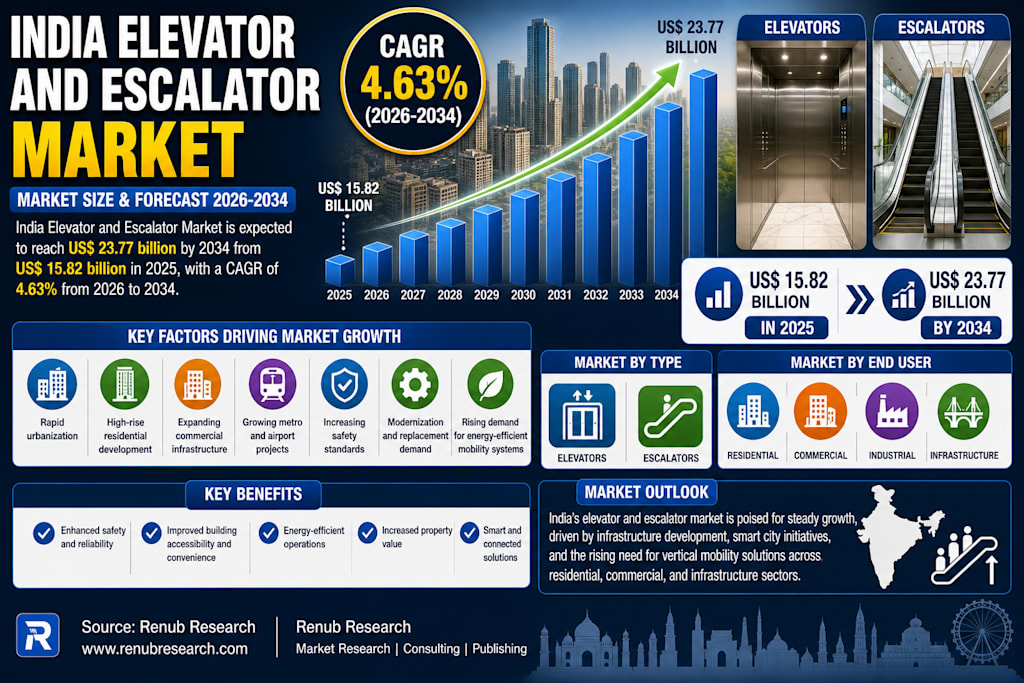
According to Renub Research, the market is expected to grow from US$ 15.82 billion in 2025 to US$ 23.77 billion by 2034, registering a compound annual growth rate (CAGR) of 4.63% between 2026 and 2034.
This growth trajectory is supported by rapid urbanization, increasing high-rise construction, and expanding investments in metro rail, airports, and smart city projects. Additionally, rising awareness of safety standards and the growing adoption of energy-efficient systems are further contributing to market expansion.
Growth Drivers
Rapid Urbanization and High-Rise Construction
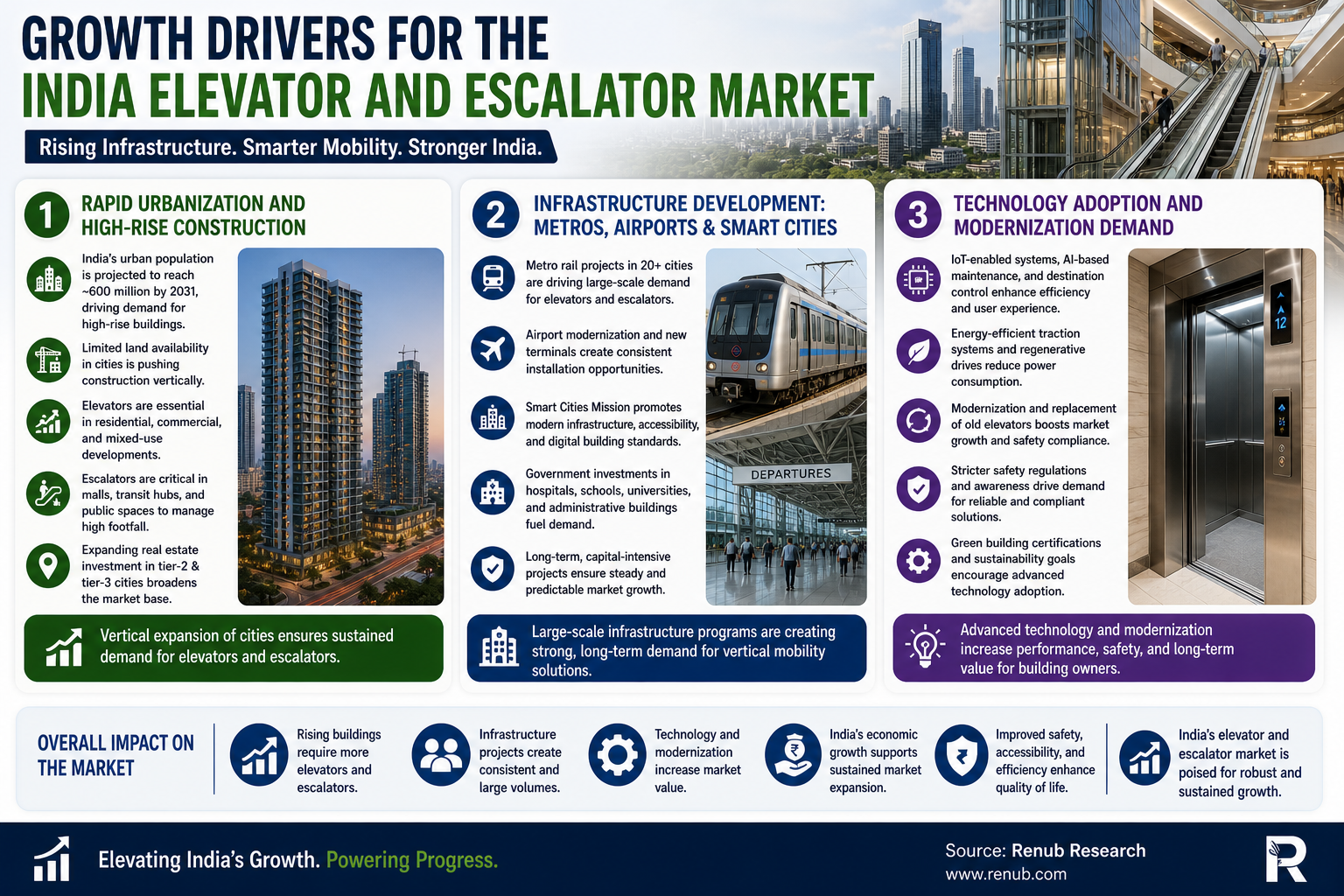
India is undergoing one of the fastest urban transformations in the world. Cities such as Mumbai, Delhi NCR, Bengaluru, and Hyderabad are witnessing a surge in high-rise buildings due to increasing population density and limited land availability.
As vertical construction becomes the norm, elevators are no longer a luxury but a necessity. Residential complexes, office towers, and mixed-use developments all require efficient vertical transportation systems. Escalators, meanwhile, are critical for managing high footfall in public spaces like malls and metro stations.
Moreover, tier-2 and tier-3 cities are also embracing vertical development, expanding the market beyond metropolitan regions and creating long-term growth opportunities.
Infrastructure Development: Metros, Airports & Smart Cities
India’s infrastructure boom is a major driver of elevator and escalator demand. Metro rail projects in cities like Pune, Ahmedabad, Chennai, and Kanpur require large-scale installation of escalators and elevators to handle passenger flow efficiently.
Airport modernization programs and new terminal developments under regional connectivity schemes are further boosting demand. Additionally, government initiatives such as the Smart Cities Mission are promoting modern infrastructure standards, including advanced mobility solutions.
Public sector investments in hospitals, educational institutions, and administrative buildings also contribute significantly to the market’s growth, ensuring a steady pipeline of projects.
Technology Adoption and Modernization Demand
The elevator and escalator market in India is increasingly driven by technological innovation. Building owners are prioritizing smart and energy-efficient systems that enhance performance while reducing operational costs.
Key technological trends include:
- IoT-enabled elevators for real-time monitoring
- AI-based predictive maintenance systems
- Destination control systems for efficient passenger movement
- Energy-efficient traction technologies
Older systems are being replaced with modern, compliant, and eco-friendly solutions. Additionally, the push for green buildings and sustainability is encouraging the adoption of regenerative drives and energy-saving technologies.
Challenges
High Installation and Maintenance Costs
Despite strong growth potential, the market faces challenges related to high installation and maintenance costs. Elevators require complex infrastructure, structural modifications, and strict adherence to safety standards, which increase initial expenses.
Maintenance costs, including regular inspections and component replacements, further add to the financial burden. For smaller developers and older buildings, these costs can be prohibitive, limiting adoption and modernization.
Regulatory Compliance and Safety Issues
India’s elevator and escalator market is also impacted by regulatory complexities. Different states have varying safety standards and compliance requirements, leading to inconsistencies in enforcement.
Many older buildings still operate outdated systems that may not meet modern safety guidelines. Additionally, the shortage of skilled technicians and lack of standardized inspection processes in smaller cities pose operational challenges.
Addressing these issues will be crucial for ensuring long-term market stability and safety.
Regional Analysis
Maharashtra
Maharashtra remains the leading market, driven by intense urbanization in cities like Mumbai and Pune. High-rise residential developments, commercial projects, and metro expansions continue to fuel demand.
Tamil Nadu
Tamil Nadu’s market is supported by strong industrial growth and a thriving IT sector in Chennai. The state also serves as a manufacturing hub for elevator companies, strengthening its position in the market.
Karnataka
Karnataka, particularly Bengaluru, is a major growth hub due to its booming IT industry and expanding urban infrastructure. The demand for smart and energy-efficient elevators is especially high in this region.
Uttar Pradesh
Cities such as Noida, Ghaziabad, Lucknow, and Kanpur are witnessing rapid development in residential and commercial infrastructure. Metro projects and smart city initiatives are further driving demand.
Recent Developments
BRIO Elevators India introduced the Brio BE360, a hybrid hydraulic panoramic elevator designed for luxury homes.
KONE India launched advanced SMART elevators with enhanced safety features aligned with updated standards.
Hybon Elevators announced a ₹25 crore investment to expand R&D and production capacity.
TK Elevator India unveiled a home elevator solution for villas and multi-storey residences.
Schindler India Pvt. Ltd. enhanced its destination control technology to improve efficiency in high-traffic buildings.
OTIS Elevator Company (India) Ltd. expanded its Gen3 connected elevator platform with cloud-based monitoring.
Johnson Lifts India Private Limited increased focus on energy-efficient elevator systems.
Mitsubishi Elevator India Pvt. Ltd. launched high-speed elevators for skyscrapers.
Fujitec India Pvt. Ltd. upgraded its service network with digital monitoring solutions.
Hitachi Lift India Pvt. Ltd. introduced AI-based diagnostics for predictive maintenance.
Competitive Landscape
The India elevator and escalator market is highly competitive, with both global and domestic players actively innovating and expanding their presence.
Key companies include:
- KONE Elevator India Private Limited
- Johnson Lifts India Private Limited
- Schindler India Pvt. Ltd.
- OTIS Elevator Company (India) Ltd.
- ThyssenKrupp Elevator (India) Pvt. Ltd.
- Mitsubishi Elevator India Pvt. Ltd.
- Fujitec India Pvt. Ltd.
- Hitachi Lift India Pvt. Ltd.
- Blue Star Elevator Pvt. Ltd.
These players are focusing on innovation, safety, digitalization, and service expansion to maintain competitive advantage.
Final Thoughts
India’s elevator and escalator market is on a steady upward trajectory, supported by urban expansion, infrastructure investments, and technological advancements. As cities grow taller and smarter, the need for efficient, safe, and intelligent vertical mobility solutions will only increase.
While challenges such as high costs and regulatory complexities remain, ongoing modernization and policy improvements are expected to address these issues over time. With strong demand across residential, commercial, and public sectors, the market is well-positioned for long-term growth and innovation.
About the Creator
Enjoyed the story? Support the Creator.
Subscribe for free to receive all their stories in your feed.
Comments
There are no comments for this story
Be the first to respond and start the conversation.