
India Diesel Genset Market Expected to Reach US$ 1.81 Billion by 2034 as Demand for Reliable Backup Power Intensifies
Rapid industrialization, infrastructure expansion, and growing energy reliability concerns are driving sustained growth in India’s diesel genset industry.

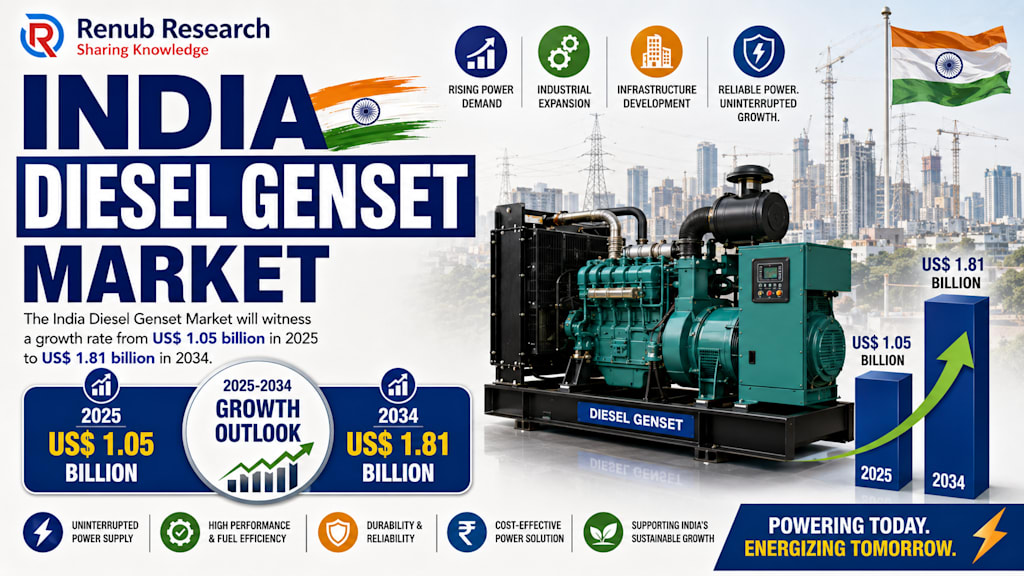
India’s diesel genset industry is entering a new phase of expansion as businesses, industries, and public infrastructure projects increasingly prioritize uninterrupted power supply in an economy undergoing rapid industrial and digital transformation.
According to Renub Research, the India diesel genset market is projected to grow from US$ 1.05 billion in 2025 to US$ 1.81 billion by 2034, registering a CAGR of 6.21% during 2026–2034.
The market continues to play a vital role in India’s energy ecosystem despite rising investments in renewable energy and cleaner technologies. Diesel gensets remain critical in regions where grid reliability issues, voltage fluctuations, and unexpected power outages continue affecting industrial and commercial operations.
From hospitals and telecom towers to construction sites and data centers, diesel generator sets continue serving as dependable backup and primary power sources across multiple sectors.
Rising Need for Uninterrupted Power Supply Is Driving Market Growth
One of the strongest growth drivers in India’s diesel genset market is the increasing demand for stable and continuous electricity supply.
Although India has significantly improved power infrastructure over the past decade, many regions still experience:
- Voltage fluctuations
- Grid instability
- Unexpected power outages
- Limited rural electrification reliability
Industries that require uninterrupted operations—including healthcare, telecom, manufacturing, and data centers—cannot afford power disruptions that may result in operational downtime and financial losses.
Diesel gensets provide reliable emergency backup power capable of supporting critical infrastructure during outages.
Commercial establishments such as:
- Shopping malls
- Hotels
- Schools
- Office complexes
- Residential towers
also rely heavily on diesel generators to maintain comfort, safety, and operational continuity.
In remote and rural regions where grid connectivity remains inconsistent, diesel gensets often function as primary power sources because of their reliability and ability to operate under difficult conditions.
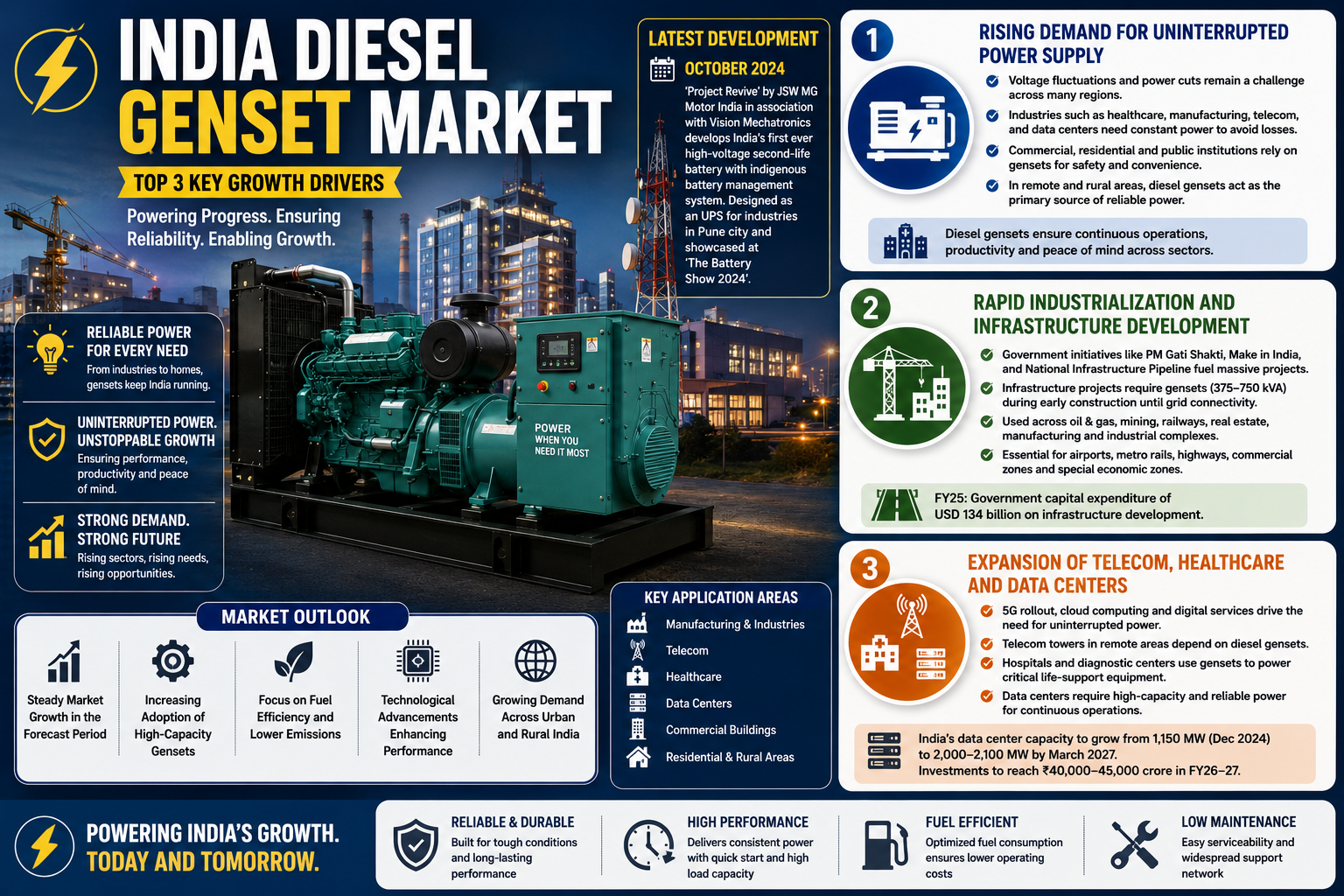
In October 2024, JSW MG Motor India partnered with Vision Mechatronics under “Project Revive” to develop India’s first high-voltage second-life battery system designed for industrial UPS applications.
This highlights the increasing focus on strengthening backup power infrastructure across India.
Industrialization and Infrastructure Expansion Continue Fueling Demand
India’s aggressive infrastructure and industrial development programs are significantly contributing to the growth of the diesel genset market.
Government initiatives such as:
- Make in India
- Smart Cities Mission
- National Infrastructure Pipeline
- PM Gati Shakti
are driving massive investments in construction, transportation, industrial corridors, airports, metro systems, and urban infrastructure projects.
According to the report, India allocated approximately USD 134 billion in FY25 toward PM Gati Shakti infrastructure projects.
Construction projects in their early stages frequently rely on rented diesel generators ranging between 375 and 750 kVA before permanent grid connectivity becomes available.
Industries such as:
- Oil & gas
- Mining
- Manufacturing
- Railways
- Real estate
depend heavily on gensets to ensure uninterrupted operations.
Rapid urbanization and the expansion of industrial zones are expected to maintain strong demand for diesel generators across the country over the coming decade.
Telecom, Healthcare, and Data Centers Are Becoming Major Consumers
The rapid expansion of India’s digital economy is creating substantial opportunities for the diesel genset market.
Telecommunication towers, especially in remote locations, continue relying heavily on gensets to ensure uninterrupted connectivity.
The growing adoption of:
- 5G infrastructure
- Cloud computing
- E-commerce
- Digital services
has accelerated the need for reliable backup power systems.
Data centers represent one of the fastest-growing end-user segments.
According to industry estimates cited in the report, India’s operational data center capacity is expected to increase from 1,150 MW in December 2024 to approximately 2,000–2,100 MW by March 2027, supported by investments worth ₹40,000–45,000 crore.
Hospitals and healthcare facilities also depend heavily on diesel gensets to support:
- Emergency power systems
- Intensive care units
- Surgical equipment
- Diagnostic infrastructure
The reliability and rapid response capabilities of diesel generators make them essential for mission-critical applications.
Low KVA Diesel Gensets Remain Popular in Urban and SME Markets
The low KVA diesel genset segment, particularly units up to 75 kVA, continues witnessing strong demand across India.
These generators are widely used in:
- Small businesses
- Retail outlets
- Residential buildings
- Telecom towers
- Educational institutions
- Banks
Their popularity is driven by factors such as:
- Compact design
- Fuel efficiency
- Affordability
- Ease of installation
The rapid expansion of small and medium enterprises (SMEs) across Tier II and Tier III cities is further strengthening demand in this segment.
Growth in India’s residential real estate sector is also contributing significantly to increased adoption of low-capacity gensets.
High KVA Generators Power Critical Infrastructure
The high KVA diesel genset segment plays a crucial role in supporting large-scale industrial and commercial facilities.
High-capacity generators above 75 kVA are widely used in:
- Data centers
- Airports
- Metro rail systems
- Factories
- Hospitals
- Large commercial buildings
These generators are designed to handle heavy electrical loads and ensure operational continuity for mission-critical infrastructure.
The expansion of smart cities, industrial parks, and logistics hubs continues driving demand for high-capacity diesel gensets throughout India.
Manufacturers are increasingly incorporating advanced technologies aimed at improving:
- Fuel efficiency
- Noise reduction
- Emission control
- Digital monitoring systems
Despite increasing environmental regulations, high-capacity gensets remain indispensable for sectors requiring dependable backup power.
Commercial Sector Continues Expanding Usage
India’s commercial diesel genset market remains highly active as businesses increasingly prioritize uninterrupted customer experiences and operational efficiency.
Commercial establishments including:
- Hotels
- Shopping malls
- IT parks
- Educational institutions
- Entertainment venues
depend heavily on backup generators during grid failures.
The rise of:
- Organized retail
- Co-working spaces
- Commercial complexes
- Hospitality infrastructure
across urban centers and emerging cities is creating sustained market opportunities.
Modern commercial gensets increasingly include:
- Noise reduction technologies
- Digital control systems
- Improved fuel efficiency
to comply with urban environmental regulations and improve operational performance.
Industrial Sector Remains a Core Market Segment
The industrial diesel genset market continues to form the backbone of India’s genset industry.
Industries such as:
- Manufacturing
- Mining
- Construction
- Cement
- Textiles
- Oil & gas
depend on gensets to avoid costly production interruptions caused by power failures.
Remote industrial operations and off-grid project sites especially rely on diesel generators for stable electricity supply.
Government-backed industrial initiatives and the expansion of Special Economic Zones (SEZs) continue driving industrial genset demand.
Heavy engineering and infrastructure projects also require high-powered generators capable of operating in harsh environmental conditions.
Maharashtra Leads the National Market
Maharashtra remains one of India’s largest and most advanced diesel genset markets due to its strong industrial base and urban infrastructure.
Major cities such as:
- Mumbai
- Pune
- Nagpur
host large concentrations of:
- IT parks
- Hospitals
- Manufacturing industries
- Data centers
- Commercial establishments
all of which require uninterrupted power supply.
Construction projects, metro rail development, and smart city initiatives are also contributing significantly to genset demand within the state.
The hospitality and retail sectors remain important contributors as well.
Uttar Pradesh Emerging as a High-Growth Market
Uttar Pradesh is witnessing rising demand for diesel gensets due to its large population, expanding infrastructure, and rapid economic development.
Industrial cities including:
- Noida
- Ghaziabad
- Kanpur
- Lucknow
are driving strong demand from:
- Commercial buildings
- IT parks
- Educational institutions
- Healthcare facilities
Government-led infrastructure projects such as industrial corridors and expressways continue supporting market expansion.
Diesel generators are increasingly used across:
- Construction sites
- Telecom infrastructure
- Small manufacturing units
- Agricultural operations
Despite increasing renewable energy adoption, gensets remain critical for ensuring power reliability across the state.
Andhra Pradesh and Gujarat Continue Expanding Industrial Demand
Andhra Pradesh is emerging as a promising market due to its growing industrial zones, logistics hubs, and port-based infrastructure development.
Cities such as:
- Visakhapatnam
- Vijayawada
- Tirupati
are witnessing rising investments in:
- Commercial infrastructure
- Manufacturing
- Healthcare
- Residential projects
Meanwhile, Gujarat remains one of India’s most industrialized states, with strong demand generated by industries including:
- Petrochemicals
- Chemicals
- Engineering
- Textiles
Industrial hubs such as Ahmedabad, Surat, Vadodara, and Rajkot rely heavily on gensets for uninterrupted operations.
Environmental Regulations and Fuel Costs Remain Key Challenges
Despite strong demand, the industry faces increasing challenges from environmental regulations and rising fuel costs.
The Indian government is implementing stricter emission norms aimed at reducing:
- Air pollution
- Carbon emissions
- Noise pollution
Manufacturers are being forced to adopt cleaner technologies and advanced emission-control systems, increasing production costs.
At the same time, fluctuating diesel prices significantly affect operational expenses for end users.
India’s increasing focus on renewable energy and carbon neutrality is also encouraging adoption of:
- Solar power
- Battery storage systems
- Hybrid energy solutions
- Natural gas generators
Government incentives supporting cleaner energy alternatives may gradually limit long-term dependence on diesel-powered systems.
However, diesel gensets continue offering unmatched reliability in many high-demand and remote operational environments.
Major Companies Operating in the Market
Several major companies continue shaping India’s diesel genset industry, including:
- Kirloskar Oil Engines
- Mahindra & Mahindra
- Ashok Leyland
- Cummins India Ltd.
- Caterpillar Inc.
- Cooper Corporation
These companies continue investing in cleaner technologies, fuel efficiency improvements, digital monitoring systems, and low-emission power solutions to maintain competitiveness in a rapidly evolving market.
Final Thoughts
India’s diesel genset market continues playing a critical role in supporting the country’s industrial growth, digital transformation, and infrastructure expansion.
Although renewable energy adoption and stricter environmental regulations are reshaping the long-term energy landscape, diesel generators remain essential for ensuring uninterrupted power supply across multiple sectors.
Growing investments in data centers, healthcare, telecom infrastructure, commercial real estate, and industrial development are expected to sustain market demand over the next decade.
As India continues modernizing its economy and expanding critical infrastructure, the diesel genset industry is likely to remain an indispensable component of the nation’s power ecosystem through 2034.
About the Creator
Enjoyed the story? Support the Creator.
Subscribe for free to receive all their stories in your feed.
Comments
There are no comments for this story
Be the first to respond and start the conversation.