
India Air Conditioner Market Expands Rapidly as Heatwaves, Smart Homes, and Energy-Efficient Cooling Fuel Demand
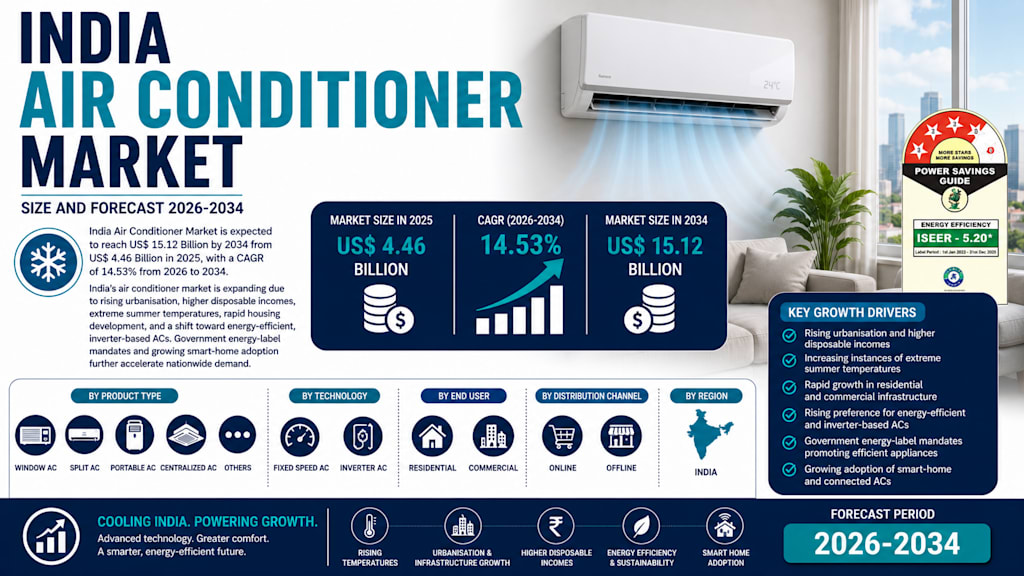
Valued at US$ 4.46 billion in 2025 and projected to reach US$ 15.12 billion by 2034, India’s air conditioner market is being reshaped by urbanization, premium product adoption, inverter technology, and rising cooling needs across residential and commercial spaces.

India’s air conditioner market is entering a strong growth phase
India’s air conditioner market is moving into a powerful expansion cycle as hotter summers, rising disposable incomes, and rapid urban development push cooling demand to new levels. According to the latest market analysis, the India Air Conditioner Market is expected to grow from US$ 4.46 billion in 2025 to US$ 15.12 billion by 2034, at a CAGR of 14.53% from 2026 to 2034.
This growth is not only a story about weather. It reflects a deeper lifestyle shift in India’s households and workplaces. Air conditioners are increasingly viewed as essential comfort appliances rather than luxury purchases, especially in metro cities and fast-growing tier-2 and tier-3 markets. Rising heat stress, improving electrification, digital retail channels, and a stronger preference for energy-efficient appliances are all accelerating demand.
At the same time, manufacturers are introducing connected, intelligent, and more efficient models that match the expectations of modern buyers. From AI-enabled cooling to smart-home compatibility, the Indian AC market is becoming more premium, more competitive, and more technology-led.
Cooling is becoming a necessity, not a seasonal luxury
India’s climate is one of the most important forces behind this market’s growth. Long and intense summers, rising average temperatures, and frequent heatwaves are making cooling a necessity in many parts of the country. In cities like Delhi, Mumbai, Hyderabad, Nagpur, and Ahmedabad, households and offices increasingly depend on ACs for comfort and productivity.
The market is also benefiting from the expansion of urban housing. As more families move into apartment-based living and compact modern homes, demand is shifting toward split ACs and inverter-based systems that deliver efficient, quiet, and space-friendly cooling. The report notes that rising middle-class purchasing power is a key support factor, especially in urban and semi-urban areas where consumers are upgrading from basic cooling appliances to higher-performance models.
Smart-home adoption is reshaping consumer expectations
One of the strongest trends in India’s AC market is the rise of smart-home adoption. Consumers now expect their appliances to connect with mobile apps, respond to voice commands, adjust automatically, and help reduce energy bills. That expectation is pushing manufacturers to pack more intelligence into their products.
AI-enabled air conditioners are especially attractive because they can learn user behavior, optimize cooling patterns, and reduce unnecessary electricity consumption. Features such as auto-cleaning, humidity optimization, multi-sensor control, and remote monitoring are becoming major selling points for urban buyers.
The report highlights Samsung’s 2026 Bespoke AI WindFree lineup, launched in India in January 2026, which includes 23 models with SmartThings connectivity and AI Energy Mode. That launch reflects the market’s clear shift toward premium smart-cooling solutions.
Energy efficiency is now a purchase driver
For many Indian buyers, electricity costs are a major factor in AC purchasing decisions. Rising tariffs have made inverter-based and high-star-rated models more attractive because they deliver steady cooling with lower power consumption. Government energy-label mandates are also helping shape consumer choices by making efficiency easier to compare.
This trend is particularly important in a market where the initial purchase price still matters. Consumers are willing to pay more for models that promise long-term savings, especially in regions where ACs are used for several months every year. The market is therefore moving toward a balance between affordability and efficiency, with inverter technology at the center of that shift.
Commercial buyers are also following this pattern. Offices, malls, data centers, hospitals, and retail stores are prioritizing efficient cooling systems that can handle high loads while keeping operational costs under control. That has made energy efficiency not just a consumer preference, but a business necessity.
Recent product launches are raising the bar
Competition in India’s air conditioner market has intensified as major global and domestic brands continue introducing new features and product lines. These launches are not just about cooling capacity anymore; they are about design, cleanliness, convenience, and connected living.
In March 2025, Sharp Corporation returned to the Indian market with three new series: Reiryou, Seiryo, and Plasma Chill. These models feature 7-stage air filtration, 7-in-1 convertible cooling, and auto self-cleaning functions. That re-entry signals renewed confidence in India’s premium AC opportunity.
In February 2025, Haier India launched its Kinouchi Limited Edition ACs in India’s first colorful AC line. With Black, Morning Mist, and Moonstone Grey options, the company combined aesthetics with AI-Enabled Supersonic Cooling, Frost Self-Clean, and HEXA Inverter Technology.
In April 2024, LG Electronics introduced a new AC lineup featuring Energy Manager functionality, convertible cooling modes, inverter compressors, and smart control through the LG ThinQ app. These launches show that product differentiation is now a major battleground in India.
Market growth is supported by strong state-level demand
India’s AC demand is not uniform across the country. Some states are stronger than others because of climate, urbanization, electricity access, and income levels. The report gives a clear view of how regional demand is evolving.
Maharashtra remains one of the strongest markets because of its dense cities, commercial infrastructure, and high summer temperatures. The state’s rising office and retail activity, along with its high electricity consumption and strong income levels, make it a core market for both residential and commercial AC sales.
Tamil Nadu is another important market because it combines long summers, humidity, industrial growth, and 100% household electrification. Chennai, Coimbatore, and Madurai continue to support strong demand for inverter and energy-efficient models.
Karnataka’s market is being supported by its urbanization, tech workforce, and commercial growth. Bengaluru in particular is a major demand center for smart, premium, and connected ACs.
Uttar Pradesh is also emerging as a major growth state because of its hot climate, expanding urban centers, and rising electricity consumption. As power distribution improves, AC adoption is expected to increase further across the state’s tier-2 and tier-3 cities.
The room AC and split AC segments remain the backbone
The Indian market is strongly led by room air conditioners, especially split ACs. Consumers prefer split ACs because they are quieter, more efficient, and better suited for modern apartments and homes. As people replace window units with inverter split models, the market is becoming increasingly premium and efficiency-driven.
Room AC demand is also being supported by e-commerce, easy financing options, and growing availability across urban and emerging markets. Many households now consider a room AC a basic comfort appliance during summer rather than a discretionary upgrade.
The 1.5-ton AC category holds a particularly important place in the market because it suits many medium-sized Indian rooms. This segment balances cooling performance, affordability, and energy use, making it one of the most popular choices for first-time and replacement buyers.
Commercial and retail applications are expanding fast
Beyond households, commercial and retail applications are contributing strongly to market growth. Offices, malls, hotels, restaurants, educational institutions, healthcare facilities, transport hubs, and co-working spaces all require reliable cooling systems.
Businesses are increasingly choosing VRF/VRV systems, cassette ACs, ducted solutions, and central cooling systems to improve energy management and comfort. These systems are especially important in larger buildings where efficient load distribution and central control can significantly reduce operating costs.
The hospitality, healthcare, transportation, and infrastructure segments also offer strong opportunities because they rely on uninterrupted cooling for both performance and customer experience. As India’s urban infrastructure expands, commercial AC demand is likely to remain a major market pillar.
Challenges still hold the market back in some segments
Despite strong momentum, the market still faces important barriers. The biggest one is affordability. Many households, especially in rural and lower-income areas, still find ACs expensive to buy, even with financing options. Inverter and smart ACs cost more upfront, which slows adoption among price-sensitive consumers.
Power infrastructure is another limitation. In several regions, voltage fluctuations and inconsistent electricity supply can affect AC performance and increase the cost of owning one. In some places, consumers also need stabilizers or more expensive inverter models to handle unreliable power conditions.
These challenges mean that India’s AC growth is strong, but uneven. Urban and semi-urban markets are progressing quickly, while rural penetration still has room to expand.
Recent developments from leading companies
The market’s recent momentum is also visible in the actions of major companies. The report highlights several key players, including Voltas, Blue Star, Havells India, Whirlpool of India, Godrej and Boyce Manufacturing, MIRC Electronics, and Johnson Controls-Hitachi Air Conditioning India.
Ten recent developments stand out clearly from the market’s current direction:
- Samsung launched its 2026 Bespoke AI WindFree lineup in India.
- Sharp re-entered the Indian market with new feature-rich AC series.
- Haier introduced India’s first colorful AC lineup.
- LG expanded its energy-saving and smart-connected AC portfolio.
Bosch acquired a majority stake in Johnson Controls-Hitachi Air Conditioning India in 2025, signaling long-term commitment to the market.
- The demand for inverter-based ACs continues to rise sharply.
- Smart-home integration is becoming a standard product expectation.
- AI-based cooling optimization is moving into mainstream product design.
- Premiumization is accelerating in urban India.
- Commercial cooling demand is growing with real estate and infrastructure expansion.
What the next phase of the market looks like
The next phase of India’s air conditioner market will likely be defined by three themes: efficiency, intelligence, and affordability. Consumers want lower power consumption, better comfort, and smart features, but they also want products that fit their budgets. That creates strong opportunities for manufacturers that can balance premium capability with practical pricing.
The market is also likely to benefit from continued real estate growth, higher appliance penetration in smaller cities, and a stronger shift toward connected homes. As energy efficiency becomes more important and cooling needs continue to rise, ACs will keep moving from discretionary purchases to essential home and business infrastructure.
Final thoughts
India’s air conditioner market is expanding rapidly because it sits at the intersection of climate, comfort, technology, and consumer aspiration. Extreme summers and rising urban living standards are creating basic demand, while smart-home adoption and energy efficiency are pushing the market into a more advanced phase.
With the market projected to rise from US$ 4.46 billion in 2025 to US$ 15.12 billion by 2034, the opportunity is substantial. Companies that invest in inverter technology, AI-enabled cooling, smart connectivity, and region-specific product design are likely to perform strongly in the years ahead. The market is not just growing; it is changing shape.
About the Creator
Enjoyed the story? Support the Creator.
Subscribe for free to receive all their stories in your feed.
Comments
There are no comments for this story
Be the first to respond and start the conversation.