
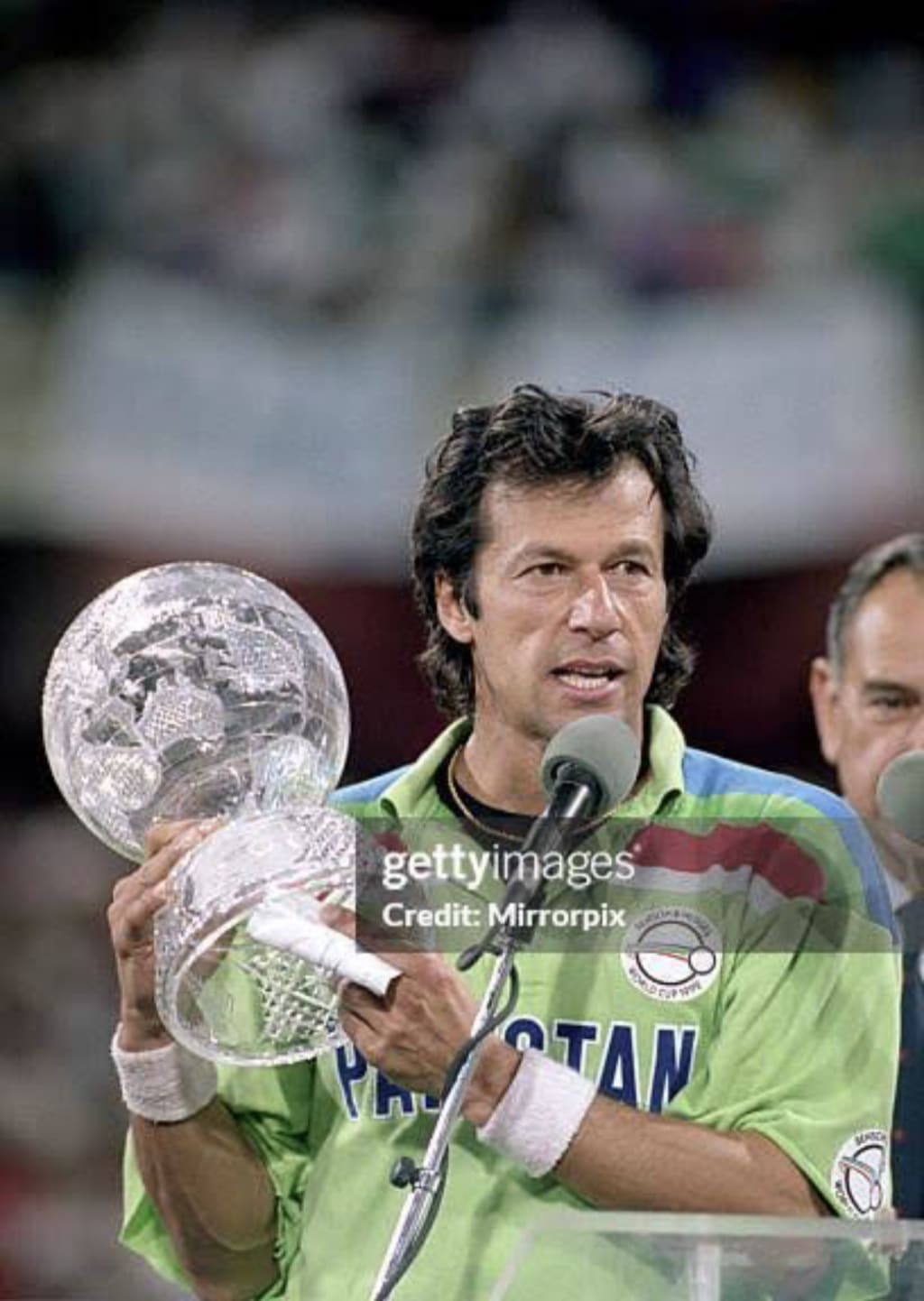
Imran Khan, born on October 5, 1952, in Lahore, Pakistan, is a figure whose life story reads like a compelling novel—one marked by determination, transformation, and an enduring drive to serve his country. From a celebrated cricket hero to a controversial political leader, Khan's journey has inspired millions and sparked debate across the world.
Imran was born into a well-off Pashtun family, the only son among four sisters. Educated at Aitchison College in Lahore and later at the prestigious Royal Grammar School in Worcester, England, Khan developed a keen interest in cricket. He went on to study philosophy, politics, and economics at Keble College, Oxford, where he also honed his cricketing talent.
His cricket career began in 1971 when he debuted for Pakistan’s national team. Initially seen as talented but inconsistent, Khan matured into one of the world’s greatest all-rounders. He was known for his pace bowling, sharp cricketing mind, and charisma on the field. But it was his leadership that set him apart. As captain, he transformed Pakistan's team into a competitive force.
The pinnacle of his cricket career came in 1992, when he led Pakistan to its first and only Cricket World Cup victory. It was a fairy-tale ending to his cricketing life, as he retired immediately after the triumph. That same year, he suffered a personal tragedy—the death of his mother from cancer. This loss would inspire his next major chapter.
Motivated by her memory, Imran Khan launched a fundraising campaign to build a world-class cancer hospital in Pakistan. Skeptics doubted him, but he succeeded, raising money both in Pakistan and abroad. In 1994, the Shaukat Khanum Memorial Cancer Hospital opened in Lahore, named after his mother. It became one of South Asia's leading cancer treatment centers and a symbol of his dedication to public service.
By the mid-1990s, Imran Khan had become a national hero not just for his cricketing exploits, but also for his philanthropy. However, he believed that real change in Pakistan would only come through politics. In 1996, he founded his political party, Pakistan Tehreek-e-Insaf (PTI), or the Pakistan Movement for Justice.
The political arena, however, proved far more challenging than cricket. PTI performed poorly in early elections, and Khan was often mocked as an inexperienced idealist. Yet he persisted, railing against corruption, dynastic politics, and social injustice. Over the years, Khan’s message began to resonate, particularly with Pakistan’s growing youth population and urban middle class.
Khan’s personal life, often under intense media scrutiny, also played a role in shaping his public image. His marriage to British heiress Jemima Goldsmith in 1995 was widely covered, but cultural and political differences led to their divorce in 2004. He later married journalist Reham Khan in 2015, a union that lasted less than a year. In 2018, he married Bushra Bibi, a spiritual guide. While his personal life drew both admiration and criticism, it never eclipsed his political ambitions.
The tide turned in PTI’s favor in the 2013 general elections, where the party emerged as a significant force, particularly in Khyber Pakhtunkhwa, a province they went on to govern. Imran’s focus on anti-corruption, education, and healthcare reforms earned him growing support. By the 2018 general elections, PTI won enough seats to form the federal government, and Imran Khan became the 22nd Prime Minister of Pakistan.
His tenure was marked by both ambitious reforms and significant challenges. He launched programs to reduce poverty, improve healthcare, and expand social welfare. His government introduced the Ehsaas Program, aimed at financial inclusion and support for the country’s poorest. He also championed environmental projects, including the ambitious “Billion Tree Tsunami” initiative to combat climate change.
On the international stage, Khan sought to improve relations with neighboring countries, while navigating a difficult relationship with India. He also positioned himself as a vocal critic of Islamophobia in the West and advocated for Muslim causes globally.
However, Khan’s time in office was far from smooth. His critics accused him of being too close to the military establishment, while others pointed to economic instability, rising inflation, and authoritarian tendencies. His government struggled to deliver on some of its promises, and opposition parties united against him.
In April 2022, Khan faced a major political blow. A no-confidence motion in parliament led to his ousting from the prime minister’s office. He alleged foreign interference and rallied his supporters, triggering nationwide protests. His popularity, however, remained strong, especially among the youth, and he continued to fight politically from the opposition bench.
Legal challenges, including multiple court cases and disqualification attempts, followed in 2023 and 2024. Yet Khan remained defiant, portraying himself as a crusader against a corrupt political elite. His resilience in the face of adversity further deepened his support base.
As of 2025, Imran Khan remains a deeply polarizing figure in Pakistani politics. To his supporters, he is a hero—a man of integrity who challenged entrenched systems and gave voice to the people. To his critics, he is a populist who failed to deliver meaningful governance.
Regardless of opinion, there is no denying Imran Khan’s impact on Pakistan’s national story. From cricket fields to hospital wards to the prime minister's office, he has lived a life of public struggle, reinvention, and unwavering ambition. His legacy, still unfolding, continues to shape the future of Pakistan.
Let me know if you'd like a shorter version or a focus on a particular part of his life (like just cricket or politics).
About the Creator
Enjoyed the story? Support the Creator.
Subscribe for free to receive all their stories in your feed.
Comments
There are no comments for this story
Be the first to respond and start the conversation.