
If You Ask AI Before You Ask Yourself, You’ve Already Lost
A child asked me why he should learn when a machine can answer everything — and the honest answer is darker than you think.
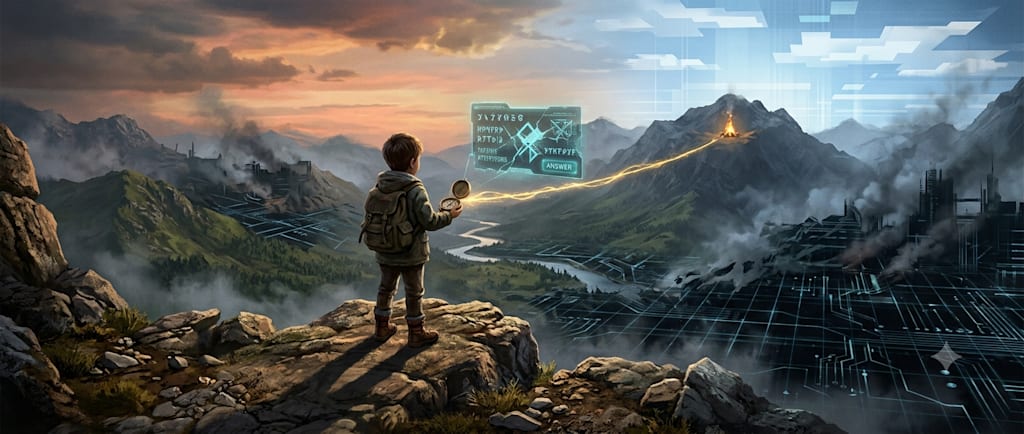
The child tilts his head. His eyes hold light, and confusion. He asks: “Why do I have to struggle learning things I don’t know? Can’t I just press a key and let AI tell me everything?”
The weight of that question is heavier than he knows.
I. Every Upgrade of Tools Comes with a Cruel Upgrade of Capability
Thirty thousand years ago, our ancestors smeared ochre on cave walls to paint bison. The tool was a rock. The bar was only a notch above what a monkey could manage.
Three thousand years ago, Cai Lun improved papermaking, and Meng Tian refined the writing brush. Writing became faster, but humans were forced to spend ten winters and summers memorizing the strokes of characters and the rise and fall of composition. Paper and ink freed the hands, yet locked more years inside the study.
A hundred years ago, the typewriter arrived. Then came the keyboard and the screen. We thought we could finally speed up. But what happened? You had to memorize key layouts, learn formatting logic, figure out why page numbers suddenly jumped from 1 to 3. Eventually, you needed a bit of functions, a bit of coding, just to make that box called a computer obey.
Now AI stands at the peak of all tools. It is like an instant teleportation gate. You name a destination, and it flings you there.
But here’s the problem: if you can’t even read a compass, how do you know whether the gate dropped you in an oasis or a desert?
Last month, someone looked up a refund policy. AI gave a confident plan: dates, channels, fees, down to the decimal. All fabricated. A law professor queried statutes; AI invented whole clauses that never existed, speaking with the certainty of a supreme court justice.
This is AI’s deadliest flaw. It always speaks, but never guarantees truth.
If you know nothing and grab AI like a toy, you’re a three‑year‑old seizing the wheel of a heavy truck. The engine roars, you feel in control. The next second, you’re in a ditch.
What you learn from the things you don’t know is never the answer itself. You learn the ability to judge answers, the skill to question AI. Without inner strength, a dragon‑slaying blade is scrap metal. With it, even grass and stones become swords.
II. When the Tide Recedes, Only the Bones That Grew on You Can Hold You Up
We always think: life is good now, and it will stay good forever.
Open history. Peace and comfort are only the breath we catch between two great upheavals. Thirty years ago, the iron rice bowl of “typist” vanished. Twenty years ago, pagers entered museums. And AI? It’s just another stone in the river—bigger, shinier than the others, but the water keeps flowing.
The app you rely on today: its servers may shut down tomorrow. The model you worship today: a new algorithm will crush it next year. If you hand over your brain as a racetrack for machines, and then power cuts, networks collapse, or a villain wields AI as a weapon, what are you?
You are meat on the chopping block.
The Terminator is not pure sci‑fi. On the day when silicon and carbon sit down to decide who’s in charge, those who ask AI for even the multiplication table will stand before the ruins with empty hands.
Learning, on the surface, is stuffing things into your head. In truth, it is growing muscle: brain muscle, the muscle of instinctive response. The tenacity to derive a formula from scratch. The quick wit to improvise tools when none exist. The resolution to choose your own direction when no one can help.
These abilities are etched in our genes. If the world crumbles to dust, if civilization reboots, as long as you have something in your mind and strength in your hands, you can still make fire, build shelter, and paint the first bison on a new cave wall. Others can confiscate your phone, but never your palace of thought.
III. If the Machine Walks Every Step for You, Who Stands at the Summit?
Imagine a thought experiment. There’s a game: you lie down and sleep, while an AI bot auto‑fights, auto‑levels, and clears all achievements for you. You wake up the next morning, your account gleams with gold.
Who played the game? You, or the machine?
Learning is bitter. Because it means failure after failure: memorize and forget, calculate and err, write and tear. But it is precisely these clumsy struggles that grow the thickness of a person.
If you hand all Tang poetry to AI for interpretation, you will never know: late one night, you flip to “This feeling, to be recalled, already aches,” and those seven characters, like a hand reaching across a thousand years, suddenly grip your heart. You don’t know what it is, but you know: you have been understood.
If you throw every math problem to a calculator, you will forever miss that moment: after three hours of torment, when insight suddenly drills through the wall, and dopamine bursts like fireworks across your cerebral cortex. In that second, you feel nothing in this world can confine you.
Learning is the soul growing taller.
Those rote‑memorized formulas, those concepts you grasped only after stumbling, they don’t stay on exam papers. They dissolve into your blood, change the way you see, let you glimpse stars that cattle cannot see, and hear in the wind lines that others miss.
The ancients said, “Belly full of poetry and prose, one’s spirit shines.” That spirit is the dignity unique to being human. The day you outsource your thinking, you become an animal in a zoo: food in the bowl, warmth in the cage, but you can no longer run. You can never again taste the wind of the wild.
The child’s question still lingers.
AI is fire: it can illuminate, and it can burn. AI is a boat: it can ferry you across, and it can sink you.
Looking up an answer fills your stomach in three minutes. But learning it yourself: that is plowing, harvesting, kindling, cooking. Finally you swallow that meal, and it turns into the bone and blood that carry you forward.
This road is not easy. Mud will stain your trousers; thorns will cut your palms.
But only those who have walked through it, when they stand on the summit, the wind on their face, the vastness spreading beneath their eyes, that is theirs.
You are a thinking being. Not a fed one.
About the Creator
Jin
Writer of reamstories
https://reamstories.com/jin
Enjoyed the story? Support the Creator.
Subscribe for free to receive all their stories in your feed. You could also become a paid subscriber, letting them know you appreciate their work.
Comments
There are no comments for this story
Be the first to respond and start the conversation.