
I Went to Buy a 1TB Hard Drive. The 2TB Was Cheaper. That’s When I Realized the Storage Industry Had Moved On.
An $89 1TB drive sitting next to a $79 2TB drive isn’t a pricing error. It’s the new math of AI data centers, rare earth shortages, and three companies that stopped making hard drives for people like you.
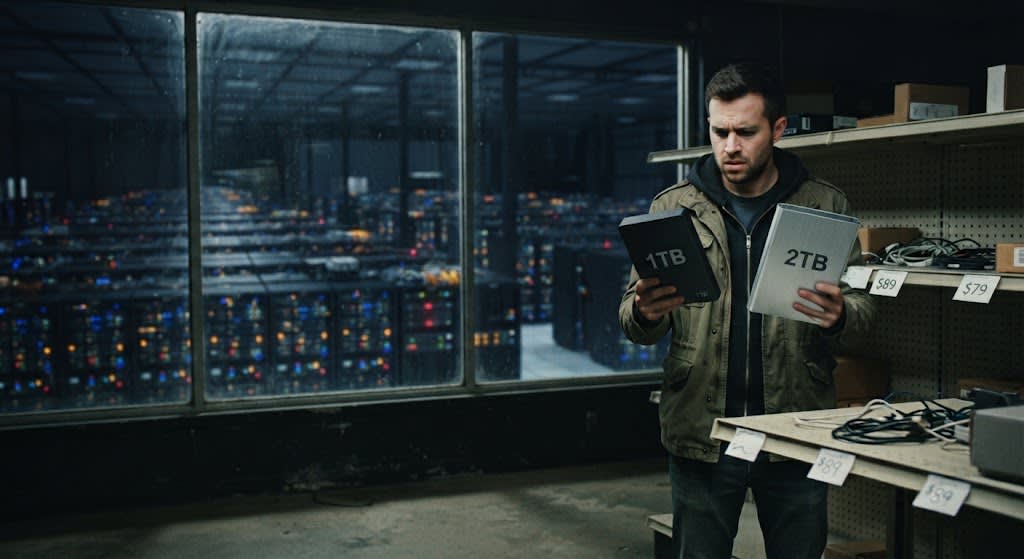
Two price tags, side by side.
1TB: $89. 2TB: $79.
A man in a computer parts store in Kuala Lumpur holds both boxes. He turns them over. He checks the model numbers. He asks the clerk if there’s been a mistake. The clerk shrugs and says the 2TB is actually cheaper now, and if he wants the best value he should just get the 4TB.
The man puts the 1TB back on the shelf.
Nothing dramatic happened. The product simply stopped being made for him.
What the CEOs said
In February 2026, Western Digital CEO Tiang Yew Tan told analysts on an earnings call: “We’re pretty much sold out for calendar year 2026. We have firm purchase orders with our top seven customers through calendar year 2026. We also have in place robust commercial agreements with three of our top five customers, two through calendar year 2027 and one through calendar year 2028.”
Seagate CEO William Mosley said on his own call: “Our nearline capacity is fully allocated through calendar year 2026, and we expect to begin accepting orders for the first half of calendar year 2027 in the coming months.” He added that multiple cloud customers were discussing demand projections for 2028. Supply assurance was their top priority, he said.
Toshiba, the third manufacturer, is understood to be in a similar position, though it no longer provides public earnings outlooks.
Three companies. All sold out. Not for a quarter. For the year. And booking orders into 2028.
What “sold out” means on the shelf
Western Digital’s cloud and enterprise segment now accounts for 89 percent of sales. The consumer share is 5 percent. That ratio is not an accident of the market. It’s a decision.
Those seven top customers Tan mentioned? Amazon. Google. Microsoft. Meta. OpenAI. Companies building AI data centers at a pace that has no precedent.
They buy in exabytes. They sign multi-year agreements. They pay upfront. When they need more storage, they don’t walk into a store and compare price tags. They call a sales representative and lock in capacity before it’s built.
The man in the store with two boxes in his hands is not in that conversation.
The data AI generates and never deletes
Tim Rausch, SVP of Product Engineering at Western Digital, gave a talk at the 2026 AI Infra Summit. He quoted an unnamed senior technology executive at a hyperscale cloud provider: “Everything that every LLM ever generates is stored on HDD. Every prompt, every piece of media that’s uploaded is being stored and retained.”
Rausch then walked through a concrete example. An AI model generates an 8-second video in 720p. The final file the user downloads is 3.97MB. But the platform also saves the encoded output, the intermediate results, the inference trace, the request log, the compliance record. Total: approximately 509MB. That’s roughly 130 times the size of the file the user actually sees.
The download is the tip. The data underneath is the iceberg. And the iceberg lives on hard drives.
IDC’s 2026 Global Datasphere forecast projects 274 zettabytes of data created this year, rising to 718ZB annually by 2030. Most of it will be stored on spinning disks, not flash. The economics don’t allow otherwise. A 30TB enterprise SSD costs $22,600. A 30TB HDD costs $1,216. That’s a difference of 18.6 times.
At that price gap, AI companies don’t really have a choice. They use HDDs.
The numbers that don’t require an explanation
The average price of a 4TB 3.5-inch SATA hard drive in September 2025: approximately $120. In September 2026: approximately $240. The 8TB models went from around $200 to $400.
A WD Blue 4TB that sold for $70-$80 now breaks $140.
An 8TB Seagate IronWolf that sold for 1,170 yuan in October 2024 now lists at over 2,850 yuan.
Morgan Stanley’s Asia checks in June 2026 put nearline HDD pricing below $15 per terabyte at that time, but noted that vendors were targeting $25-$30 per terabyte over the next two to three years.
The firm estimated HDD demand growing at 40-50 percent annually while supply growth ran at 30-35 percent. That gap, Morgan Stanley said, is driving shortages “through at least CY28.”
The shortage gap: 300 exabytes in 2026, widening to 400 exabytes in both 2027 and 2028.
What goes into a hard drive besides the disk
The voice coil motor and spindle motor both require neodymium-iron-boron magnets. In April 2025, China introduced export controls on gallium, germanium, and additional critical materials, with stricter licensing requirements on rare earth elements.
Neodymium oxide prices rose approximately 40 percent. Dysprosium oxide prices more than doubled.
By late April 2026, NdPr oxide peaked at $102.88 per kilogram before easing. Ex-China dysprosium oxide CIF Europe gained 56 percent to reach an average of $3,500 per kilogram in Q3 2026.
Rising rare earth costs eroded profit margins on lower-capacity drives. Some manufacturers issued End-of-Life notices for select 1-8TB models or reduced production volumes.
The 1TB drive on that shelf costs more to make, per gigabyte, than the 4TB drive next to it. Popularity has nothing to do with it. The platters tell the story.
Why four is the new one
A consumer hard drive contains one to five platters.
A 1TB drive: one platter, 1TB per platter. Old technology.
A 2TB drive: typically one platter at 2TB per platter in newer models. Older models used two.
A 4TB drive: two platters, each at 2TB.
The single-platter 1TB configuration uses older, lower-density media. The cost of manufacturing that platter is nearly the same as manufacturing a 2TB platter. The revenue is half. The margin is negative after rare earth price increases.
Seagate’s current Mozaic 4+ platform uses HAMR (Heat-Assisted Magnetic Recording) technology to achieve 4TB per platter, with 10 platters yielding 44TB total capacity. The company plans to reach 50TB with Mozaic 5+ in 2027 and has demonstrated 8TB per platter in laboratory conditions.
Western Digital’s 44TB HAMR drive uses 11 platters at 4TB each. The company’s roadmap targets 100TB by 2029 using 14 platters at approximately 7.1TB per platter.
The technology gap between consumer and enterprise drives keeps growing. Every platter that goes into a 1TB consumer drive is a platter that could have gone into a 40TB enterprise drive at 10 times the margin.
The decision to not decide
Seagate is not expanding production capacity. CEO Mosley said growth will come only from higher-capacity drives, not from additional unit numbers. CFO Gianluca Romano added: “If in a quarter, we can produce a little bit more, of course, we will sell those exabytes in the open market at a good profitability. But I would say the vast, vast majority of the volume is already allocated.”
Western Digital’s revenue in Q4 2025 increased 25 percent year-over-year to $3 billion. Operating profit rose 62 percent to $908 million. Gross margin expanded from 38.4 percent to 46.1 percent.
Building a new hard drive factory takes years and billions of dollars. The last time the industry added new capacity, it triggered a price collapse that wiped out margins for a decade. The executives who lived through that are not eager to repeat it.
So they sell what they make. They raise prices when they can. They allocate to the customers who sign the longest contracts. And they let the retail channel figure out what to do with whatever is left.
What’s left for everyone else
The man in the store does not buy the 1TB or the 2TB.
He goes home. He opens his browser. He removes the 1TB drive from his shopping cart. He adds a 4TB. He opens a second tab and searches for “used enterprise hard drive 14TB.”
The price difference between the 4TB and the 14TB, per terabyte, is not that large anymore. The enterprise drives are louder. They run hotter. They come with no warranty and unknown hours. But they work.
He clicks “add to cart.”
The hard drive industry did not crash. It did not collapse. It simply stopped returning his calls. The product still exists. It’s just not for him anymore.
Morgan Stanley’s analysts described HDDs as “our still-most-preferred area of AI exposure” within IT hardware. Valuations remained “undemanding.” The firm’s bull case suggested Seagate and Western Digital could 10x EPS between 2025 and 2028.
Seagate and Western Digital are posting record margins. The hard drive just has different priorities now.
About the Creator
Jin
Writer of reamstories
https://reamstories.com/jin
Enjoyed the story? Support the Creator.
Subscribe for free to receive all their stories in your feed. You could also become a paid subscriber, letting them know you appreciate their work.
Comments
There are no comments for this story
Be the first to respond and start the conversation.