
I Watched the iPhone 18 Pro Launch. Here’s Why the Pro Max Got Scalped and the Pro Got Ignored.
A 1,000-yuan gap, a Burgundy color, and a buyback board with one blank column.
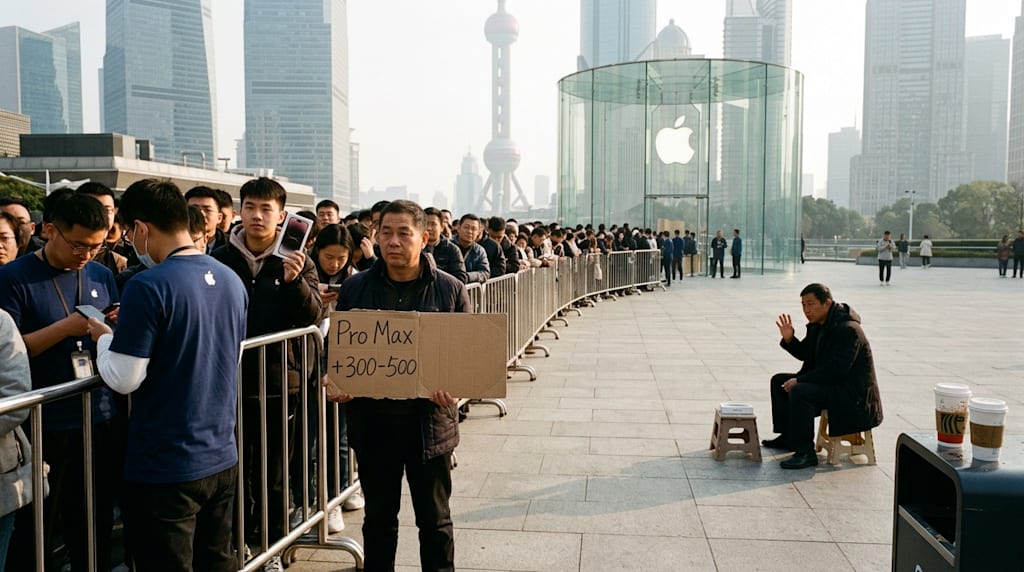
On September 18 at 8 a.m., barriers were already up outside the Apple Store on Century Avenue in Lujiazui, Shanghai. More than a hundred people stood in line with reservation codes. Staff called numbers at the door and let people in a few at a time. According to staff, neither iPhone 18 Pro model was available for walk-in purchase. Both had been reserved.
The store was hot. The heat was uneven.
Near the scalpers, the question heard most was: “Any Pro Max?” Before new buyers had opened the box, scalpers were leaning in with offers. For 256GB and 512GB iPhone 18 Pro Max, buyback markups generally ranged from 300 to 500 yuan. The new Burgundy color could fetch a little more. Fewer people asked about 1TB and 2TB versions. Scalpers waved them off, saying large-capacity models were hard to move.
The Pro was a different story.
A customer walked out with an iPhone 18 Pro. A scalper glanced at it and said nothing. Asked again, he shook his head: “Not buying.” The price was not the issue. He would not take it. On launch day, the Pro broke below its official price in the channel.
This had happened before. Last year, at the iPhone 17 launch, the same split appeared: Pro Max got marked up, Pro broke below price and was refused. Shenzhen scalpers offered roughly 600, 450, and 450 yuan over cost for the 17 Pro Max 256GB, 512GB, and 1TB. The orange 256GB could reach 700. This year, buyback markups for the 18 Pro Max generally fell between 300 and 500 yuan, with Burgundy a little higher. The split and the color logic were the same. Only the star changed from orange to Burgundy.
Last year, scalpers who took Pros lost money. This year, they refused the 18 Pro from the start.
After a 1,000-yuan hike, the Pro is stuck in the middle
This year, the iPhone 18 Pro series starting price rose by 1,000 yuan. The Pro starts at 9,999 yuan. The Pro Max starts at 10,999 yuan. The difference is 1,000 yuan.
That 1,000 yuan is the problem.
Before the price hike, there was a price gradient between Pro and Pro Max. Consumers could choose based on budget and hand feel. After the hike, the gap narrowed. Many people’s mental accounting began to recalculate. They were already spending nearly 10,000 yuan. They might as well add 1,000 and go straight to the top.
Consumers split into two groups. Those who wanted to save money did not buy the Pro at launch. They waited for Pinduoduo, JD.com, or Double 11. Those who insisted on a launch flagship very likely went straight to the Pro Max. The Pro was stuck in between. It had neither the standard model’s price advantage nor the Pro Max’s flagship scarcity.
Outside the Apple Store, a man who had just reached the front of the queue said to his companion, “The Pro and Max are only 1,000 apart. Then of course it’s the Max. Bigger battery, too.” His companion nodded and handed his reservation code to the staff.
The Pro Max wins on what you can feel. The Pro loses on a spec sheet.
The Pro Max and Pro differ in ways you notice every day. The Pro Max has a 6.9-inch screen. The Pro has a 6.3-inch screen. The Pro Max does 43 hours of video playback. The Pro does 34. A bigger screen and longer battery are things you notice every day. Watching a show or scrolling, your fingers and eyes do not lie. The Pro’s upgrades are concentrated in the 2nm chip, VC vapor chamber, and variable aperture. These things matter, but on launch day, ordinary consumers cannot feel them.
The Pro Max sells a flagship you can feel immediately. The Pro sells a flagship on a spec sheet.
In the high-end market, specs can support a price. They can hardly support the desire to upgrade on their own. After a 1,000-yuan price increase, consumers become many times more sensitive to whether something is worth it. The Pro Max at least offers two irrefutable reasons: a bigger screen and longer battery. The Pro requires users to convince themselves.
Most people are not willing to spend 10,000 yuan to convince themselves.
Scalpers refuse the Pro: The math does not work
Scalpers are not taking the Pro for a simple reason: the risk-reward ratio does not work.
E-commerce platform subsidies for the Pro push the actual purchase price below Apple’s official price. On channels like Pinduoduo, a subsidized Pro can be about 900 yuan below the official price. If a scalper buys it back at the official price, he loses money on resale. If he lowballs, the consumer will not sell. The result: the Pro loses liquidity on the scalper side.
The Pro Max is different. Demand is concentrated in 256GB and 512GB, and new colors have scarcity, so buyback markups still exist. But this year, even Pro Max markups have narrowed. Last year, orange 256GB could reach 700 yuan. This year, it is generally only 300 to 500. Even for the hottest Pro Max, scalpers do not dare stock up as boldly as they once did.
Buyers in this segment still spend. They just spend more carefully.
Sales data pointed to the same split
Scalpers do not decide what to buy on a whim. They look at historical data. Take the iPhone 17 series in China. In January 2026, cumulative activations were 4.9 million for the Pro and 8.26 million for the Pro Max. By May, the Pro had reached 7.8 million and the Pro Max 13.2 million. In Q2 2026, Counterpoint put the Pro Max at 6% share and the Pro at 4%. Pro Max sales are consistently 1.5 to 1.69 times those of the Pro. In the high-end flagship market, the Pro Max is Apple’s main volume driver. The Pro looks more like an accessory to the Pro Max.
Seeing this data, and combining it with this year’s 1,000-yuan price hike and the narrowed 1,000-yuan gap, scalpers hardly need to hesitate: take the Pro Max, refuse the Pro.
The decision is arithmetic.
Apple’s problem: The Pro has to answer why it is worth 1,000 yuan less than the Max
The split in the iPhone 18 Pro launch points to a positioning crisis inside Apple’s product line.
In a price-hiking cycle, Apple needs to give every model an irrefutable reason to buy. The Pro Max has one: it is bigger and lasts longer. The Pro’s reason is getting blurrier. It is better than the standard model, but if the standard model is delayed or cheaper, the Pro loses its anchor. It is cheaper than the Pro Max, but only by 1,000 yuan. That is not enough to offset the pull of a bigger screen and longer battery.
So the Pro falls into a loop:
People who want a Pro mostly wait. People willing to buy at launch go straight to the Pro Max. Scalpers only take the Pro Max, where markup is certain. The Pro breaks below price at launch, reinforcing the expectation that it is not worth buying early.
The store queue happened. The Pro Max markup happened. The Pro broke below price and was refused. All three can happen at once without contradiction. They point to the same fact: In the high-end market, consumers are not unwilling to spend. They are unwilling to spend on a flagship that is not top-tier enough.
In the afternoon, the barriers outside the Lujiazui Apple Store were folded up. A scalper flipped his quote board over. On the Pro Max side it said “300 to 500.” The Pro side was blank. Someone asked, “What about the Pro?” The scalper shook his head and pointed at the Pinduoduo price on his phone. Next to the convenience store, coffee cups piled on the trash can, beads of water on the sides.
Inside the store, the last batch of reservation holders were picking up their phones. At the door, someone opened a Pro Max box. Burgundy caught the sunlight and flashed. The scalper stepped up and quoted a price. The buyer thought for a moment and handed the box over.
About the Creator
Jin
Writer of reamstories
https://reamstories.com/jin
Enjoyed the story? Support the Creator.
Subscribe for free to receive all their stories in your feed. You could also become a paid subscriber, letting them know you appreciate their work.
Comments
There are no comments for this story
Be the first to respond and start the conversation.