
I Watched Apple Promise a New Siri. Then I Watched Them Delay It.
A class action over delayed Apple Intelligence features ends with payments for some U.S. iPhone buyers. Here is what the agreement covers.
I Watched Apple Promise a New Siri. Then I Watched Them Delay It.
I was sitting in my living room in June 2024, laptop open, watching the WWDC keynote stream. Apple put a new Siri on screen. It read emails. It understood schedules. It checked flights, saw what was on the screen, and connected to apps without being told. The demo felt less like an update and more like the thing I had wanted since I bought my first iPhone. I remember closing the laptop and thinking the feature was a few months away.
That was the promise.
In March 2025, I opened my phone during lunch and saw the headline: Apple was delaying personalized Siri. The ads were gone. The feature I had watched on that stream did not exist, and there was no new date. The U.S. National Advertising Review Board later found that Apple's claim the new Siri was "available now" had misled users. Less than nine months sat between the keynote and the silence. By then the iPhone 16 had been on sale for half a year, and people who bought it on the strength of that demo had nothing to show for it.
I kept reading. What followed was a class action. The argument was simple: Apple described an unfinished feature as "coming soon" in its marketing, and people bought devices based on that. The lawsuit accused the company of violating false advertising, unfair competition, and consumer protection laws. Apple denied everything and pointed out that it had shipped other Apple Intelligence features. Then it settled, which is what companies do when the cost of fighting is higher than the cost of paying. The settlement includes no admission of wrongdoing.
The number that came out was $250 million. Ryan Clarkson, one of the lawyers in the case, called it the largest false advertising settlement in history. The fund covers about 36 million eligible iPhones. The baseline payout is $25 per device, roughly 167 yuan. If fewer people file claims than expected, the top amount per device rises to $95, about 637 yuan. If more people file than expected, the payout drops below $25. The final number depends entirely on how many valid claims get submitted.
This is where most people stop reading, because the fine print is where the story usually ends. It is also where I learned the money is not for me.
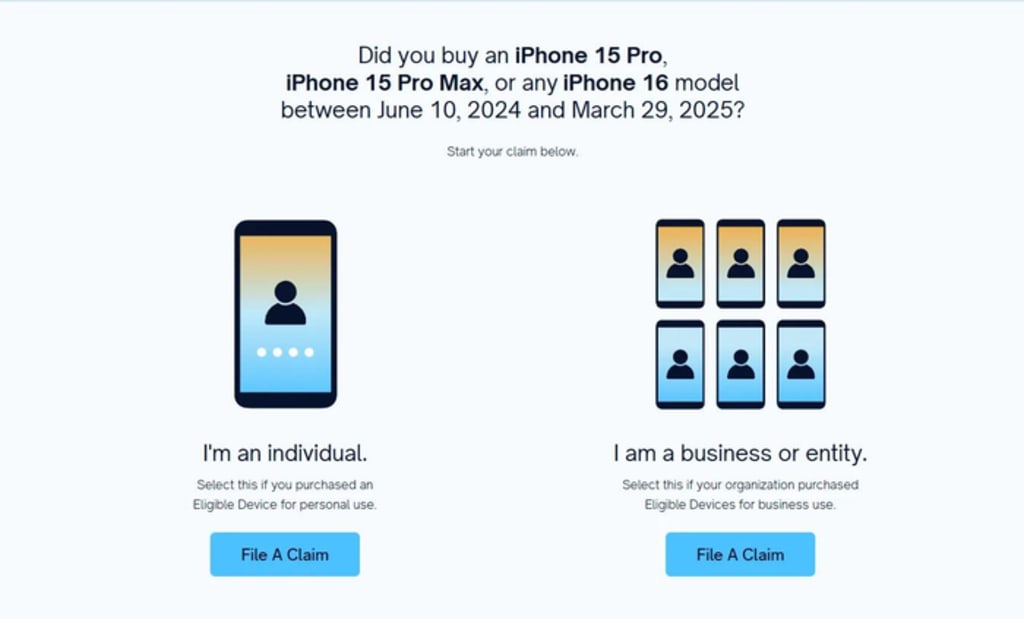
To qualify, three things have to be true at once. You must live in the United States. You must have bought an eligible model in the U.S. between June 10, 2024, and March 29, 2025. And you must be the original purchaser, not someone who bought the phone secondhand. The eligible models are the iPhone 15 Pro, 15 Pro Max, 16, 16e, 16 Plus, 16 Pro, and 16 Pro Max. U.S. citizens living abroad do not qualify. People who bought their phones in mainland China, Hong Kong, or other regions are not covered either. The settlement is limited by geography and by the reach of U.S. class action law, and a U.S. court cannot extend jurisdiction to consumers inside China.
If you do qualify, the claims window opens on September 21, 2026, and closes on December 21, 2026. Eligible users get an email with a claim ID and PIN. You can also file without the email through the official settlement website, where the form asks for your name, contact information, and device serial number. If the serial number is gone, an Apple account email and phone number can take its place. Payment comes by check, PayPal, Venmo, or bank transfer. Incomplete or false forms get rejected.
Then there is the wait. A final approval hearing is set for February 24, 2027. Payments are expected to start roughly 60 days after that. Nearly three months separate the close of the claims window from the first payout, because the court has to review claims, remove duplicates, and calculate the final distribution. The $25 figure is where the math begins. The $95 figure is the ceiling. What anyone actually receives depends on how many people file.
What stayed with me, though, was not the payout. It was the arithmetic. In fiscal 2025, Apple's net profit passed $90 billion. A $250 million settlement is less than 0.3% of one year's profit. Apple's stock barely moved. Investors treated the payout as a one-time legal cost, which is exactly what it is. The company can market a "coming soon" feature, miss the deadline, and still report record profit.
Consumer trust does not show up on a balance sheet. That is where the real cost sits, and it is the part no settlement can pay back.
Siri AI finally arrived in September 2026, on iOS 27, roughly 18 months after the promise, and it was still labeled Beta. I watched the announcement the same way I watched the first one. This time I did not close my laptop and assume it was months away. I waited to see what would actually ship.
That is the part of the story that stayed with me: not the money, but the habit of not believing the stage.
About the Creator
Jin
Writer of reamstories
https://reamstories.com/jin
Enjoyed the story? Support the Creator.
Subscribe for free to receive all their stories in your feed. You could also become a paid subscriber, letting them know you appreciate their work.
Comments
There are no comments for this story
Be the first to respond and start the conversation.