
I Wasn't Waiting for Friday. I Was Waiting for Wednesday:
The Oregon Trail and the Computer Game That Had Me Looking Forward to School

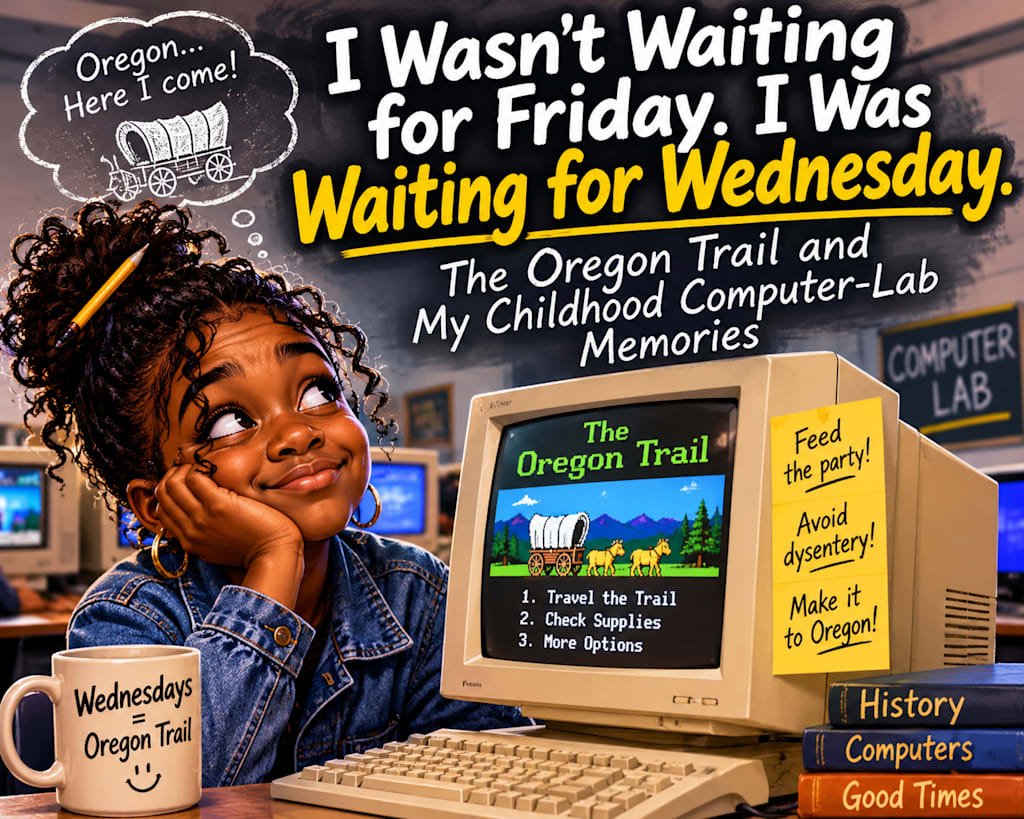
I Wasn't Waiting for Friday. I Was Waiting for Wednesday: The Oregon Trail and the Computer Game That Had Me Looking Forward to School
There was a time when Wednesday was the most exciting day of my school week.
Not Friday. Not the day before a holiday. Not even the last day of school before summer vacation.
Wednesday.
And the reason was a damn computer game.
Yes, a computer game. Not a trip to an amusement park, not a shopping spree, and certainly not anything that required spending money. I was excited because, on Wednesdays, we got approximately one hour to play The Oregon Trail at school.
An entire hour!
Do you understand what that meant? I was looking forward to going to school so I could sit in front of one of those big-ass computers and pretend I was responsible for getting a wagon full of people across the country.
I wasn't waiting for Friday. I was waiting for Wednesday.
And if you grew up during that era, you already know that getting computer time at school was a big deal.
Those Big-Ass Computers Were Something Else
Let's take a minute to appreciate the computers we had back then.
I'm talking about those enormous, grayish-beige desktop computers that looked like they needed their own zip code. The monitors were big, the keyboards were bulky, and the entire setup took up enough room to make you wonder why anybody thought this was a good idea.
These weren't the cute little laptops children carry around today. You weren't slipping one into your backpack and taking it home.
Those computers had a permanent home in the school computer lab.
And when it was time to use them, it felt like something special was happening.
We didn't have smartphones. We didn't have tablets. We couldn't pull up a game whenever we felt like it. There was no downloading an app while sitting in the back of the classroom.
We had a scheduled hour.
And for me, that hour happened on Wednesdays.
I don't know who decided that we needed an entire day dedicated to computer time, but I hope they understand how much excitement they created. Because I was ready.
I had places to go.
Well, technically, Oregon was the place I was trying to get to.
The Oregon Trail Had Me Thinking I Was a Pioneer
For anyone who somehow missed this childhood experience, The Oregon Trail was an educational computer game that simulated the journey westward during the nineteenth century.
You were responsible for a wagon party traveling toward Oregon. You had to purchase supplies, manage food, make decisions about the route, deal with river crossings, and try to keep everybody alive long enough to reach the destination.
Sounds simple enough, right?
Wrong!
This wasn't one of those games where you could just press a few buttons, make a couple of mistakes, and carry on like nothing happened.
Your decisions mattered.
You had to think about what your travelers needed. You had to make sure you had enough food and supplies. You had to decide how to handle obstacles along the way.
Basically, you were running a nineteenth-century transportation company without a business degree, a GPS, or anybody from customer service to complain to.
And the employees weren't particularly cooperative.
I just wanted to get to Oregon!
Was that too much to ask?
Apparently, it was.
Apparently, I Wasn't Qualified to Be in Charge of Anybody
Now, let's talk about the part of this game that could really mess up your whole afternoon.
You could make the wrong decisions, run low on food, fail to manage your supplies, or take chances that didn't work out. You could have people in your wagon party get sick or die.
DIE!
I'm sitting there trying to enjoy my one hour of computer time, and suddenly I'm responsible for a whole group of people who apparently cannot survive without my supervision.
Did I forget to feed somebody?
Did I take the wrong route?
Did I make the wrong decision at the river?
Why is everybody depending on me?
I came to school to play a game, not become the director of a nineteenth-century emergency management department!
And then you'd get one of those messages telling you somebody had died.
Damn! I done killed my boy!
What the hell just happened?
I was perfectly happy five minutes ago. Now I've got a wagon full of problems, somebody isn't feeling well, and I'm starting to question whether I should have been trusted with this responsibility in the first place.
And let's not forget the infamous dysentery.
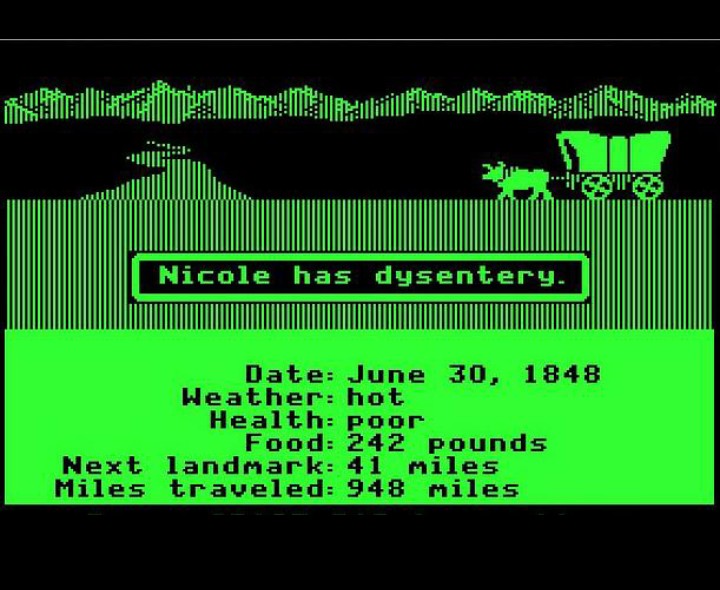
If you played The Oregon Trail, you probably remember that word whether you wanted to or not.
I don't know how many children learned what dysentery meant because of that game, but I'm willing to bet it was quite a few.
We weren't just learning about westward expansion. We were learning that apparently everybody could die if we didn't know what the hell we were doing.
And the worst part?
We would come back the following Wednesday and do it all over again.
Apparently, I had not learned my lesson.
One Hour Was Never Enough
Here's what made those Wednesdays so memorable.
We knew we had a limited amount of time.
We couldn't just keep playing all afternoon. We couldn't take the computer home and finish our journey. When that hour was over, it was over.
And if you hadn't made it to Oregon yet, well, I guess you had to wait.
That was part of the experience.
Today, children have access to games whenever they want. There are gaming systems, smartphones, tablets, computers, and entire online worlds available at the touch of a button.
Back then, we looked forward to a scheduled hour.
And somehow, that was enough to make Wednesday feel like a special occasion.
I think that's one of the things I miss about growing up during that time. We didn't need constant access to everything. Sometimes having a little time to do something we enjoyed was all it took.
Nobody had to convince me to get excited about computer class.
Just tell me it's Wednesday.
Before Social Media, We Were Learning Our Way Around Computers
What's interesting about looking back at those memories is realizing how much technology changed during our childhood and adulthood.
The computer lab was part of an earlier chapter in our relationship with technology.
Eventually, computers became more common in people's homes. The internet became something we could explore outside of school. We went from playing educational games to discovering websites, online communities, chatrooms, and instant messaging.
There was AOL, Yahoo Messenger, ICQ, GeoCities, and BlackPlanet.
People created screen names and online identities. They found communities, talked to strangers, explored websites, and discovered things they might never have encountered otherwise.
Then came MySpace.
Suddenly, people weren't just visiting websites. They were creating their own little spaces online. You could customize your profile, share your interests, connect with people, and show everybody a little piece of your personality.
Facebook came along, YouTube changed how we watched videos, and eventually smartphones put the internet in our pockets.
The internet went from somewhere you had to sit down and visit to something that followed you everywhere.
But before all that, there were those school computers.
And for me, one of my favorite memories involved a wagon, a bunch of travelers, and a weekly opportunity to make questionable decisions.
The Game Was Educational. The Trauma Was Apparently a Bonus.
Here's the funny thing about The Oregon Trail.
It was designed to teach students about history, geography, resource management, and the challenges faced by pioneers traveling west.
It was created in 1971 by three student teachers: Don Rawitsch, Bill Heinemann, and Paul Dillenberger. Rawitsch wanted to make an eighth-grade history lesson more engaging, and the three turned the idea into a computer game.
The game eventually became one of the most recognizable educational games in American schools.
And I understand why.
It made you participate instead of simply sitting there listening to somebody explain what happened hundreds of years ago.
You had decisions to make. You had consequences to deal with. You had to figure things out.
It was learning disguised as entertainment.
Although I would argue that whoever came up with the dysentery portion of the experience was a little too committed to making sure we understood how difficult pioneer life could be.
We got the message!
People got sick. Wagons broke. Food ran out. Rivers were dangerous.
And apparently, I was not the person you wanted leading the expedition.
But that's what made the game memorable.
You could laugh at the ridiculous situations, get frustrated when things went wrong, and still look forward to playing again.
Technology Has Come a Long Way, But I Still Remember Wednesdays
Think about where we are now.
Children can play games with people around the world. Graphics look almost like real life. Computers are faster, smaller, and more powerful than anything we could have imagined sitting in that school computer lab.
We have social media, streaming services, artificial intelligence, and access to information that previous generations could only dream about.
And while all of that is impressive, I sometimes wonder whether children today understand what it was like to look forward to something that happened only once a week.
We weren't checking notifications every five minutes.
We weren't worried about likes, followers, views, or whether somebody had commented on our latest post.
We were waiting for our turn at a computer.
And I was waiting for Wednesday.
I don't remember every single decision I made during those games. I can't tell you how many times I successfully reached Oregon or how many unfortunate travelers might have lost their lives under my leadership.
But I remember the excitement.
I remember those enormous computers.
And I remember looking forward to that one hour.
That's what makes childhood memories so interesting. Sometimes it's not the big vacations, expensive gifts, or extraordinary experiences that stay with us.
Sometimes it's a simple school activity that gave us something to look forward to.
The Oregon Trail was one of those things for me.
Today, I can sit down at a computer and do just about anything. I can write, research, communicate, publish stories, and explore the internet without having to wait for a particular day of the week.
But there's something about remembering when technology was still a new adventure.
Before everybody was an influencer, before social media became a full-time occupation, and before the internet became something we couldn't seem to put down, there was a little girl looking forward to playing a computer game at school.
And apparently, that little girl was responsible for a wagon party she had absolutely no business managing.
If I could go back, I'd probably do a few things differently.
I'd buy more supplies. I'd pay closer attention to the food. I'd think twice before making certain decisions.
And I'd like to formally apologize to anybody who didn't make it to Oregon on my watch.
I hope your families are doing well.
Because I wasn't waiting for Friday.
I was waiting for Wednesday.
And Wednesday meant Oregon Trail.
Now, if you'll excuse me, I have a wagon party to rebuild.
Challenge:My First Internet
About the Creator
Dakota Denise
Every story I publish is real lived, witnessed, survived, by myself or from others who trusted me to tell the story. Enjoy 😊
Enjoyed the story? Support the Creator.
Subscribe for free to receive all their stories in your feed. You could also become a paid subscriber, letting them know you appreciate their work.
Comments
There are no comments for this story
Be the first to respond and start the conversation.