
I Was Using AI All Wrong. Here’s How Claude Taught Me to Learn Anything 10x Faster.
6 prompts that turn AI from a random answer machine into your personal tutor, examiner, and study partner—so you never forget what you learn again.
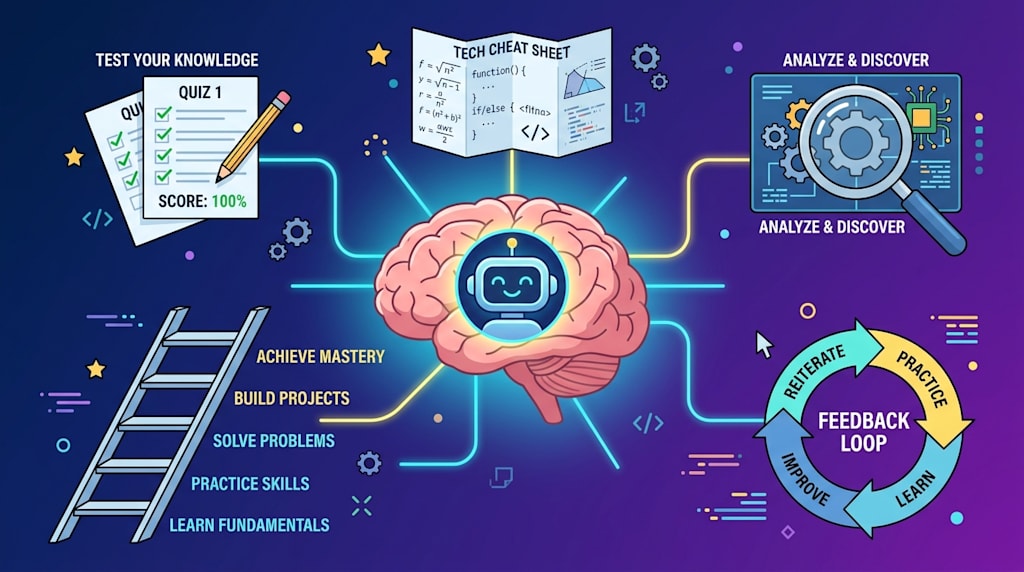
Learning anything today is both easy and confusing.
Easy, because AI can explain almost anything in seconds.
Confusing, because most people just ask random questions, get random answers, and feel like they're learning.
A week later, nothing sticks.
I'm talking about myself.
Three months ago, I asked Claude to explain "Bayesian statistics." It gave me a clear, bullet-pointed answer. I read it through and thought, "Got it."
Three days later, someone asked me the difference between Bayesian and frequentist statistics. I opened my mouth and managed only: "Uh... Bayesian updates priors?"
Awkward silence.
That wasn't learning. That was self-soothing.
The problem isn't AI. It's how you use it.
Here are 6 prompts that pulled me out of the "ask and forget" mud. They turn Claude into your personal tutor, examiner, curator, and study partner.
Not for getting answers. For actually learning.
Bookmark this. You'll use it every time you want to master any skill.
Why Casual Asking Fails
You ask Claude: "Explain quantum computing."
You get a decent answer.
You feel smart for 10 minutes.
Then nothing sticks—because there's no structure, no testing, no repetition, and no feedback loop.
Real learning needs 4 things, and AI conversations usually skip all of them:
→ A path—so you know what to learn in what order
→ A test—so you discover what you don't actually understand
→ A compression—so you can review quickly when you need it
→ A feedback loop—so gaps are caught and filled immediately
Each prompt below builds one of these.
1. Build a Learning Ladder (Know Exactly Where You Are and What's Next)
Most people fail because they jump into advanced material before their foundation is solid.
This prompt breaks any subject into 5 clear difficulty levels—from absolute beginner to confident practitioner—each with a milestone and a self-test.
You'll always know exactly where you stand.
Prompt:
I want to learn [subject] step by step, without skipping any important foundations.
Act as an expert teacher and skills coach. Break [subject] into 5 clear difficulty levels, from complete novice to confident practitioner.
For each level, include:
Level name
What I should understand at this stage
What mastery looks like at this level
The core concepts or skills to focus on most
A milestone that proves I'm ready to move forward
A hands-on exercise or mini-project
Common mistakes learners make at this level
One simple self-test question before moving to the next level
Use this structure:
Level 1: Complete Novice
Level 2: Basic Understanding
Level 3: Practical User
Level 4: Problem Solver
Level 5: Confident Practitioner
Keep explanations practical, beginner-friendly, and focused on real progress.
2. Learn Anything in 20 Hours (The 80/20 Rule, Structured into 10 Study Units)
Most subjects have a small set of core concepts that unlock everything else.
This prompt finds that critical 20% first, then turns it into a 10-unit, 2-hour-per-unit study plan—each with exercises, resources, and review questions.
Prompt:
I want to learn [subject] in 20 focused hours.
Act as an expert teacher and learning strategist. Your job is to help me learn the most useful parts first, not everything.
Please do the following:
Identify the 20% of concepts, skills, or principles that deliver 80% of real-world results.
Explain why these core areas matter and how they connect to practical applications.
Create a 10-unit study plan, 2 hours per unit.
For each unit, include:
Main learning objective
Core concepts to study
A practice exercise or mini-project
A recommended resource (preferably free and beginner-friendly)
Expected outcome after completing the unit
At the end of each unit, give me 5 review questions to check my understanding.
After the full plan, suggest a final project that proves I understand the subject well enough to use it in real life.
Make the plan beginner-friendly, practical, and focused on rapid progress.
3. Quiz Me Until I Break (Find the Exact Boundary of What You Don't Know)
Passive reading feels productive. Active recall reveals the truth.
This prompt turns Claude into a strict examiner: ask one question at a time, score each answer, pinpoint gaps, re-teach only what you missed—and raise difficulty as you improve.
The first time I ran this, Claude asked me 10 questions on "expected utility theory." By question 4, I was sweating. By question 7, I realized I couldn't even define "risk preference" cleanly.
That wasn't humiliation. That was a gift. Because without that test, I would have kept thinking I "mostly got it"—and then crashed at some critical moment on a real project.
Prompt:
I just finished learning [subject], and I want to test my true understanding.
Act as a strict but helpful examiner. Your job is to find the boundaries of my understanding through active recall.
Ask me 10 questions, one at a time.
Rules:
Increase difficulty gradually:
Questions 1–3: Beginner level
Questions 4–6: Intermediate
Questions 7–8: Advanced
Questions 9–10: Expert
Ask only one question at a time and wait for my answer.
After each answer, do four things:
Score my answer (out of 10)
Tell me what I got right
Point out the exact gaps, errors, or weak spots
Re-explain what I missed in plain language
If my answer is weak, ask one follow-up question before moving on.
If I answer well, slightly increase difficulty.
At the end, give me:
My final score
My strongest areas
My weakest areas
A short review plan
5 ultimate challenge questions to help me master the subject
Don't give all answers at once. Make this feel like a real learning interview.
4. Create a One-Page Cheat Sheet (Your Brain Remembers Structure Better Than Paragraphs)
This prompt compresses any subject onto one page that you can review in 5 minutes—definitions, rules, examples, common mistakes, and quick-fire test questions, all in scannable bullet points.
Perfect for before exams, meetings, interviews, or any real-world task where you need to recall the subject quickly.
Prompt:
I want a one-page cheat sheet for [subject].
Act as an expert teacher who simplifies complex ideas into quick review sheets.
Create a cheat sheet I can review in 5 minutes before I need to use the subject.
Include:
A short definition of the subject in plain language.
The most important concepts, rules, formulas, or steps.
Use clear bullet points, not long paragraphs.
If helpful, include a simple labeled diagram, flowchart, table, or mental model.
3–5 concrete examples of how the subject is used in real life.
Common mistakes or confusing parts I should avoid.
A quick "before you use" checklist.
5 quick-fire questions to test memory.
Keep it practical, visual, beginner-friendly, and easy to scan.
5. Find the Signal in the Noise (Stop Collecting Resources. Start Using the Right 5.)
Every subject has thousands of resources. Most people waste time collecting them instead of learning.
I once spent two whole weeks "researching" how to learn Python. I bookmarked 40 tutorial links, bought 3 courses, followed 7 tech bloggers. And then? I couldn't even write a working loop.
Bookmarking isn't learning. Downloading isn't progress.
This prompt finds the 5 highest-leverage resources—books, videos, courses, communities—ranks them, and builds a 7-day learning path using only those 5.
Prompt:
I want to learn [subject] quickly, but I don't want to waste time on low-quality resources.
Act as an expert learning curator. Find the 5 highest-leverage resources for learning [subject].
Resources can include books, videos, courses, websites, newsletters, communities, or experts to follow.
For each resource, include:
Resource name
Type of resource
Why it's worth my time
Which specific part of [subject] it helps me learn
Which type of learner it's best for
Difficulty level: Beginner, Intermediate, or Advanced
How I should use it effectively
A reminder of what not to waste time on
After the list, rank these resources in order of best use.
Then give me a simple 7-day learning path using only these resources.
Focus on quality, clarity, and practicality. I want signal, not noise.
6. Use the Feynman Loop (If You Can't Explain It Simply, You Haven't Understood It)
The Feynman technique exposes fake understanding almost instantly.
Claude explains the subject like you're 12 years old. You explain it back in your own words. Claude finds every gap and re-teaches only what you missed—then loops until your explanation is clean and accurate.
My first loop took 45 minutes. It was painful. But that night, lying in bed, I realized I could walk through the whole concept from start to finish—not reciting, but explaining. That feeling was worth it.
Prompt:
I want to deeply understand [subject] using the Feynman learning method.
Act as a patient teacher. First, explain [subject] to me in simple language, as if I were a 12-year-old.
Use:
Simple words
Real-life examples
Analogies
No unnecessary jargon
Short explanations
After explaining, ask me to explain the subject back in my own words.
Then review my explanation and do the following:
Point out what I got right.
Identify every gap, error, confusion, or missing concept.
Re-teach only the parts I got wrong or missed.
Ask me to explain again in a cleaner way.
Repeat this loop until my explanation is simple, accurate, and complete.
Rules:
Don't move forward until my explanation is clear.
Don't overwhelm me with extra theory.
Correct me gently but firmly.
Use examples whenever I'm confused.
At the end, give me a final clean explanation of [subject] that I can save as notes.
Make this feel like an interactive learning conversation, not a lecture.
How to String These Together
These aren't 6 isolated tricks. They're stages of a learning system.
→ Start with the Learning Ladder to see the whole map
→ Use the 20-Hour plan to find the critical 20% to focus on first
→ After each study session, run Quiz Me Until I Break to find real gaps
→ Compress what you learned into a One-Page Cheat Sheet for quick review
→ Before you start, run Find the Signal to pick your 5 resources
→ For anything still shaky, run the Feynman Loop
Path → Test → Compress → Repeat.
That's the whole system.
Why This Actually Works
Most AI learning conversations are just unstructured answers.
This system solves that by forcing the 4 things any real learning process needs:
A path, so you never wonder what to study next.
A test, so you discover what you don't know before it costs you—in an exam, interview, or real project.
A compression, so review takes 5 minutes instead of rereading everything.
A feedback loop, so gaps are caught and filled immediately, not silently piling up.
AI won't make you a better learner by giving better answers.
It makes you a better learner when you force it to quiz you, compress for you, and correct you.
Start Now
Open Claude.
Pick a subject you've always wanted to learn but kept putting off.
Paste in the first prompt.
Then work through the system, one step at a time.
Look back in a week—you'll be surprised that what you've kept is no longer just chat logs, but something truly yours.
About the Creator
Jin
Writer of reamstories
https://reamstories.com/jin
Enjoyed the story? Support the Creator.
Subscribe for free to receive all their stories in your feed. You could also become a paid subscriber, letting them know you appreciate their work.
Comments
There are no comments for this story
Be the first to respond and start the conversation.