
I Used Both DeepSeek Harness and Codex. The Difference Shows Up After Hour Three
The weak point is the default workflow, not the model.
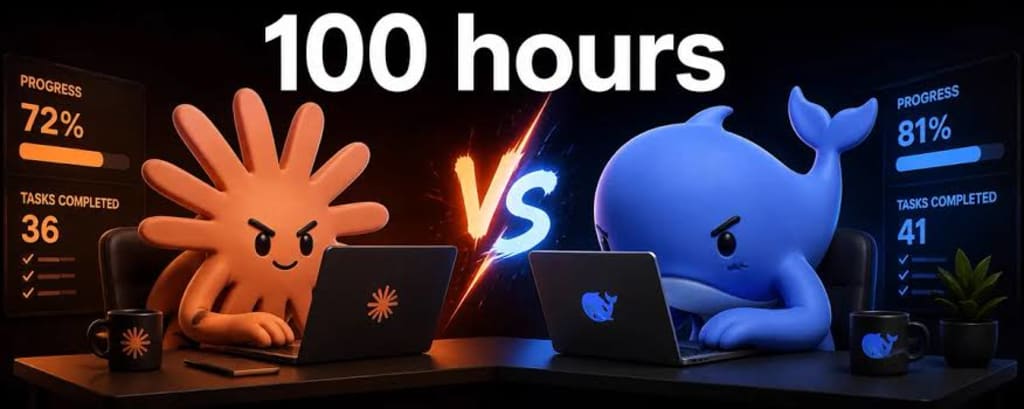
I use both. Codex’s quota runs out, so I keep DeepSeek Harness nearby. After running both on real work, I see where they split. For small jobs, change a function, build a page, fix a test, the gap is small. Requirement clarity, repository quality, and clean context decide most of the result. A messy repo with a vague ticket will waste any model’s effort.
The gap appears when work runs for hours or days. Long work needs planning, isolation, verification, recovery, review, and handoff. The agent must know what is done, which assumption failed, which file to touch next, where to resume, and whether parallel jobs will collide. Product work around the model starts to matter: checklists, isolated branches, test logs, review screens, cleanup.
Short jobs test the model. Long jobs test the tooling.
Short jobs are mostly a test of input quality. If the repo is clear, the test command is fixed, and the context is clean, many models can produce a usable patch. If the repo is messy and the acceptance criteria are missing, a stronger model will still work hard in the wrong direction.
Long jobs expose a different problem. A plan can look good in the first ten minutes. The hard part is knowing at hour three which acceptance items are complete, which assumption the logs killed, and which file comes next. At that point, the useful state lives outside the chat: plans, code, tests, logs, diffs, and decision notes.
Codex pushes progress into those places. It tracks milestones and keeps state outside the conversation. It also uses feedback from tests, builds, and logs. For long work, that beats asking how much the chat still remembers.
DeepSeek Harness has Goal, Session, Subagent, Workflow, and scheduling. It has a long-task framework. The problem is assembly. These parts feel like a box of blocks. You still need to know how they fit. In use, the planning mode sometimes wanders. The plan and the execution do not always hand off cleanly. Project history is hard to find again in the UI. Remote environments and folder selection add friction. Subtasks and local processes sometimes leave residue. None of this means the model cannot write code. It means the tooling layer is still young.
DeepSeek Harness’s strength and weakness come from one design choice.
Its official line is “Everything is a Plugin.” Models, tools, Skills, Session, sandbox, storage, Agent Loop, scheduling, and UI can be replaced or recombined. That appeals to people who study agent infrastructure, connect private models, or rewrite the execution loop. Composability is high. The cost is direct: you gain choice and you take on integration work.
The repository is marked developer preview and warns about breaking compatibility changes. APIs, plugin combinations, UI behavior, and docs will move. For people who like tinkering, this is fast evolution. For teams that need stable delivery, it means version pinning, upgrade validation, plugin compatibility checks, and troubleshooting.
This strength and weakness come from one design choice. DeepSeek Harness is open. You can inspect the architecture, swap models, change the loop, and rebuild a different agent. It will not decide where session state lives for you. It will not invent a branch isolation method. It will not remind the agent which checks to run after a change. It gives infrastructure developers room and asks users to act like a harness engineer and a project manager.
Codex makes users assemble less.
Codex links planning, code edits, test runs, error checks, fixes, and saved project state into one flow. It puts parallel tasks, Skills, Automations, and Git worktree into the product. A single feature may look ordinary. Together they cut manual relay. You do not first decide where session state lives. You do not improvise branch isolation. You do not remind the agent which checks to run after every change.
The plan-to-execution handoff is the easiest gap to feel. A good plan is cheap. Knowing at hour three which acceptance items are done, which assumption failed, and which file comes next is not. Codex keeps progress in the repo, docs, test results, and diffs. That beats chat memory for long work.
Isolation and review are the second gap. Multiple agent tasks do not naturally avoid file collisions, port conflicts, or dependency pollution. Codex turned worktree and parallel threads into product features. You can put each job in its own workspace and come back to diffs, tests, and results. DeepSeek Harness can do the same through Git, plugins, and custom process rules. Today, that usually means users define branch strategy, working directory, ports, and process lifecycle. Teams pay for it with version pinning, upgrade windows, plugin locks, branch and directory rules, process cleanup hooks, and CI as the final review check.
Context compression needs evidence, not slogans.
I do not trust token thresholds or “model-specific compression” claims without public proof. Long-task stability depends on whether important state leaves the chat. Plans, code, tests, logs, and decision records need to be inspectable. A short summary helps. It does not replace external state.
Codex treats external state as part of long-task design. DeepSeek Harness can go deep with open storage and plugins. Today, users often define the rules, choose the plugins, and check the handoff quality. The useful question is who moves important state out of the chat earlier and puts it somewhere verifiable.
Using both tools is a routing decision.
Codex’s quota is limited, so I route by task stage.
DeepSeek Harness fits exploratory work, private model access, execution-loop changes, agent infrastructure research, small fast changes, and deep customization. It is open, modifiable, and useful when the harness itself is the object of study.
Codex fits long delivery, parallel tasks, worktree isolation, a stable plan-execute-verify loop, and review of diffs and test results. Its value is a more mature default path and a cleaner long-task finish.
When I use both, I keep repository state unified, put acceptance checklists outside the chat, fix test commands, and standardize branches and working directories. Otherwise tool switching creates new fragments. The thing to manage is not which model to use. It is where task state lives, who checks it, and where to resume after failure.
Conclusion
DeepSeek Harness’s weak points are product maturity, default workflow, and long-task cleanup. The model has not lost intelligence. The ceiling is high. Reaching it today means filling in plan handoff, isolation strategy, process cleanup, and review checks yourself. Codex turns many of those engineering constraints into a built-in path.
DeepSeek Harness is open, replaceable, and good for research and deep customization. Codex is more closed and makes more choices for the user. DeepSeek Harness gives infrastructure developers room. Codex lets ordinary developers spend less time as a harness engineer and a project manager.
For most people who want to finish a project, a mature default path beats a high theoretical ceiling. Openness needs builders. Someone has to write the checklists, set branch rules, clean up processes, and run the final review. DeepSeek Harness asks for that work. Codex packages much of it.
The real test is simple. At hour three of a long task, can you see where the agent is, what changed, what passed, and what comes next? That is where the tools separate.
About the Creator
Jin
Writer of reamstories
https://reamstories.com/jin
Enjoyed the story? Support the Creator.
Subscribe for free to receive all their stories in your feed. You could also become a paid subscriber, letting them know you appreciate their work.
Comments
There are no comments for this story
Be the first to respond and start the conversation.