
I Tried to Build a Dev PC in 2026. RAM and GPUs Had Other Plans.
AI data centers are eating the memory supply, and developers are paying the price. Here is when RAM and graphics cards might finally get cheaper, and what to buy instead.
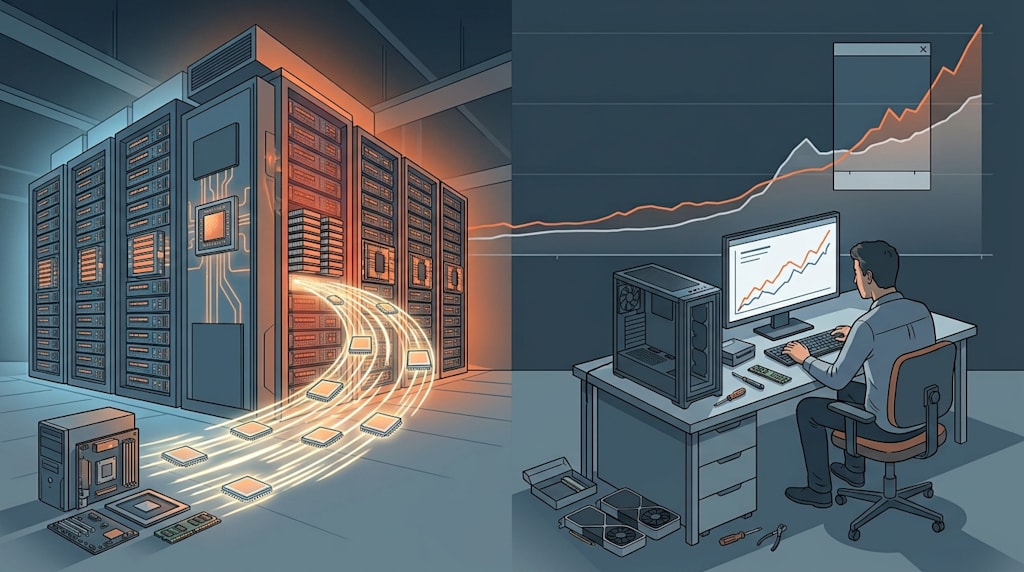
When RAM and GPU prices may return to normal: a PC-building dilemma in the AI compute wave
You want to build a development machine. You open an e-commerce site and look at RAM and GPU prices. DDR5 has climbed from about 450 yuan last year to 1,800 yuan. The RTX 5070 Ti is above 8,000 yuan. The RTX 5090 has jumped from about 20,000 yuan to around 35,000 yuan. The increase runs through the entire consumer electronics market. It is not limited to one platform.
The end of this round is not obvious. To see when prices might fall, separate memory from graphics cards, then look at how the two markets interact.
1. Memory: the first window is the second half of 2027
Memory prices used to follow a predictable cycle. Higher prices encouraged expansion. Expansion created oversupply. Oversupply cut prices. Price cuts forced capacity exits. Then the cycle began again. This round is different.
AI compute demand changed how memory capacity is allocated. Samsung, SK Hynix, and Micron shifted more than 40% of advanced DRAM wafer capacity to high-margin HBM to meet demand from Nvidia’s Blackwell and Vera Rubin AI accelerator platforms. Producing one HBM wafer consumes about three times the capacity of a traditional consumer DRAM wafer. Every additional unit of HBM output compresses consumer DRAM supply at three times the speed.
TrendForce estimates that HBM will consume about 23% of global DRAM wafer capacity in 2026, up from 19% in 2025. Servers are overtaking smartphones as the largest memory market. Server DRAM is expected to account for more than 50% of the total in 2026. With HBM included, total server demand is close to 53%. AI is now the largest downstream market for DRAM. Smartphones and notebooks are being pushed to the side.
The mismatch is structural. The major manufacturers treat capacity as a strategic asset and prioritize AI applications that maximize profit. The predictable boom-and-bust cycle has ended.
Supply signals are becoming clear. Kyung Kye-hyun, former president of Samsung’s semiconductor division, said at a forum of the National Academy of Engineering of Korea that global memory supply could rise sharply as early as the second half of 2027, driven by large-scale expansion by Chinese manufacturers. CXMT’s DDR5 capacity is expected to be released further in 2027. The consumer memory shortage should then ease. Citi forecasts that DRAM prices will fall 3% quarter-on-quarter in the second half of 2027, while NAND prices will fall 5%.
Demand is also weakening. Counterpoint data shows that global smartphone shipments in 2026 are expected to fall by about 14%. As device prices rise, consumers buy less. Cooling demand forces prices toward rationality.
Falling prices do not mean a return to earlier levels. Samsung has completed customer allocation for full-year 2027 DRAM and HBM capacity. Some customers receive only 60% to 70% of their requested volume. A large share of advanced capacity is already locked into AI servers through long-term contracts. The consumer market may receive less incremental supply than the headline numbers suggest. SK Hynix CEO Kwak Noh-jung has warned that demand may exceed the company’s production capacity into the 2030s.
The second half of 2027 to the first half of 2028 is the key window for memory prices to shift from surging to loosening at a high level. Prices will fall, but a return to 2023 and 2024 levels is almost impossible. SSDs follow a similar path. TrendForce predicts that NAND Flash supply will loosen in the second half of 2027 as new capacity is released and consumer demand stays weak. Prices may face correction pressure. The timeline is roughly synchronized with memory.
2. GPUs: a longer chain, with a perceptible decline likely in 2028
The GPU market is more complex than memory. It is squeezed by VRAM costs and GPU chip capacity at the same time.
The VRAM side of the transmission is direct. While the three major manufacturers shift capacity to HBM, GDDR6 and GDDR7 supply is crowded out. Nvidia has confirmed that it will cut gaming GPU production by 30% to 40% in the first half of 2026 and will prioritize scarce advanced process capacity for AI GPUs. GDDR7 VRAM prices tripled in three months. Manufacturers have begun limiting purchases of popular models such as the RTX 5060 Ti 16GB. This is cost-push price inflation. Even if sales fall, manufacturers must raise prices to maintain profit.
The chip-side squeeze is more severe. Nvidia’s strategic focus has shifted to its highly profitable data center business. Consumer GPUs are now a secondary product line. H100 rental prices rose from $1.70 per GPU per hour in October 2025 to $2.35 in March 2026, an increase of nearly 40%. Delivery schedules for newly signed contracts generally extend into the first half of 2027. Board partners and distributors are intensifying the tension. Major graphics card brand factories in Huaqiangbei have sealed warehouses and suspended bulk shipments. Spot supply is tightening. Some models are hard to find. Channel distributors are hoarding and refusing to sell.
Timing depends on the order backlog for high-end AI chips. Orders for H100, H200, and B200 are generally scheduled into the first half of 2027 both domestically and internationally. Domestic Ascend series orders are also scheduled into 2027. TechNews analysis says the turning point will fall in the second half of 2027 to 2028. As new wafer fab capacity comes online, the imbalance should shift from tight to a mild correction. Multiple analysts expect a gradual decline around the first half of 2028.
A mild correction means prices go from absurd back to expensive. It does not mean normal. Even if GDDR7 VRAM costs decline, the drop will be limited. Board manufacturers and distributors will try to maintain higher price anchors after this round of increases. The next-generation RTX 60 and RDNA 5 have been confirmed for launch in early 2028. The current RTX 50 and RX 9000 series will have a two-and-a-half-year lifecycle. Manufacturers have no incentive to cut prices.
3. Practical advice for developers building a PC
If the purpose is development rather than gaming, the strategy can be more flexible. The rule is simple: get the work running at a reasonable cost. Do not wait for a perfect price.
Memory: buy enough capacity now. 32GB DDR5 is the most cost-effective capacity point. Rather than waiting until 2027, buy now and get the development environment running. With memory, enough is more important than cheap. If development gets stuck because of insufficient memory, you lose time. After prices loosen in the second half of 2027, consider expanding.
GPU: a used RTX 3090 is currently the most undervalued development GPU. Tech columnist Tanveer Singh’s reviews and market observations show that as of 2026, the five-year-old RTX 3090 is still the best value choice in edge AI. It has 24GB GDDR6X VRAM, 936GB/s bandwidth, and 10,496 CUDA cores. It balances compute performance, VRAM capacity, and price. The RTX 5090 has 32GB of VRAM but costs more than $3,800. A used RTX 3090 costs only $600 to $800 on platforms such as eBay.
For development, especially local large-model inference, CUDA development, and deep learning debugging, 24GB of VRAM is a key dividing line. A solution published by KDnuggets shows that a used RTX 3090 costing less than $800, combined with llama.cpp, DFlash speculative decoding, and a Pi terminal Agent, can enable a localized AI coding experience. Speed jumps from 46 tokens/s to 127 tokens/s. In China’s second-hand market, a decent-condition RTX 3090 costs about 5,000 to 6,000 yuan.
Watch for ex-mining cards. Prioritize cards sold by individual users with purchase records. After receiving the card, test VRAM stability.
Time strategy: turn waiting into staged upgrades. A development machine does not need to be completed all at once. Start with DDR5 32GB plus a used RTX 3090 to get the development environment running. Concentrate the budget at this step. When GPU prices begin to loosen in 2028, consider upgrading to a new-generation mid-to-high-end graphics card. The core value of a development machine is being able to run, not perfect specifications.
Conclusion
This round of memory and GPU price increases is a run on consumer electronics caused by the explosion of AI compute. The memory turning point is likely in the second half of 2027. GPUs may not see a perceptible decline until 2028. A decline does not mean a return to earlier levels. The capacity allocation logic of memory manufacturers has changed permanently. AI servers occupy half of DRAM supply bits. The consumer market will not return to the low prices of the past.
For developers building a PC, the rational choice is not to wait. Use the currently acceptable cost to get the work running. The RTX 3090 is five years old, but 24GB of VRAM has more practical value in development than a brand-new mid-range card. In a period of compute inflation, waiting can cost more than buying at today’s prices.
About the Creator
Jin
Writer of reamstories
https://reamstories.com/jin
Enjoyed the story? Support the Creator.
Subscribe for free to receive all their stories in your feed. You could also become a paid subscriber, letting them know you appreciate their work.
Comments
There are no comments for this story
Be the first to respond and start the conversation.