
I Tested DeepSeek’s New All-in-One API for 0.5 Yuan. Here’s What It Gets Right and Where It Breaks.
The toolkit is cheap, fast, and useful for prototypes. It still leaves gaps that specialized services fill better.
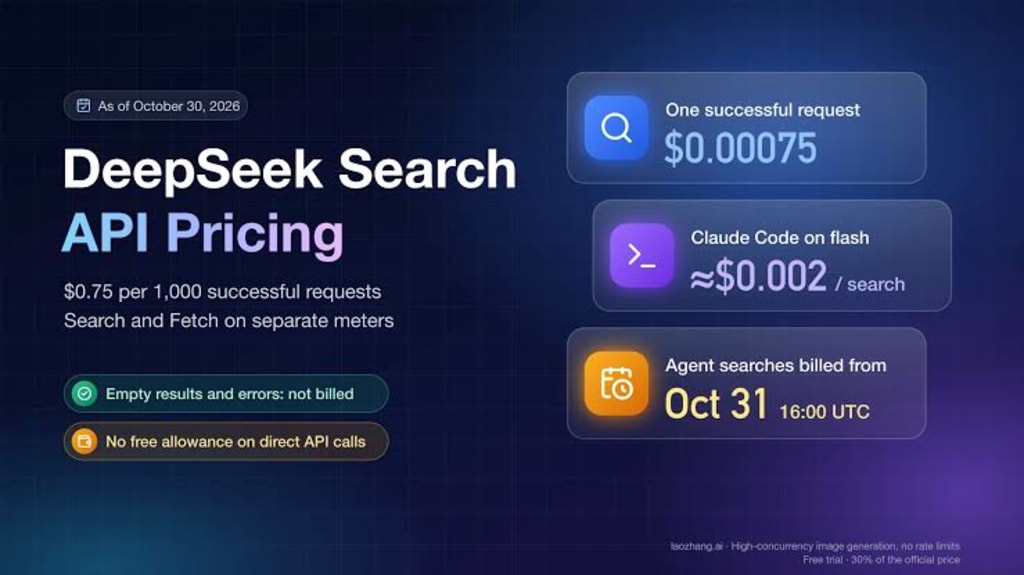
Late on Friday, November 13, 2026, DeepSeek updated its API again. No new model. No benchmark fight. The company opened the tools inside its app as APIs: web search, deep-thinking search, URL reading, file input, OCR, speech input, speech synthesis, and safety review.
The offer is simple. Add one or two parameters to a request. The server searches, opens pages, reads files, and adds the results to context. Search and Fetch were already available last month. This update adds the in-chat web tool, file input, OCR, voice, and safety review. DeepSeek says developers can reproduce the full DeepSeek App 1:1.
Can developers accept the price? Yes, as a base layer. No, as a replacement for every service.
The bill
Model prices have not changed. The model is V4.1 Flash: 2 yuan per million input tokens and 8 yuan per million output tokens during weekday peak hours. Outside peak hours, the price is half.
New tools are billed per use:
Search and web fetch: 5 yuan per 1,000 calls.
One hour of audio-to-text: 0.39 yuan.
Speech recognition and speech synthesis: 50% off for a limited time.
OCR: about 1.5 yuan per 1,000 pages.
Firecrawl’s cheapest Hobby plan costs $16 per month on annual billing. That works out to about 21 yuan per 1,000 pages fetched and 43 yuan per 1,000 searches. DeepSeek charges 5 yuan per 1,000 for both, pay-as-you-go, with no subscription.
The test bill is more useful than a price table. Nearly 20 conversations, two 35-page PDF parses, OCR, voice, and more than 20 search and fetch calls cost just over 0.5 yuan.
That number is the main argument for the API. It is also easy to misread. Cheap means cheap. It does not mean complete.
Hands-on: fast search, a hole in file parsing
The first test asked about an event from the night before. A latest_reminder message told the model the date and the user’s location. The answer came back in about 5 seconds. The model searched three keywords and attached 13 citations.
Without that date context, the model searched for “June 2026” and corrected the user: “the release you mentioned last night may be a misunderstanding.” The date was wrong. The tone was confident. A confident wrong answer is worse than a slow one.
Normal search handles narrow facts. Asking how speech synthesis is priced came back in 2.4 seconds. But normal search reads snippets. It does not open pages. When the price table was inside an announcement image, normal search missed the OCR and voice prices.
Deep-thinking search fixed that. It searched three keywords, opened five news pages, and returned the full price table in 8.7 seconds. A harder query about a developer’s work over the past month pulled 26 pages, opened seven, and produced a timeline in 11 seconds. The dates matched.
URL reading has a clear limit. A tutorial URL returned a three-sentence summary in 6 seconds. Usage data showed the model read only 495 tokens, the opening intro. The tutorial’s table of contents was rendered by JavaScript. DeepSeek does not execute JavaScript during fetch, so the model never saw it.
That is a fetch-layer boundary, not a model failure. If a page depends on client-side rendering, this API will not see the page a browser sees.
The file input test exposed a sharper split. A 35-page, 36 MB PDF with dozens of images took about 20 seconds to parse. A question whose answer was in the body text came back in 1 second. A second reference to the same file hit 16,000 cached tokens.
Then I asked about information that existed only inside a mind-map image: how long stage 1 and stage 2 should take, and which domestic AI coding tools stage 2 listed. Both text-only parsing and mixed text-image parsing said the document did not contain it.
The same page, sent as a screenshot to the OCR endpoint, extracted every stage duration in 2.3 seconds.
So the OCR endpoint can read the image. The document parser inside the chat flow lost that page. The practical workflow is to run OCR first, then hand the text to the model. OCR is not clean either. The mind map’s hierarchy came back scrambled. Cursor landed under “core features.”
Voice works better than expected, with hard limits. A 60-second clip was transcribed in 3.2 seconds, with punctuation added. Against the original subtitle script, 280 characters produced one error: “three modes” became “three kinds of modes.” Speech synthesis offers one male and one female voice. First byte arrived in about 1 second. A 14-second audio file finished in under 3 seconds. Markdown bold markers were filtered out. But speech recognition caps a single request at 120 seconds, and synthesis has no speed control. Long audio needs slicing before it goes in.
Against Firecrawl: faster and cheaper, not a full replacement
For AI apps, Firecrawl is a common choice for search and fetch. I ran the same three search terms and four URLs through both services.
DeepSeek returned each search in about 0.3 seconds. Firecrawl took 2.6 to 4.4 seconds. DeepSeek is roughly 10 times faster. Search quality was close. DeepSeek adds relevance scores and authority levels to each result. English queries sometimes pulled in Spanish and traditional Chinese documents.
On fetch, DeepSeek returned most pages in under a second with cleaner body text. Firecrawl pulled GitHub pages with a large amount of navigation clutter. One homepage was blocked by the site’s firewall, and Firecrawl returned the error page.
But Firecrawl executes JavaScript. It could read the tutorial’s table of contents that DeepSeek missed. It also supports full-site crawling and browser interaction. On capability depth, the specialized service is still more mature.
On price, DeepSeek is cheaper: 5 yuan per 1,000 calls, pay-as-you-go. Firecrawl’s annual Hobby plan works out to about 21 yuan per 1,000 pages and 43 yuan per 1,000 searches.
The sensible split is not to pick one service. Use DeepSeek for Chinese-language AI search and cheap fetch. Keep Firecrawl for JavaScript rendering, full-site crawls, and browser interaction. That combination cuts cost without pretending the cheaper tool has no edges.
From selling models to selling capabilities
Before this API, building an Agent with web access, file reading, and voice meant integrating several vendors and writing glue code. The developer had to call search, open pages, extract text, pass context to the model, handle OCR separately, add speech-to-text, and add text-to-speech.
Now one API key and a tools parameter move that work to DeepSeek’s server.
That lowers the threshold for a chat app by a wide margin. It also changes DeepSeek’s position. The company is no longer only selling model tokens. It is selling the capability stack around the model: search, fetch, OCR, voice, and safety review. Developers who build on that stack stay inside DeepSeek’s ecosystem.
There is a compliance cost. For public-facing services, DeepSeek requires safety_check to be enabled. Developers still carry content review, model registration, and AI labeling obligations. I tested a technical question about SQL injection with safety review on. It answered. No obvious false kill.
That requirement is the condition for serving public applications. It is not a gift.
Is the price acceptable?
Yes, for prototypes, internal tools, and content-production helpers. One key covers web search, file reading, and voice. A complex test run costs 0.5 yuan. The cost of trying an idea is close to zero. Work that used to take days of integration now takes a few lines of code.
No, not if you plan to ship a product where one of these capabilities is the core selling point. The fetch layer does not execute JavaScript. The document parser can lose information that exists only in images. Speech synthesis has no speed control, and recognition stops at 120 seconds. Those gaps can be routed around in a demo. In a product, they become missing features.
The better strategy is a base layer plus targeted reinforcement. Use DeepSeek’s all-in-one API for high-frequency, low-cost work: Chinese web search, OCR, and voice. Bring in Firecrawl or a specialized voice service where the edge matters.
Cheap does not mean all-capable. One-stop does not mean use it for everything. The developers who get value from this API will not ask whether it can replace every service. They will ask which part of the job it handles most cheaply, and where the 0.5 yuan stops being enough.
About the Creator
Jin
Writer of reamstories
https://reamstories.com/jin
Enjoyed the story? Support the Creator.
Subscribe for free to receive all their stories in your feed. You could also become a paid subscriber, letting them know you appreciate their work.
Comments
There are no comments for this story
Be the first to respond and start the conversation.