
I Refuse to Pay Over ¥5,000 for an RTX 5070—and You Shouldn’t Either
GPU prices have gone completely insane. AI is devouring the supply chain, Nvidia’s hiking prices on purpose, and the “sweet spot” card is dead. Here’s why your old rig is still enough—and exactly when to buy (spoiler: not now).
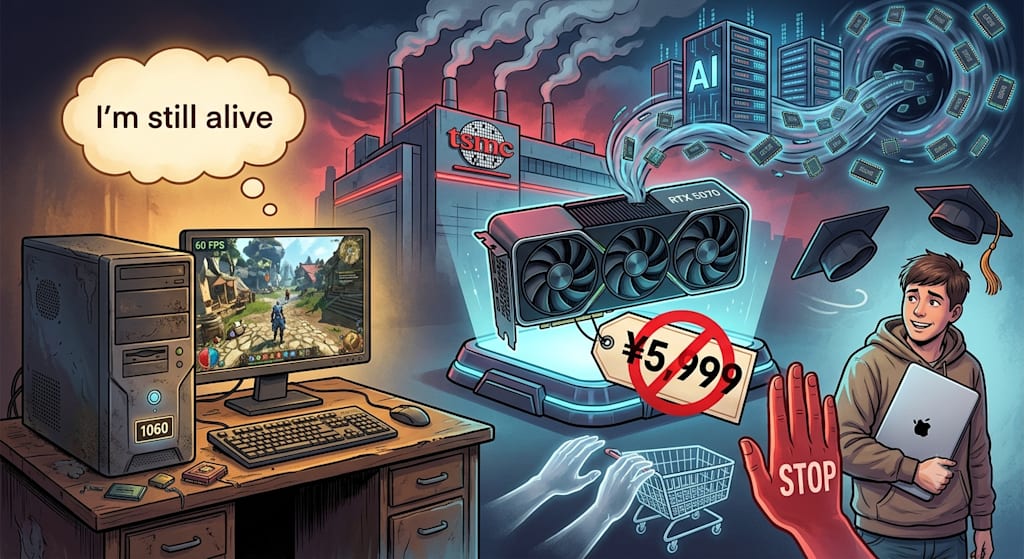
An RTX 5070. MSRP in the four-thousand-yuan range. The number on the e‑commerce page? High five-thousand, a few steps shy of six.
The 5060, the card that last year was still called the "sweet spot gatekeeper," has gone from just over two thousand to twenty-five hundred. Push a little higher, and you're brushing against the tail-end of the previous generation’s 70‑class.
This isn't dealers speculating. It's a single memo from upstream. Memory chips—both GDDR6 and GDDR7—got a price bump at the same time. Nvidia didn't absorb it; they told the AICs directly: stop shipping, unify the price adjustment. The GPU die, the memory, the cooling assembly, the PCB—every single component on the entire supply chain is going up. The cost of a new build, starting from the very first screw, is now a good chunk higher than it was six months ago.
People in my feed who build PCs are cursing. Forums are on fire. Parents whose kids just submitted their college entrance exam choices are asking: buy now, or wait?
The answer is simple. Wait.
I. This Is Not Another Mining Boom—It's AI Eating All the Slack
During the crypto mining craze a few years back, GPU prices shot up because people were using them to make money. Miners had their electricity cost ledgers—as long as hash rate revenue covered electricity, there was a price floor. When coin prices fell, miners shut down, and card prices crashed. That was a cyclical logic—ups and downs were both predictable.
This time is different.
TSMC's CoWoS packaging capacity has been largely consumed by Nvidia's enterprise-grade chips and AMD's MI series. Not enough HBM—capacity spills over, squeezing GDDR memory production. Consumer-grade VRAM is being cut passively—not because anyone is deliberately holding out on gamers, but because AI vendors are bidding higher, ordering larger volumes, and offering fatter margins.
Nvidia doesn't need consumer GPUs to prop up its earnings. Enterprise chip margins are right there in plain sight. Gaming cards get a price hike largely to keep the gap from looking absurd. Manufacturers are no longer chasing thin margins and high volume—they've switched to precision harvesting. The ceiling isn't set by market supply and demand; it's welded in place by the profit margins of the AI industry—and below that number, prices simply won't come down.
So don't hold your breath for a mining crash. Even if coin prices tank, it won't matter—the root of this price hike isn't in crypto, it's on the capital expenditure sheets of AI infrastructure.
II. That Old Machine Can Still Spin for Another Two Years
The most defiant line on the forums is always: "It's not like a 1060 can't run anything."
That phrase has been tossed around as self-deprecating humor for years. But it's true.
Check the Steam Hardware Survey—the 1060 and 2060 are still near the top of the charts. Not because people don't want to upgrade, but because upgrading doesn't make much difference. At 1080p, the vast majority of competitive titles run just fine. For AAA games, drop shadows and anti-aliasing by one notch—the image doesn't crumble into pixels, and you can still hold a playable frame rate.
Gaming isn't a production task. Playing the Black Myth sequel a year late won't cost you a paycheck, nor will it derail your life. What do you lose? A little novelty from "buy early, enjoy early." What do you gain? Two to three thousand yuan saved in cash. That's not consumer downgrading. It's rational calculation after the math is done.
Vendors are manufacturing anxiety—"can't run new games," "you'll be obsolete without DLSS 4"—and after hearing that pitch too many times, the strongest counter is simply: I don't care.
III. That XP Machine in the Office Can Type for Another Decade
Some will say: I need to run large language models, I need local rendering.
But reality doesn't work that way.
In private enterprises, a Core 2 Duo, 2GB of RAM, Windows XP, and Office 2007 are still lighting up screens on many workstations. The HP LaserJet 1020, launched in 2006, is still spitting out paper today. That's not a meme—it's the actual state of affairs. The core requirement for office PCs has never been raw compute—it's "open a browser, write a Word doc, print."
The government and state‑owned enterprise sector has a clear timetable for Xinchuang (domestic IT) replacements, but in practice, many positions are running two sets of machines—the new one sits beside the desk, while the old one keeps chugging through business workflows. Compatibility, habits, legacy system dependencies—none of that gets solved with a single replacement cycle.
More importantly: compute has already left the building.
Doubao, Yuanbao, ChatGPT—all the inference runs in the cloud. Your local GPU only needs to light up the screen. Even in professional design, the cost-performance of cloud desktops and remote render farms now beats owning a top-tier card. The server‑side compute market plateaued around 2015—except for a few leading AI players, large‑scale hardware refreshes have been dead for years.
So let prices rise. Enterprise IT procurement isn't buying, and individual gamers aren't biting. This premium will just end up spinning in circles at high altitude, all by itself.
IV. The Kids Heading to College This Year Are the Only Ones with No Way Around
The real victims of this price surge are the incoming freshmen of fall 2026.
They actually need a computer. That requirement can't be dodged.
But there are ways to avoid capitulating to the price hikes.
First, the M1 or M2 MacBook Air is, at this moment, an outstanding value proposition. All‑day battery life, a screen that punches far above its price tier, solid build quality. For liberal arts, business, or even most science and engineering majors—writing papers, coding, watching media—it'll last four years. And its price hasn't been touched by the GPU inflation.
Second, if gaming is non‑negotiable, a PS5 or Xbox Series X at just over three thousand yuan delivers far better game optimization and performance than a DIY desktop that's been crippled by GPU price hikes at the same budget. Consoles aren't riding the GPU inflation wave.
Third, most universities have computing centers. Real deep‑learning training won't rely on a laptop's mobile GPU. And certainly not during the first semester.
Hold on for three years. Wait until that wave of AI infrastructure spending slows, or until domestic GPUs tear open an opening in the low‑end market. Then, when the time comes, build a machine that actually makes sense. No rush.
V. Don't Buy, Save 100%—Let the Old Rig Fight Another Day
GPUs have gone from a hobby to a financial asset. Building a PC has shifted from consumption to speculation. That fact alone tells you something: it's a tool, not a faith.
The era of "buy early, enjoy early; buy late, save money" is over.
Now it's: "Don't buy, save every penny. Your old machine can survive another two or three years."
Let those premium‑priced cards sit a little longer in the warehouse. Let the cash flow tighten on the other side. A GPU isn't air, it isn't water—it's a pure consumer‑market product. As long as most people keep their hands on their keyboards instead of their shopping carts, it won't be the anxious buyers—it'll be the upstream.
Summer 2026. The best way to cool down your PC isn't installing top‑tier water cooling.
It's closing the shopping cart. Opening the old games in your library. Playing on.
Waiting until the price returns to where it belongs. That day won't be too far off, but it also won't be tomorrow.
No grand conclusion. Just one concrete act: shut down, sleep.
If there is any conclusion to be drawn, it's that this conclusion doesn't need to be spelled out. By the time you close this page, you already know in your gut.
About the Creator
Jin
Writer of reamstories
https://reamstories.com/jin
Enjoyed the story? Support the Creator.
Subscribe for free to receive all their stories in your feed. You could also become a paid subscriber, letting them know you appreciate their work.
Comments
There are no comments for this story
Be the first to respond and start the conversation.