
I Looked at My Online Footprint Through a Social Media Deep Search
Social Media Deep Search

It started with a surprisingly simple question.
I was filling out an application that asked me to list my public social media profiles. At first, I thought it would take less than a minute. LinkedIn, Instagram, maybe GitHub - that was probably it.
But as I started searching for my own accounts, I realized something unexpected.
There were old profiles I had forgotten about, usernames I hadn't used in years, and public pages that still appeared in search results. Some accounts were active, others had been abandoned long ago, but together they painted a much bigger picture than I expected.
That curiosity led me to try a social media deep search on myself.
I wasn't looking for hidden information. I simply wanted to understand what a stranger could learn about me using only publicly available information.
The results changed the way I think about my online identity.
I Thought I Knew What Was Public
Like most people, I assumed I already knew my digital footprint.
After all, I created those accounts.
I knew which ones were public and which ones were private.
Or at least I thought I did.
Once I started searching, I quickly realized that years of using the internet had left behind far more public information than I remembered.
A professional profile here.
An old portfolio there.
A discussion forum I hadn't visited in years.
A conference speaker page.
None of these profiles contained sensitive information, but together they told a fairly detailed story about my interests, work, and online activity.
That was my first lesson: a social media deep search isn't about finding one account - it's about seeing how dozens of small public details connect together.
Starting a social media deep search using publicly available profile information.
Google Was Helpful - But Only to a Point
Naturally, I started with Google.
I searched my full name.
Then old usernames.
Then combinations of my city, profession, and personal website.
Google found quite a lot.
But after twenty minutes, I had more than a dozen browser tabs open.
Some results were relevant.
Others clearly belonged to someone else with the same name.
Google is excellent at finding webpages, but organizing all of those pieces into a coherent picture still required a lot of manual work.
Google's own Search Operators documentation explains how quotation marks, exact-match searches, and other advanced techniques can improve search accuracy when looking for public information online.
Those operators definitely helped, but they didn't solve the bigger problem: everything was scattered.
A Social Media Deep Search Is More Than One Search
This experiment also made me realize that many people misunderstand what a social media deep search actually is.
It isn't a single search engine.
It isn't one database.
Instead, it's the process of combining multiple publicly available signals, including:
usernames;
profile photos;
biographies;
personal websites;
public mentions;
professional profiles;
links shared across platforms.
Each individual clue may seem insignificant.
Together, they create a much clearer picture of someone's public online identity.
That's why simply typing a name into Google rarely tells the whole story.
I Wanted to See Everything in One Place
After jumping between dozens of tabs, I wondered whether there was a better way to organize all of this information.
Rather than repeating the same searches across multiple websites, I wanted a clearer overview of publicly available profiles.
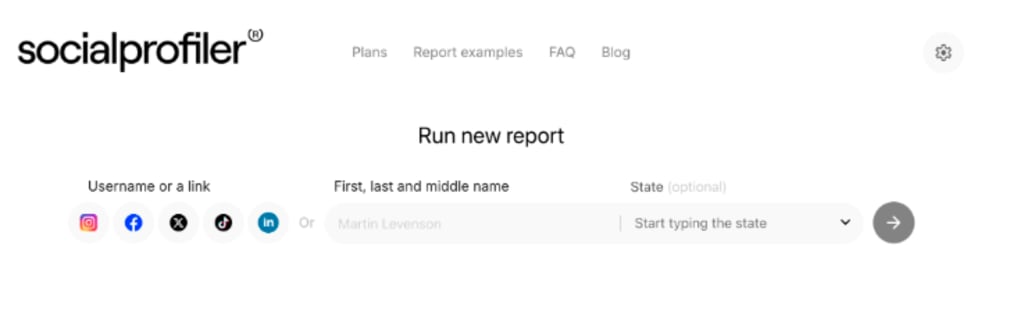
That's when I decided to try Socialprofiler.
Instead of replacing traditional search, it complements it by organizing publicly available profile information into a single view, making it easier to compare results without constantly switching between platforms.
I found that approach much less overwhelming than manually checking every social network one by one.
Reviewing publicly available social media profiles from a single dashboard.
The Biggest Surprise Wasn't Finding More Profiles
Ironically, the biggest surprise wasn't discovering accounts I had forgotten.
It was realizing how fragmented my online identity had become.
One profile focused entirely on my professional work.
Another reflected hobbies I'd barely thought about in years.
A different platform highlighted projects that were no longer relevant.
Individually, none of these profiles represented who I am today.
Together, however, they created a surprisingly complete timeline of my public online presence.
That made me think differently about how other people might experience my digital identity.
When someone performs a social media deep search, they don't see one carefully curated profile.
They see pieces collected from many different places.
Comparing publicly available profile information across multiple sources.
It Made Me Think About My Own Privacy
One unexpected outcome of this experiment was that I stopped thinking about search tools and started thinking about my own habits.
For example, I realized that I had reused the same username across several platforms for years.
I also noticed that some profiles still contained outdated information that no longer reflected my current work or interests.
None of this felt alarming.
But it reminded me that public information tends to accumulate quietly over time.
Every profile, every bio, every public comment becomes another small part of your digital footprint.
A social media deep search doesn't create that information - it simply makes it easier to see how those pieces fit together.
What I Would Do Differently Today
If I repeated this experiment in a year, I'd probably prepare a little differently.
First, I'd review old accounts that I no longer use.
Second, I'd update profile biographies to make sure they still reflect who I am today.
I'd also check which websites still link to profiles I created years ago.
Finally, I'd make it a habit to perform a social media deep search on myself every once in a while - not because I'm worried about privacy, but because it's surprisingly easy to forget what information is still publicly available.
It's much easier to manage your digital footprint when you occasionally look at it from someone else's perspective.
Final Thoughts
Before this experiment, I assumed I had a pretty good understanding of my online presence.
It turned out I only understood individual pieces.
What I hadn't appreciated was how easily those pieces could be connected through publicly available information.
A social media deep search didn't reveal anything private about me.
Instead, it reminded me that our public digital identities are often much larger than we realize.
If you're curious about your own online footprint, try searching for yourself first using public search engines and publicly available information. You may be surprised by what you find.
And if manually organizing dozens of public profiles becomes overwhelming, tools like Socialprofiler can help bring that information together into a clearer overview - while working entirely within the boundaries of publicly available data.
About the Creator
Gulshan
SEO Services, Guest Post & Content Writter.
Enjoyed the story? Support the Creator.
Subscribe for free to receive all their stories in your feed.
Comments
There are no comments for this story
Be the first to respond and start the conversation.