
I Found DeepSeek’s V5 in the Code. A Month Later, the Model Still Isn’t Here.
Three placeholders, one version gate, and the difference between a release pipeline and a finished model.
This is based on public code traces and engineering logic. It is observation and speculation, not official information. As of this writing, DeepSeek has not released an announcement, model card, or API identifier for V5.
Meng saw a screenful of deepseek-v5 in the DeepSeek Harness codebase this afternoon and sent me a screenshot.
My first thought: here we go again. A model name for the next generation shows up in a large-model company’s codebase. It could be a placeholder, a test fixture, or a mock some engineer wrote on a whim. I went through the repository. Every occurrence of deepseek-v5 is used as a model name. None is an API version number.
The first appearance was September 24, 2026.
More than a month later, the model has not arrived.
It is a model name, not an API version
The evidence sits in packages/llm/llm-deepseek/tests/loader-composition.spec.ts:169. The file simulates the response from https://api.deepseek.com/models:
ts
{
  id: 'deepseek-v5',
  api_capabilities: [...],
  client_requirements: { ... }
}
In an OpenAI-compatible API, id holds the model name. When a client requests /models, the list includes deepseek-v5 alongside the existing models. A request can call it directly with model="deepseek-v5". The fields next to it, api_capabilities and client_requirements, describe the model. They are not its name.
This is not a v5 version number for an API. It is a model identifier prepared for clients to recognize, accounts to see, and requests to call.
A model name in a test file can be invented. The context around this one does not look casual.
The name first appeared on September 24
Meng went through the git history.
The first appearance was 2026-09-24 13:06, commit d8c9868, author Yichen Jiang. The commit message:
feat(llm): gate DeepSeek account models by declared client version and bundled support
The commit decides which models in an account are visible based on the client version the client declares.
It added resolve-catalog.ts, which resolves the model catalog. The tests in resolve-catalog.spec.ts use deepseek-v5 as a sample. The file was modified twice more that afternoon, all within five minutes.
In the test, v5 plays a clear role: a model that exists in the account but stays invisible when the client version is too old.
The test checks one rule. The server sends models with client_requirements.min_version. If the client is too old, the model does not appear in the list.
To test that rule, you need a model as an example. You could invent one. The person writing the test used v5.
In the first screenshot, v5 appears with the two tier constants FLASH and PRO:
ts
{ ...FLASH, id: 'deepseek-v5' }
{ ...PRO, id: 'deepseek-v5' }
Those cases were adapted from the two existing models. If you were inventing a name, you would not write it for both tiers.
FLASH and PRO have been live for a while. Old clients can still use them. No version gate is needed. The only thing this rule can block is a new model that clients do not recognize yet, a model that has not been released: v5.
The name has sat in the repository for over a month. The model has not come.
The three variants matter more
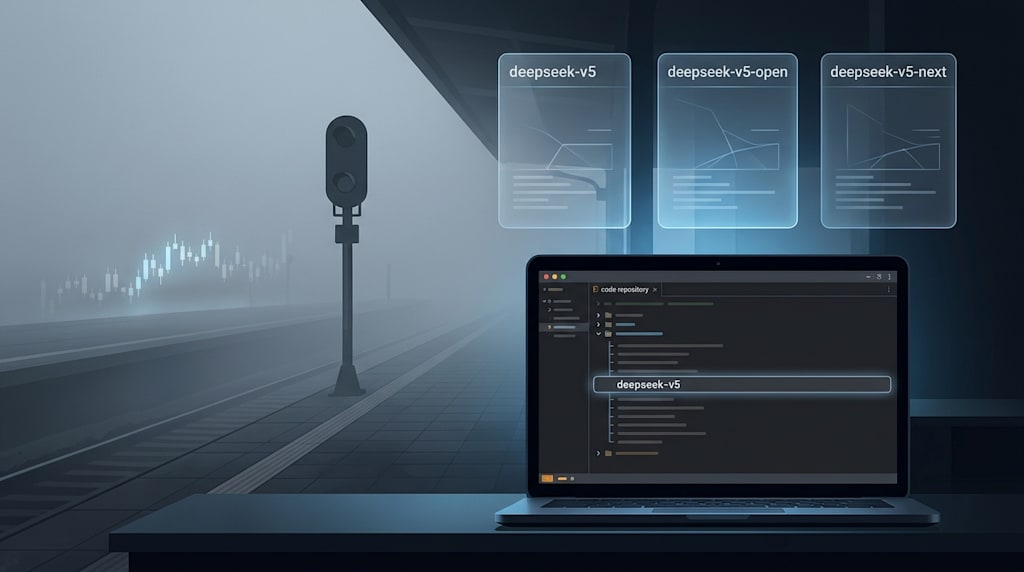
A single deepseek-v5 name could still be a test fixture. The repository also has two other variants:
deepseek-v5
deepseek-v5-open
deepseek-v5-next
Their client_requirements are deliberate.
deepseek-v5 is the basic placeholder. Current clients cannot recognize it. Calls return MODEL_UNSUPPORTED. It tests the completely unsupported case.
deepseek-v5-open requires a minimum client version of 0.0.1. It can be used without updating the client. It tests the smooth transition path.
deepseek-v5-next requires 99.0.0-alpha.1, a version number no real client can reach. It reliably triggers the forced update branch.
Put together, these three variants look less like a made-up test model and more like a gray-release and compatibility mechanism for a future launch.
The mechanism decouples server releases from client releases. When V5 launches, the server can change the /models response and push the new model to clients of different versions and accounts. Users do not need to update the app.
The model has not arrived. The release pipeline has been laid.
Code traces do not prove a finished model
Code traces prove a limited set of things. They show that DeepSeek’s engineering team reserved a place for V5 at the system level. They show that release mechanisms, version gating, and client compatibility are being prepared. They do not show that the model has finished training. They do not show that the model was finished long ago and is being withheld.
Training completion is not launch. A model still goes through evaluation, alignment, safety testing, inference optimization, capacity planning, pricing, documentation, and model card preparation. Writing a name in code is the earliest and cheapest step.
V5’s release mechanism is ready. Whether V5 itself is ready is something the code does not tell us.
Official silence remains the best evidence for real progress. At the end of October 2026, DeepSeek has not released a V5 announcement, model card, or API identifier. It has not publicly commented on the placeholders. The current flagships are V4-Pro and V4.1-Flash. V4.1-Flash launched in September with a new architecture, but the company still placed it in the V4 series. This company does not jump major versions lightly.
What is it waiting for
DeepSeek is backed by High-Flyer, a quantitative fund. Its boss is Liang Shen. When to release a model is not only a technical question for High-Flyer. Every DeepSeek release moves Nvidia, compute leasing, and the A-share AI concept stocks.
When is the best time to release?
That question cannot be confirmed. The timeline is suggestive. v5 was buried in the code on September 24. Over a month has passed with no movement. This does not look like forgetting to release. It looks like waiting for a window. The window could be technical: inference costs coming down, a benchmark result stabilizing, feedback on V4.1-Flash coming in. It could be commercial: waiting for a day that draws a beautiful candlestick chart.
Maybe Liang Shen is not refusing to release. Maybe he is waiting for a window that draws a beautiful K-line.
That sounds like a joke. With High-Flyer, it is not entirely a joke.
A trailer for a trailer
DeepSeek has built the platform for V5 in its code. The train has not pulled into the station.
deepseek-v5 is a model name, not an API version number. It first appeared in the September 24 commit, with client version gating logic. The repository also has -open and -next variants for the smooth-transition and forced-update paths. These traces show that the release mechanism is being prepared. They do not show that the model has finished training.
For writers, this story has technical detail, a timeline, commercial speculation, and suspense. For users, the safe attitude is simple: read the code, believe half of it, wait for the official announcement, then act.
A name that has sat in the code for over a month can be a trailer. It can also be a trailer for a trailer.
DeepSeek’s official announcement is the thing that will arrive.
About the Creator
Jin
Writer of reamstories
https://reamstories.com/jin
Enjoyed the story? Support the Creator.
Subscribe for free to receive all their stories in your feed. You could also become a paid subscriber, letting them know you appreciate their work.
Comments
There are no comments for this story
Be the first to respond and start the conversation.