
I Counted the Faces in the White House Intern Photo. Then I Counted Again.
Asian talent runs the AI race. The rooms where rules get written tell a different story.
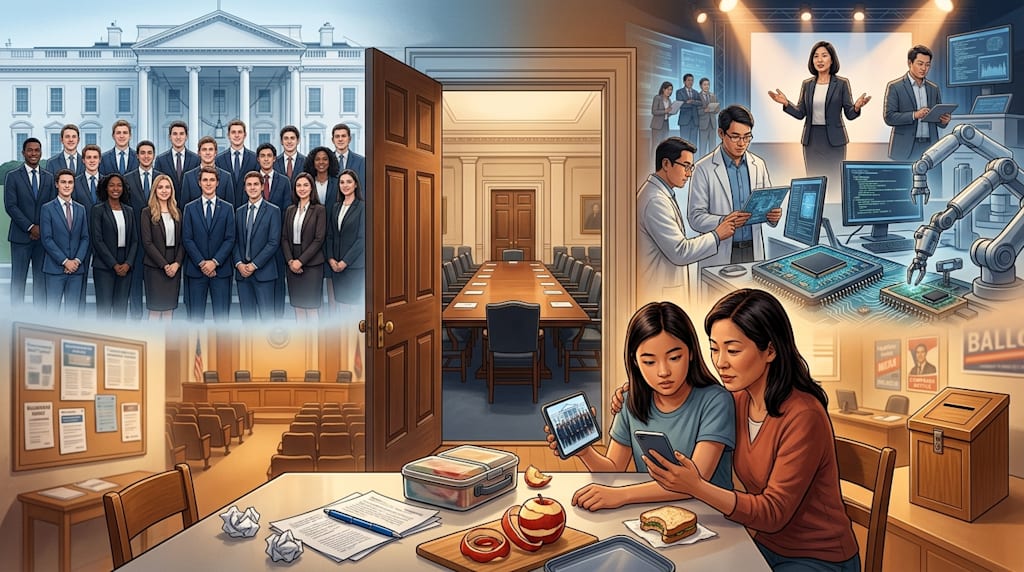
I zoomed in and counted twice.
The 2026 White House summer interns. Posted by Trump’s team. Young, bright, confident. White. Apart from one or two darker faces, almost no Asian faces.
I put the phone down, went to the kitchen, poured water. Next to the kettle was my kid’s unwashed lunchbox. I was not surprised. Trump’s White House looks like that.
Then I pulled up another set of photos. Jensen Huang holding up a chip. Lisa Su at AMD. Hock Tan at Broadcom. Lip-Bu Tan at Intel. Then Meta’s AI team, xAI’s Grok team. Asian faces everywhere.
Two sets of photos on the same screen. People stand at the front of technology, business, AI. At the entrance to federal power, they vanish.
I. A White House internship is not an internship. It is a ticket.
The White House internship lasts ten to twelve weeks. You work with White House staff. Next stops: congressional office assistant, campaign team, junior federal agency role, think tank, lobbying firm.
American politics is not a public exam. It is a mentor chain. The White House internship is the cheapest, most forward ticket on that chain.
The website says: U.S. citizen, 18 or older, undergraduate or graduate student, able to work full-time. Not harsh. It also says: public service, diverse teamwork, communication, responsibility, fast-paced complex tasks.
Those words hide a longer list.
One kid has been in community organizations, nonprofits, local government, student council since high school. Another spent the summer washing test tubes. Not who works harder. Who was placed in public arenas earlier.
Unpaid. D.C. rent. A summer of food, housing, commute: tens of thousands of yuan. The applicant pool narrows. It narrows into a shape: family social capital, school public affairs tradition, parents with channels, community network.
It does not filter for the smartest. It filters for the earliest contact with the power structure.
I know a Chinese girl who worked as a congressional intern in D.C. Her first year, she lived in Virginia, took the subway then a bus. Her mom mailed a box of instant noodles from California. She said office talk was weekend fundraisers, summer campaign trips. She could not join in. She could write policy briefs better than anyone. She did not know what shoes to wear to a fundraiser.
Not ability. Never been in that room.
II. The Chinese family ranking: survive first, speak later.
In the U.S., people ask why Chinese people with money do not go into politics.
I heard it again recently because of a mansion. Hillsborough, California. Twelve acres. Seventy million dollars. The buyer was an anonymous company. Clues pointed to Yuhuai Wu, 31, founding member of xAI, University of Toronto PhD, former Google research scientist, core developer of Grok. After xAI was acquired by SpaceX, his personal wealth soared.
Under the news, someone asked the question. One comment: Wealth can take one generation. Power takes several generations of family investment.
Many read that as resignation. I read it as time. The first generation buys the house. The second stands firm. The third walks into the room. We are stuck in the middle.
For a generation on H-1B, waiting for green cards, rooting itself in a foreign country, survival comes first. Computer science, medicine, finance, engineering: visa sponsorship, high salary, security you can see and touch. Political science, sociology, plus an unpaid political internship: too little margin for error. If you cannot stay, status itself is a problem.
So math olympiad, coding, instruments go first. Debate, drama, student government go later. We know public expression matters. We have to fill in “can we stay” first.
The cost shows up later.
The logic of American power is persuasion. Campaigns, bills, fundraising, lobbying, hearings, media. All of it requires moving people in public. That skill sits last on the list.
I know a Chinese couple. Their daughter is in twelfth grade at the best private school in town. Grades and talents, impeccable. This summer she got into an Ivy League medical research program for high schoolers. Eight weeks, groups of three, public presentation at the end.
She did the core work. The two white classmates fought from the start to go on stage, to present the key slides.
Those two were not decent. They felt entitled because “going on stage” is taught from childhood: if you did something, let people know you did it.
Our kids are taught: do a good job, and people will see.
That sentence works in the Chinese exam system. Scores speak for you. Outside that system, it does not.
Her mom later cut apples in the kitchen. “She did not cry when she came back. She just revised the PPT again. Until two in the morning.”
The apple peel broke. She did not say more.
III. Bamboo ceiling: not ability, entrance.
“Bamboo ceiling” was coined by Jane Hyun in 2005. It describes the invisible barrier Asian Americans face in senior management, boards, government, and core decision-making.
Twenty years later, it has not disappeared.
The Ascend Foundation used data from Google, HP, Intel, LinkedIn, and Yahoo submitted to the EEOC. White men become executives at 2.5 times the rate of Asian men, and 3.6 times the rate of Asian women. The negative effect of race was 3.7 times that of gender. For an Asian woman in Silicon Valley, “Asian” is a bigger obstacle than “woman.”
Harder than the social and economic wall is the political wall.
Tufts University’s CIRCLE research center tracked young Americans in the 2022 midterms. Only 31 percent of Asian young people thought they were “qualified” to participate in politics. Among non-Asian peers, 41 percent did. At the same time, 61 percent of Asian young people said they understood important political issues “quite well.”
They understand American politics and culture. They do not think it is for them.
Culture plays a part. In many Chinese families, politics is imagined as dangerous. Amy Chua’s daughter went to Harvard, then joined the military aiming toward politics. Many people treated that as “failure.” Stable, high-paying, predictable remains the deepest expectation.
If every generation chooses only stability, the rules will always be written by others. If you are not at the table, you are on the menu. If you do not take part in distribution, you accept distribution.
IV. We teach “do good work and people will see.” Power does not work that way.
I watched the recording of the research presentation. She stood at the side of the screen, clicker in hand. The two white classmates stood in the center, taking turns. She added one sentence at the end about the data source. Quiet. The teacher nodded. The video ended.
Another scene. Last year, a charity sale at the community center. A Chinese boy was in charge of moving tables. Twenty tables. His T-shirt was soaked. After the event, the host thanked the three people who spoke on stage. No one mentioned him. His mom said, “It’s fine. Good deeds do not need a name.” The boy folded the last table and leaned it against the wall. He wiped his nose with the back of his hand.
Neither event was big. They grew from the same soil: we teach kids to do the work, not to talk about the work. To be executors, not initiators. To optimize within the system, not to change the system.
The logic of American power is persuasion. Campaigns, bills, fundraising, lobbying. You have to move people. You did something, let people know. Stand up, speak, fight, ally.
This is how public life works. Doing ten and letting people see three is waste. Worse: many Chinese kids do not lack ability. They lack the habit.
V. Change is happening, but slow.
In 2026, eight major U.S. cities have Asian American mayors: New York, Boston, San Antonio, Cincinnati, St. Paul, Wichita, Bakersfield, and Fremont.
Boston Mayor Michelle Wu was first elected in 2021, the first Asian American woman mayor in Boston history. Her parents immigrated in the early 1980s. At Harvard, her mother became ill. After law school, she moved the family to Boston, cared for her mother diagnosed with schizophrenia, became legal guardian of her two sisters, and started from a junior job in city government. This January, she announced a second four-year term.
This January 14, May Nivar entered the Virginia House of Delegates, the state’s first Chinese American woman delegate. She was born in Philadelphia, her parents immigrants from China. To pay tuition, she worked in a supermarket. Later she studied journalism at NYU, spent years in corporate work, lived in Richmond for twenty years. She broke her own ceiling.
In that Tufts report, there is another number: 18 percent of Asian young people have participated in mutual aid groups or informal volunteer service, twice the rate of non-Asian peers. Translating for elders, filling out forms for neighbors with limited English, organizing donations in Chinese groups, telling a newly transferred student when the school bus comes.
These things are not counted as “political participation.” They do not appear in any photo. They are the muscle underneath.
My daughter helped an elderly person fill out a form at the community center last week. She did not tell me. Someone sent a photo. She was squatting next to a chair, a blue ballpoint pen in her hand, the cap in her mouth. The elderly person pointed at a column. She leaned in.
That is all.
VI. Not every kid needs to go into politics, but every community needs someone at the table.
What Chinese families need to change is not sending every kid to run for office, study political science, or do unpaid internships. That is not realistic.
What needs to change is the default: public participation is “dangerous,” “useless,” “affects grades.”
There are many paths: school board, city council, community organizations, poll worker, campaign finance, congressional aide, policy research, media, law, unions, chambers of commerce, nonprofits. Not everyone needs to be on stage. Every community needs people in the rule-making room.
“Cultural fluency” means staying rooted in your own culture while stretching in the new. Understanding Chinese family ethics, diligence, faith in education. Also expressing, negotiating, allying, organizing in the mainstream public arena. Making results in the lab, explaining results in the conference room. Building chips, writing rules.
For Chinese parents, change may happen in a small moment.
A kid comes home and says he opposed something at school, and wants to run to change it. A new generation of Chinese parents may not reflexively ask, “Will this affect your grades?”
Instead: “What do you want to change? How will you persuade people? What do you need from me?”
I saved that White House photo in my phone album. Next to it is the photo of my daughter squatting at the community center, filling out a form. She is not smiling. The blue pen cap is in her mouth. The window is dark.
When she came home, her backpack landed on the sofa. “Mom, the bus was ten minutes late.”
I said, “Food’s in the pot.”
She said, “Oh.” She went to wash her hands. The faucet ran.
About the Creator
Jin
Writer of reamstories
https://reamstories.com/jin
Enjoyed the story? Support the Creator.
Subscribe for free to receive all their stories in your feed. You could also become a paid subscriber, letting them know you appreciate their work.
Comments
There are no comments for this story
Be the first to respond and start the conversation.