
I Built a 256GB “E-Waste” AI Rig to Escape Token Fees. Here’s What Nobody Tells You.
11 kWh a day, 450 tok/s, and the hard truth: local AI gives you token freedom, not intelligence freedom.
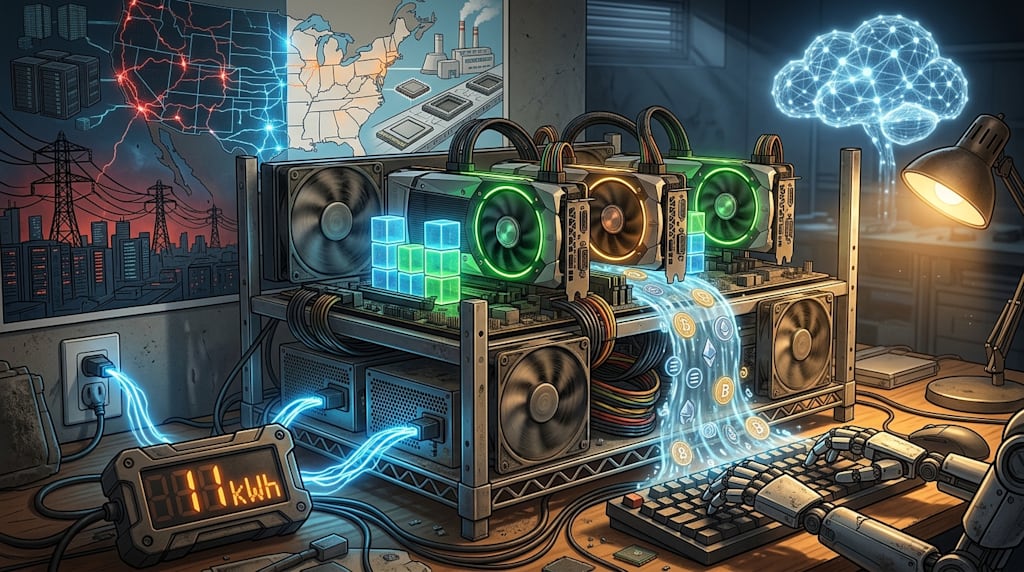
Many people say local deployment means token freedom. I ran mine for over half a year. Token freedom has three layers: physical, economic, and intelligence. The first two are free. The third is not.
Configuration: dual X99, two E5-2696 v4, 128GB DDR4, four CMP 170HX unlocked to 64GB each, 256GB VRAM total. Qwen3.8 Flash-Next official native version, TP2*PP2, 1M context. About 60 tok/s single stream, about 450 tok/s at 16 concurrent. About 11 kWh per day. It is now my main machine. It writes code and runs tasks with almost no cache hit rate.
I have deployed DSV4F, DSV4F Exp, and Qwen3.8 27B locally. I kept Qwen3.8 Flash. On my tasks, it beats DSV4F and GLM5.3 Flash.
Why keep an 8B? Do the math.
256GB VRAM. With 8B, I can run 1M context and 16 concurrent, and still leave room for KV cache and activations. With 70B, single stream works, but concurrency goes OOM. With a trillion-parameter MoE, loading is painful. Speed: 60 tok/s single stream is close to fast reading. A larger model drops to 10 tok/s. You wait over ten seconds for one sentence. 16 concurrent at 450 tok/s can serve multiple agents at once. Power: 11 kWh/day, over 300 kWh/month. A larger model doubles that. Engineering: CMP 170HX is a mining card, GCN architecture. Driver, operator, and CUDA compatibility are all pits. Dual X99 PCIe 3.0 bandwidth is a bottleneck. TP2*PP2 requires tuning KV cache paging, attention masks, and communication overhead. Without months of Linux and CUDA experience, you cannot install the driver.
Qwen3.8 Flash balances capability, speed, VRAM, power, and engineering complexity.
Token freedom has three layers.
Physical freedom: you have VRAM, compute, and concurrency. The model runs and serves multiple requests. 256GB VRAM, TP2*PP2. 60 single-stream, 450 at 16 concurrent. That is productivity.
Economic freedom: you do not pay per token. You pay for electricity: 11 kWh/day, a few to a dozen yuan at residential rates. For heavy use, cloud API costs dozens to hundreds of yuan a day. Local pays off if you run it 24/7.
Intelligence freedom: can a local model understand complex requirements? Can it do multi-step reasoning? Can it refactor a 100k-line codebase? No. 8B is a fast typist. Code completion, paragraph rewriting, document summarization, RAG QA, and agent routing work. Complex system design does not. Long-chain reasoning breaks down. Huge codebase refactoring gets lost. Local solves token freedom. Productivity freedom is a different problem. You have unlimited bullets, but the gun is small.
Why 8B? Every local deployment player faces an arithmetic problem.
VRAM sets the ceiling. 256GB sounds big. Run 1M context, turn on KV cache, leave activations and intermediate tensors. Not much is left for weights. With 8B, you get high concurrency, long context, and a large batch. With 70B, single stream, and concurrency goes OOM. With a trillion-parameter MoE, loading is painful.
Speed sets the experience. 60 tok/s single stream is close to fast reading. A larger model at 10 tok/s makes you wait over ten seconds for a sentence. 16 concurrent at 450 tok/s serves multiple agents, tasks, and users. That is the value of a local cluster.
Power sets sustainability. 11 kWh/day, over 300 kWh/month. A larger model and more cards double that. You compete with the grid in endurance.
Engineering complexity decides whether you survive. CMP 170HX mining card, GCN architecture. Driver, operator, and CUDA compatibility pits. Dual X99 PCIe 3.0 bottleneck. TP2*PP2 requires understanding KV cache paging, attention masks, and communication overhead. Without months of experience, most people cannot install drivers.
Qwen3.8 Flash is the balance point for my rig.
Token scarcity: VRAM and power.
AI is moving into documents, customer service, law, medicine, and education. Token consumption grows exponentially by the month. In the first three years, coding consumed over 90% of tokens. In the future, coding will be no more than 1% of total social token consumption. Coding is the first wave.
Global token scarcity is inevitable. Constraints: VRAM and power. The US does not lack VRAM. It lacks power. H100 and B200 stack in data centers while the grid ages, approvals slow, and renewable interconnection stalls. Build a 100k-GPU cluster and the substation says no. China does not lack power. It lacks VRAM. It has large generation capacity and a broad grid, but advanced-node GPUs and HBM are blocked. Stack domestic cards, and single-card compute and memory bandwidth cannot catch up in the short term. Unless China and the US reconcile, token scarcity is the norm.
Local deployment can pay off for a productivity-grade token supply. Use your own power, cards, and machine room. Produce tokens. API rate limits, price changes, and export rules do not touch it. You worry about cards burning, power prices rising, and models crashing.
Local deployment does not solve everything.
Know the boundary. Qwen3.8 Flash is a fast typist, not a universal brain. Complex logic, long-chain reasoning, and cross-domain knowledge integration go to cloud API. Local handles frequent, private, cost-sensitive work. Cloud handles rare, hard, high-value work.
Squeeze VRAM. With 256GB VRAM, deploy speculative decoding or Medusa heads. Use idle VRAM for a 2B draft model. Single-stream speed jumps to 90+ tok/s. Free performance.
Watch domestic compute. Huawei Ascend 910B has weak FP16, but China does not lack power. Stack quantity and multi-machine clusters to solve the VRAM shortage. For individuals, e-waste rigs are a stopgap.
Do the total math. Add power, depreciation, noise, and time. Mining card lifespan is unstable. One card dies, and the whole system is down. If you only ask occasional questions, power and noise are a loss. If you run code completion or multi-agent concurrency 24/7, it wins.
In the next three years, token consumption grows exponentially by the month. Coding share drops below 1%. Global token scarcity goes from occasional to normal. Local deployment goes from geek toy to infrastructure. People used to build servers, then NAS boxes. Now they run local LLM clusters. Technology democratization often starts with cheap hardware and stubborn people.
The meter read 11 kWh. The fans are still spinning. Qwen3.8 is still spitting tokens.
About the Creator
Jin
Writer of reamstories
https://reamstories.com/jin
Enjoyed the story? Support the Creator.
Subscribe for free to receive all their stories in your feed. You could also become a paid subscriber, letting them know you appreciate their work.
Comments
There are no comments for this story
Be the first to respond and start the conversation.