
I Asked an AI Agent to Clone Google Flow. The Bill Was $3, and the Teapots Were Everywhere.
A clean-room app replication test with DeepSeek Harness, ADB, and one very stubborn 16-second video.
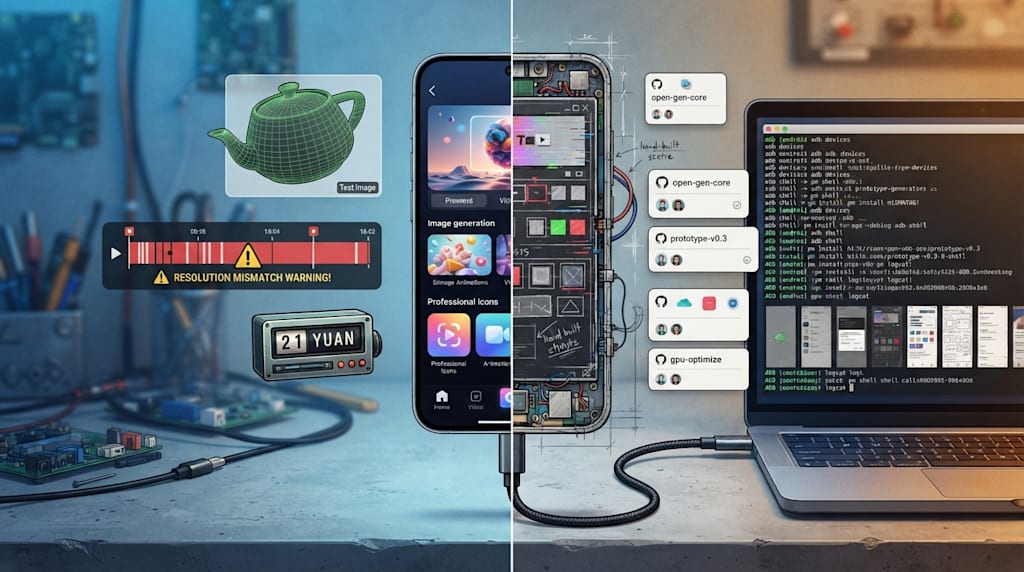
Last weekend a friend showed me how he used DeepSeek Harness with REA and Craft-anything to rebuild a short-drama studio from zero. The comments filled with questions. One reader asked about a free short-drama app. I did not answer that one, because I did not know the app. Then another comment asked whether the same method could rebuild a phone app. I decided to test it on Google Flow, the image and video generation product. No jadx. No Frida. No decompilation. I used public screens and interaction results and rewrote the app from scratch. The result was FlowClone, with comparison shots against Google Flow on the home screen, project page, image editor, and parameter panel. The effect checks included a live LLM agent, a 16-second extended video that played end to end, multiple saved versions under one source image, and original-image attribution. I also packaged the process as a skill called bggg-copy-app and put the app and server on GitHub.
The method has five steps. First, set a level from L0 to L5. The default target is L3, where the effect matches and static fake data is rejected. Second, connect a phone over USB debugging and let DeepSeek Harness drive ADB commands. Third, dump the UI tree with uiautomator and take screenshots with screencap, then read colors, corner radii, and font sizes. Fourth, write a per-screen UI difference table and a behavior audit table. Fifth, rebuild the native app in Kotlin and the server in Python, install both on the same phone, and compare the original on the left with the clone on the right. I tried mobile-mcp, which lets an agent operate a phone, but app replication needed lower-level access. The native ADB path covered more.
The agent has one habit that ruins replication: it stops too early. It taps one button, sees the state change, and leaves to write code for the next feature. That produces a broad, shallow copy that does not work. I had to give a hard order: go three, four, or five layers deep. Open the next screen, test the function, follow the state chain, then rebuild that chain.
The second trap is the gap between a similar UI and a working function. Modern apps hide deep state and media logic behind a simple input box and a few buttons. Google Flow gave me two clean examples. In the first build, an 8-second video extension saved the new clip without merging it, so the result stayed at 8 seconds. When the agent merged two clips into 16 seconds, the two source segments had different resolutions, 416 by 752 and 400 by 736. The last eight seconds showed artifacts. The fix was Media3 Transformer with one scale and one re-encode pass. The same section needed asset attribution and long-task recovery. Adding animation or editing a video had to keep the original file and save a 2/2 version under the same asset. Generation tasks had to be split into jobId records on disk so the agent could resume after the process was killed. Downloads needed a file-header check, because an upstream HTTP 202 JSON response could be saved as a broken MP4.
The third trap is coordinate reuse. On a physical phone, the soft keyboard appears, lists scroll, and a Xiaomi phone can pull up global search or Xiao Ai from an accidental touch. Old coordinates fail right away. Compose cards often lack text descriptions. The agent has to re-run the semantic tree before every tap.
The fourth trap is the backend. A commercial app cannot ship with the gateway key inside the APK. I had DeepSeek read the login state, credit balance, notifications, and chat page, then infer 18 API endpoints. If the product later needs a complex agent, the Harness can sit in that server and schedule work there.
The live run was less dramatic than the screenshots suggest. I connected a Xiaomi 9 Pro, turned on USB debugging, opened DeepSeek Harness, selected DeepSeek-V4.1-Flash Max, and gave full permissions. It built an environment and collection checklist, with a 99% cache hit rate on the bottom bar. It sent ADB commands and saved screenshots to /tmp/state.png, then read the image back to sample colors and measure sizes. Every time I let it choose a test image, it generated a green teapot. I still do not know why. In half an hour it collected 59 screenshots and produced a v0. Then it cheated. It made a mobile web app in Chrome because the compile package download was slow. I sent it back to native. It switched to Kotlin and Jetpack Compose, ran the five missed function classes, built an APK, and compared it with the original side by side for pixel fixes.
The first native demo cost 6.78 yuan and took under two hours. The first day ended after seven hours of work, 55 rounds, 421 million tokens, and a little over 21 yuan. DeepSeek Harness planned 30 automation rounds and used goal_round to trigger the next reply. The built-in rounds run two to three hours. Running eight hours or more needs an Agent Loop, which I will cover next time. Later rounds replaced the fake camera and fake generation with a live AI gateway. The virtual avatar path moved through six layers: L1 entry, L2 English protocol, L3 camera selfie, and L6 gateway output. The app also switched to a self-built server with registration and login, so it could reach a release-ready state.
The repos are open. The app and server are in GitHub binggandata/flowclone, with native code, a Python server, and the spec tables. The skill is in binggandata/bggg-skills under bggg-copy-app. If you connect an Android phone and tell DeepSeek Harness to use bggg-copy-app on an installed app, it will start with this checklist. If you do not know what to build, copy something first. The path appears while you walk it.
About the Creator
Jin
Writer of reamstories
https://reamstories.com/jin
Enjoyed the story? Support the Creator.
Subscribe for free to receive all their stories in your feed. You could also become a paid subscriber, letting them know you appreciate their work.
Comments
There are no comments for this story
Be the first to respond and start the conversation.