
I Almost Quit DeepSeek – Here’s What I’m Using Instead (And You Should Too)
When the price tripled overnight, I went down the rabbit hole of alternatives – from a sneaky subscription to a Chinese underdog and even the global giants. This is what I actually settled on.
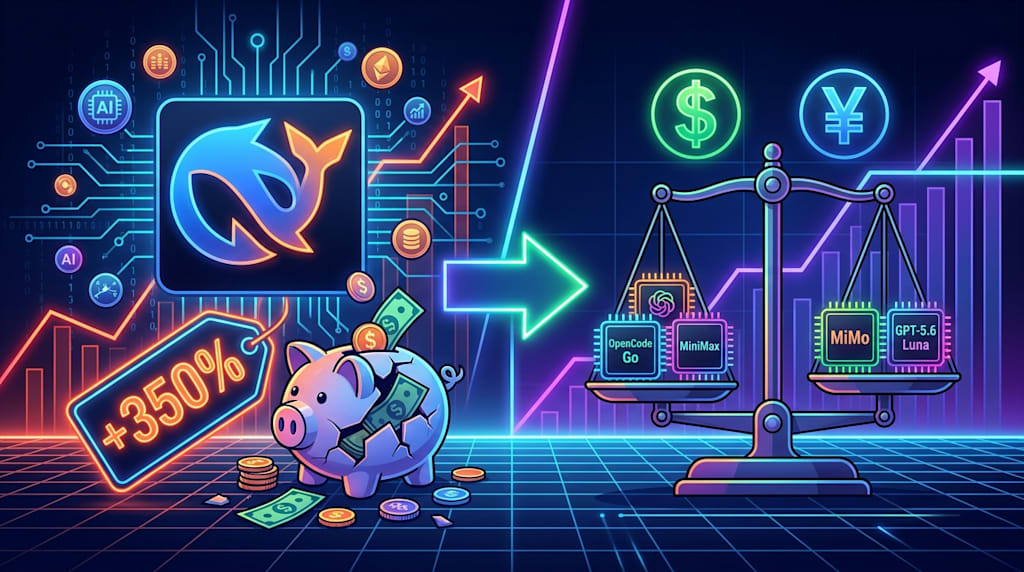
Last Thursday, I was sipping my morning coffee and casually checking my API usage dashboard. Then I saw the email from DeepSeek – new pricing effective August 17, peak hours at 27 yuan per million tokens for V4‑Pro output. My heart actually sank. I do most of my coding between 10 AM and 4 PM, which is exactly their peak window. That meant my monthly bill would go from something like 600 yuan to over 2,000. For a solo developer, that’s not a minor annoyance – it’s a budget breaker.
The announcement came bundled with a shiny new “V4 Pro” version, better agent workflows, and OpenAI‑compatible endpoints. But I couldn’t shake the feeling that they were locking in the early adopters and then pulling the rug. The off‑peak discount sounded nice – half price – but even that half was more than the original full rate. So I started hunting.
My first stop was OpenCode Go, which some friends in a Telegram group had been raving about. It’s a subscription service from the OpenCode team – $10 a month, first month $5, and you get $60 worth of credits. The clever bit is that they’ve negotiated a special internal rate for DeepSeek V4 Flash that’s actually lower than the old official pricing. So your $60 stretches to about six times the normal token volume. That translates to roughly 7 billion tokens a month – enough for a heavy coder like me. But there’s a giant asterisk: if DeepSeek’s hike flows through to OpenCode’s internal billing, that 7 billion could shrink to 1.4 billion. Nobody knows if or when that will happen. It felt like a gamble, and I don’t like gambling with my toolchain.
Next, I looked at MiniMax. They’re the safe, local choice – servers in China, official invoices, no VPN headaches. Their Token Plan has three tiers, and the 119‑yuan Max plan gives you a combined quota that boils down to about 4 billion M3 tokens plus 8 billion M2.7 tokens. What really caught my eye is that M2.7, when used as a code‑exploration sub‑agent, barely touches your main allowance – it’s practically free for trial‑and‑error work. In my 9‑to‑5 schedule, I’d never hit the cap. The 49‑yuan Plus plan is also decent for lighter use, but I wanted the full flexibility. MiniMax felt solid, stable, and boring in a good way. But I still wondered if I could get a better deal.
Then I remembered MiMo‑V2.5. Back in May, Xiaomi announced a permanent price cut – up to 99% off – and aligned their rates exactly with DeepSeek V4 Flash’s old pricing. Same input, same output, same cache‑hit numbers. They also boosted their token plan volumes by 5 to 8 times. So if I just switched to MiMo, I’d pay exactly what I used to pay for DeepSeek, with no changes to my billing model. It felt like a mirror image – the easiest escape route. But I was curious about the international scene too.
So I peeked across the border. OpenAI had slashed GPT‑5.6 Luna by about 80% on July 30 – now at $0.20 input and $1.20 output per million tokens. At today’s exchange rate, that’s about 0.86 yuan per hundred million tokens, which is exactly the “one yuan per hundred million” dream many devs talk about. Google’s Gemini 3.7 Flash is running a promotion at $0.75 input and $3.75 output until the end of the year – about 27 yuan for output per million tokens, which is competitive. Grok 4.6, fresh from SpaceXAI, claims to be “half the price of other frontier models” at $2 input and $6 output, but that still ends up around 43 yuan per million tokens – too rich for my blood. And Alibaba’s Qwen3.8, with its massive 2.4 trillion parameters, charges 12 yuan input and 36 yuan output domestically – a middle‑of‑the‑road option.
After a week of spreadsheet crunching and a few sleepless nights, I made my choice. I’m going with MiniMax’s 119‑yuan Max plan. Why? Because I need reliability more than I need the absolute lowest per‑token price. OpenCode Go is tempting, but that pass‑through risk keeps me awake. MiMo is a great drop‑in, but I don’t want to be the first to jump ship if something breaks. And the international options, while cheap, come with latency and occasional connectivity hiccups that slow down my workflow. MiniMax just works, it invoices properly, and I don’t have to explain to my accountant why I’m paying in dollars.
That said, if you’re a freelancer who codes at night and doesn’t mind a bit of uncertainty, OpenCode Go could be your winner. If you’re purely cost‑driven and have a good VPN, GPT‑5.6 Luna is unbeatable. And if you want a seamless switch with no learning curve, MiMo‑V2.5 is ready and waiting.
The market is moving fast – new deals pop up weekly. But for now, I’ve found my anchor. The real lesson isn’t about which model is cheapest; it’s about knowing your own priorities. For me, stability won. For you, it might be different. And that’s okay.
About the Creator
Jin
Writer of reamstories
https://reamstories.com/jin
Enjoyed the story? Support the Creator.
Subscribe for free to receive all their stories in your feed. You could also become a paid subscriber, letting them know you appreciate their work.
Comments
There are no comments for this story
Be the first to respond and start the conversation.