
HVAC Equipment Market to Reach US$ 322.33 Billion by 2033 as Smart Climate Technologies Transform Buildings Worldwide
Rising Urbanization, Energy Efficiency Goals, and Smart HVAC Innovations Are Reshaping the Future of Indoor Comfort

Introduction
The way people heat, cool, and ventilate buildings is undergoing a significant transformation. As climate change intensifies, urban populations grow, and governments push for greener infrastructure, the demand for advanced Heating, Ventilation, and Air Conditioning (HVAC) systems continues to accelerate.
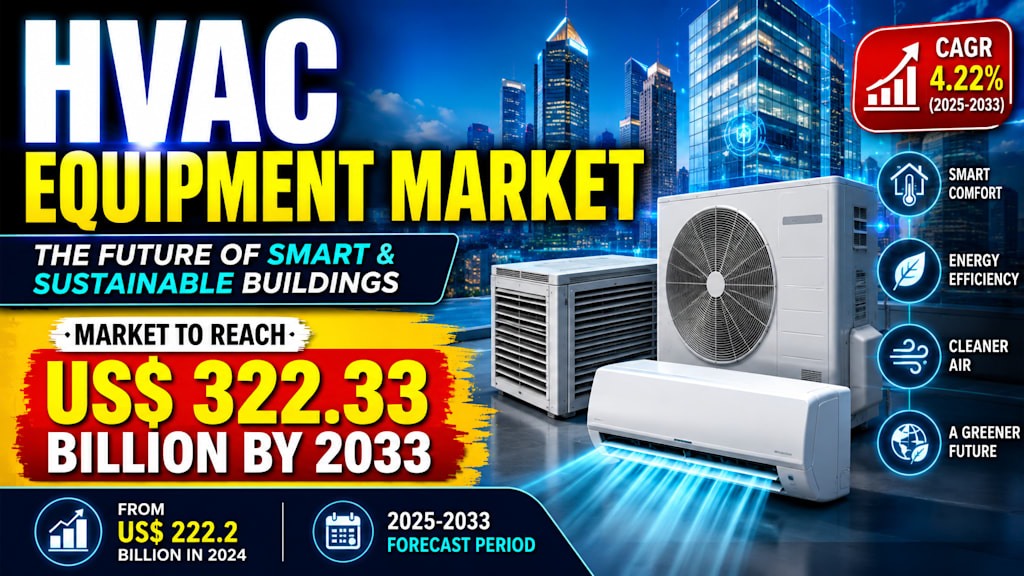
According to Renub Research, the Global HVAC Equipment Market is projected to grow from US$ 222.2 billion in 2024 to US$ 322.33 billion by 2033, expanding at a CAGR of 4.22% between 2025 and 2033. The market's expansion is being driven by technological innovation, growing environmental awareness, stricter energy regulations, and rising demand for healthier indoor environments.
From smart thermostats and IoT-connected systems to high-efficiency heat pumps and advanced air purification technologies, HVAC equipment is becoming more intelligent, sustainable, and essential than ever before.
Why HVAC Systems Have Become More Important Than Ever
HVAC systems are no longer viewed simply as tools for maintaining comfortable indoor temperatures. They now play a critical role in health, productivity, sustainability, and energy management.
The global pandemic significantly increased awareness about indoor air quality. Businesses, schools, healthcare facilities, and homeowners have become more conscious of ventilation and filtration systems that help create healthier indoor environments.
Modern HVAC systems are now expected to provide:
Efficient heating and cooling
Air purification
Humidity control
Energy optimization
Smart remote management
Reduced environmental impact
As a result, manufacturers are investing heavily in advanced technologies that deliver both comfort and sustainability.
Urbanization Is Creating Massive Demand for HVAC Equipment
One of the strongest growth drivers for the HVAC market is rapid urbanization.
According to United Nations projections, nearly 68% of the world's population is expected to live in urban areas by 2050. Growing cities require extensive residential, commercial, and industrial infrastructure, all of which depend heavily on HVAC systems.
Modern buildings need sophisticated ventilation solutions capable of:
Maintaining comfortable temperatures
Removing pollutants
Controlling humidity
Preventing mold growth
Improving indoor air quality
As megacities continue expanding across Asia, Africa, and the Middle East, HVAC equipment demand is expected to rise significantly.
Indoor Air Quality Has Become a Top Priority
Air quality concerns have emerged as a major catalyst for HVAC innovation.
Consumers increasingly want systems that do more than cool or heat indoor spaces. They want equipment that actively contributes to healthier environments.
Advanced HVAC manufacturers now integrate technologies such as:
HEPA filtration
UV sterilization
Ionization systems
Smart ventilation controls
Air quality monitoring sensors
These features help remove bacteria, allergens, dust particles, and airborne pollutants while ensuring cleaner air circulation.
The shift toward healthier buildings is creating new opportunities across residential, healthcare, educational, and commercial sectors.
Sustainability Is Driving a New Era of HVAC Innovation
Buildings represent one of the world's largest sources of energy consumption.
According to European Commission estimates, buildings account for more than 40% of total energy consumption and 36% of greenhouse gas emissions in Europe. HVAC systems represent a substantial share of that energy usage.
To address environmental concerns, governments worldwide are implementing:
Energy-efficiency standards
Carbon-reduction targets
Green building certifications
Incentive programs for efficient equipment
As a result, manufacturers are developing systems that consume less energy while delivering superior performance.
Modern HVAC innovations include:
Variable-Speed Compressors
These systems automatically adjust operating capacity according to actual cooling or heating requirements, reducing unnecessary energy consumption.
Smart Thermostats
Connected thermostats learn user preferences and optimize temperature settings automatically.
High-Efficiency Heat Pumps
Heat pumps provide heating and cooling while consuming substantially less energy compared to traditional systems.
Renewable Energy Integration
Many HVAC systems are now designed to work alongside solar energy installations and other renewable technologies.
Smart HVAC Systems Are Revolutionizing Building Management
The Internet of Things (IoT) is transforming HVAC equipment into intelligent building management tools.
Today's smart HVAC systems allow users to:
Monitor performance remotely
Adjust temperatures using smartphones
Schedule operations automatically
Receive maintenance alerts
Track energy consumption in real time
Artificial intelligence is further enhancing these capabilities through predictive maintenance and automated optimization.
Building owners benefit from:
Lower operating costs
Improved comfort
Reduced downtime
Extended equipment lifespan
The integration of digital technologies is expected to remain one of the strongest growth opportunities throughout the forecast period.
Challenges Facing the HVAC Equipment Market
Despite strong growth prospects, the industry faces several significant challenges.
Energy Consumption Concerns
Although HVAC technology is becoming more efficient, heating and cooling systems remain among the largest energy consumers in buildings.
Many older structures still operate with outdated HVAC systems that:
Waste energy
Increase utility costs
Generate higher emissions
Retrofitting existing buildings can be expensive and technically challenging.
High Maintenance Costs
HVAC systems require ongoing maintenance to operate efficiently.
Routine servicing includes:
Filter replacements
Component inspections
Refrigerant management
System calibration
Poor maintenance can result in higher energy bills, unexpected failures, and reduced equipment life.
Businesses increasingly rely on predictive maintenance solutions to minimize these risks.
Regional Outlook: Where Growth Is Happening
Asia-Pacific Leads Global Expansion
Asia-Pacific remains the largest and fastest-growing HVAC market.
Factors supporting growth include:
Urbanization
Rising disposable incomes
Expanding construction activity
Government sustainability initiatives
Countries such as China and India continue investing heavily in residential and commercial infrastructure.
United States Market
The United States remains one of the world's most mature HVAC markets.
Growth is supported by:
Energy-efficiency incentives
Smart building adoption
Building renovation projects
Growing demand for air purification technologies
Manufacturers continue introducing advanced connected HVAC solutions aimed at reducing energy costs and improving user experience.
Germany Market
Germany's HVAC industry is heavily influenced by ambitious climate goals.
The country's transition toward carbon neutrality is accelerating demand for:
Heat pumps
Renewable energy-integrated HVAC systems
Smart building technologies
High-efficiency ventilation systems
Government subsidies continue encouraging adoption of sustainable equipment.
China Market
China represents one of the largest HVAC opportunities globally.
The government's commitment to carbon neutrality and green construction is encouraging widespread deployment of energy-efficient systems.
Programs such as China's Clean Heating Plan have accelerated the shift away from coal-based heating solutions toward cleaner alternatives.
United Arab Emirates Market
Extreme temperatures and large-scale infrastructure projects make the UAE a major HVAC market.
Key growth drivers include:
Smart city developments
Green building initiatives
Commercial real estate expansion
Adoption of advanced cooling technologies
Demand for energy-efficient cooling systems remains particularly strong.
10 Recent Developments Shaping the HVAC Industry
1. Midea Group Expands Manufacturing Presence
In November 2023, Midea Group announced a US$105 million investment to establish its third industrial complex in Egypt, strengthening production capabilities and export potential.
2. Carrier Advances Smart Cooling Solutions
Carrier continues expanding its Greenspeed Intelligence technology portfolio, improving energy efficiency and adaptive cooling performance.
3. Daikin Accelerates Heat Pump Adoption
Daikin is increasing investments in heat pump technologies to support global decarbonization efforts and reduce reliance on fossil-fuel heating.
4. LG Enhances Air Purification Technology
LG continues integrating advanced ionization and filtration technologies into HVAC products to improve indoor air quality.
5. Johnson Controls Expands OpenBlue Platform
Johnson Controls is strengthening its AI-driven OpenBlue ecosystem to provide smarter building automation and energy management solutions.
6. Hitachi Focuses on Sustainable Cooling
Hitachi is expanding development of environmentally friendly refrigerant technologies to support global climate targets.
7. Fujitsu Introduces Advanced VRF Solutions
Fujitsu continues upgrading Variable Refrigerant Flow systems designed for commercial energy efficiency.
8. Haier Invests in Smart Home Integration
Haier is enhancing connectivity features that integrate HVAC equipment with broader smart-home ecosystems.
9. Havells India Expands Premium HVAC Offerings
Havells continues strengthening its air conditioning and climate control product portfolio to meet rising demand in India.
10. Industry-Wide Shift Toward Low-GWP Refrigerants
Leading HVAC manufacturers are accelerating adoption of low Global Warming Potential (GWP) refrigerants to comply with evolving environmental regulations.
Competitive Landscape
Major companies operating in the global HVAC equipment market include:
Carrier Corporation
Daikin Industries, Ltd.
Fujitsu
Haier Group
Havells India Ltd.
Hitachi Ltd.
Johnson Controls
LG Electronics
These companies continue investing in digitalization, sustainability, smart controls, and energy-efficient technologies to strengthen their market positions.
Final Thoughts
The HVAC equipment industry stands at the center of several global megatrends, including urbanization, sustainability, digital transformation, and public health awareness.
As buildings become smarter and governments intensify efforts to reduce carbon emissions, demand for intelligent, energy-efficient HVAC systems is expected to remain strong throughout the coming decade.
With the market projected to reach US$ 322.33 billion by 2033, HVAC equipment manufacturers have a significant opportunity to redefine how buildings manage comfort, air quality, and energy consumption. The next generation of HVAC technology will not simply control temperature—it will help create healthier, smarter, and more sustainable spaces for billions of people worldwide.
About the Creator
Enjoyed the story? Support the Creator.
Subscribe for free to receive all their stories in your feed.
Comments
There are no comments for this story
Be the first to respond and start the conversation.