
Huawei’s AI Plan Isn’t to Win the Model War. It’s to Own the Ground Under It.
The company isn’t trying to outbuild ChatGPT. It’s trying to become the compute platform that runs every model, from DeepSeek to Kimi, on Ascend, Kunpeng, and SuperPoD clusters.
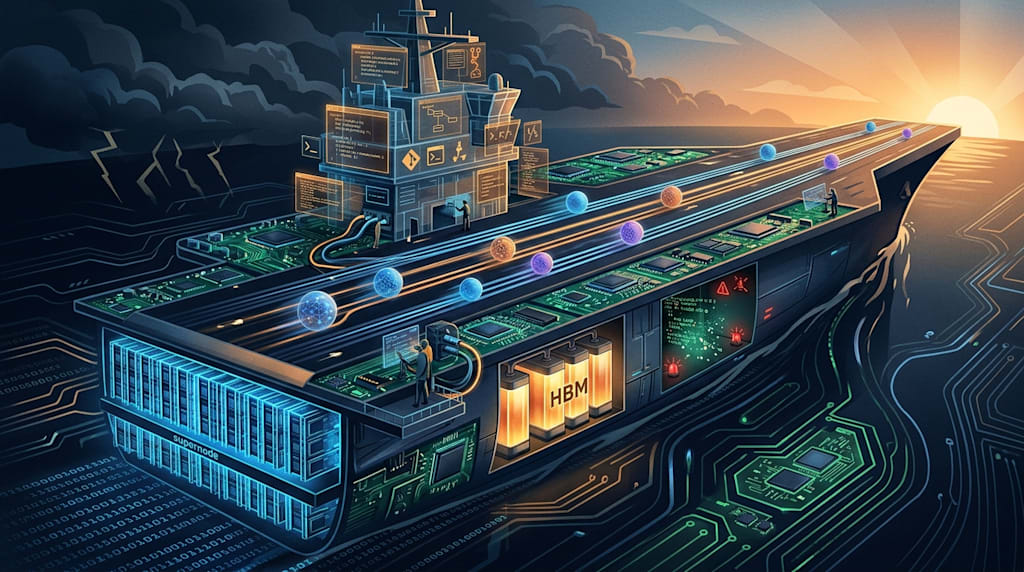
Huawei's AI Niche: A Long Campaign for the Base Layer
A Positioning That Is Repeatedly Misread
The most easily misread part of Guo Ping's remarks in Xinsheng Community is the phrase "become Nvidia." Most people see chips. But Guo Ping said "enable any large model in the world to run efficiently on Huawei's Ascend, Kunpeng, SuperPoD, and clusters." Chips are the hardware premise. The emphasis falls on "any" and "efficiently."
Those two words do not correspond to a chip spec sheet. They correspond to a set of system capabilities that make models runnable, cheap, and stable. Huawei has staked out not a position as a contestant in the AI race, but as the track itself.
This choice must be seen on a longer timeline. Huawei spent thirty years doing connectivity in communications equipment. The base stations, switches, and routers embedded in global carrier networks eventually formed a physical network that is very hard to replace. The AI computing platform is the same logic extended into the computing era: do the foundation, do scale, do the long term. When Guo Ping says there is "no business expansion plan," the subtext is that Huawei does not intend to race anyone at the model layer. It wants every runner to step on its ground.
Pangu Open Source: An Easily Overlooked Signal
In June 2025, Huawei Cloud open-sourced the full-size versions of the Pangu large model, covering a model matrix from 718B to 1B, and connected to more than 160 mainstream industry models. The move did not generate enough discussion at the time, but the information it revealed is more complicated than "Huawei also open-sourced something."
Open-sourcing Pangu means this: Huawei Cloud needs a large model to prove that its cloud platform can run large models, but that model does not need to become the core competitiveness of the cloud business, and it should not. The competitiveness of cloud lies in compute scheduling, storage, networking, and cost control. Models are one of the workloads running on top. Open-sourcing Pangu tells every model company: I am not competing with you for customers. I am giving you a runway.
This logic is executed even more thoroughly in the ICT and computing business. There is no Pangu there, only CANN, the Mind series toolchain, the Lingqu interconnect protocol, and Ascend chips. The customers are model companies such as DeepSeek, Zhipu AI, Kimi, and Minimax; carriers; and algorithm engineers in finance and manufacturing who build their own model teams. What Huawei wants is to let these people use Ascend compute without changing their tech stack.
Ascend 950 SuperPoD: Where Is the Limit of System-Level Compensation?
The Ascend 950 SuperPoD, shown as a physical machine at WAIC 2026, offers a concrete window for observation. A 1,024-card cluster, 256TB of globally unified memory addressing, TB-level NPU interconnect bandwidth, and 3-microsecond RTT latency. These numbers point to the same engineering goal: make 1,024 cards work logically as one computing body.
Single-card performance is not the strength of this system. Liang Wenfeng's judgment is that four Huawei cards roughly equal one Nvidia card, and that ratio will not fundamentally change in the short term. But Liang also said that all tasks the latter can do, the former can do. The weight of that sentence comes from a team extremely sensitive to inference cost. DeepSeek's business model is built on extreme inference efficiency. If Huawei's SuperPoD had not crossed a certain threshold in cost-performance, Liang would not have made the replacement judgment.
The realization of that threshold depends on system-level compensation. The Lingqu interconnect protocol pushes the cost of moving data between cards low enough. 256TB of unified memory addressing keeps model weights from being repeatedly copied across cards. The 1,024-card cluster allows a single inference to be parallelized to a sufficient granularity. According to BOC International, the total compute of the Ascend 950 SuperPoD reaches 6.7 times that of Nvidia's NVL144 system. That multiple does not come from a single card. It comes from the product of scale, interconnect density, and scheduling efficiency.
But system-level compensation has boundaries. When HBM supply is insufficient, the bandwidth and capacity of the chip cannot reach design targets. When kernel stability is inadequate, models will expose hard-to-debug errors under real workloads. Neither problem has been fully solved.
HBM and Kernel: Two Compartments Still Taking on Water
HBM is the fuel of AI chips. The Ascend 950 series has extremely high requirements for high-bandwidth memory capacity and bandwidth, while global HBM supply is concentrated in the hands of SK Hynix, Samsung, and Micron. Against the backdrop of continuously tightening U.S. export controls, insufficient HBM supply has directly pushed up the cost of Huawei's AI chips. According to reports, the Ascend 950DT rose by as much as 50% within two months.
Domestic substitution is advancing. ChangXin Memory Technologies has started mass production of HBM3 modules and plans to dedicate about 20% of capacity specifically to the Ascend series. But yield and capacity ramping take time, and HBM supply is expected to remain tight in 2026–2027. This means Huawei's computing platform still faces a disadvantage in cost structure that is not easy to eliminate.
The challenge at the kernel level is equally concrete. Efficiently mapping computations in large models onto Ascend hardware requires a large amount of operator development and low-level optimization. Actual tests show that deploying Kimi-K3 on a 910C cluster once encountered low-level memory race conditions and release errors, exposing the fact that the domestic AI computing ecosystem still faces software-stack stability challenges when adapting frontier large models. The CANN community has used tools such as CANNBot to increase single-operator development efficiency by more than 5 times, but the breadth and depth of the operator library still lag markedly behind the ecosystem CUDA has accumulated over more than a decade.
These two compartments are still taking on water. Looked at another way, they are also the parts of the ship that are hardest to imitate. Interconnect protocols, operator libraries, and developer toolchains, once built and validated by large-scale real workloads, become barriers that latecomers need just as long to catch up to.
Developer Migration Cost: From "Usable" to "Willing to Use"
Whether a platform can stand ultimately depends on whether developers are willing to put their code on it. Ascend's strategy on this matter is to not make developers adapt to Ascend, but make Ascend adapt to developers.
The CANN software stack has been fully open-sourced, adapting to more than 90 mainstream open-source projects including PyTorch, vLLM, SGLang, Megatron, and Triton. It has achieved Day 0 adaptation for mainstream open-source large models such as DeepSeek, Kimi, and GLM, meaning new models can run on Ascend on the day they are released. Through the torch_npu plugin, developers usually only need to change the device identifier in their code from "cuda" to "npu" to run existing models on Ascend. Triton Ascend has become the first domestic accelerator backend supported by the official Triton community, and TorchNPU has officially launched on the PyTorch website.
These advances control migration costs. When a developer can directly call Ascend compute within familiar frameworks and toolchains, the time cost and psychological cost of migration are pushed down to an acceptable level. The CANN open-source community now has more than 5,270 monthly active developers, open-source repository downloads exceeding 60 million, and more than half of active contributions come from outside Ascend. The health of a platform's ecosystem depends on whether external contributors are willing to invest time. More than half of contributions coming from outside is a positive signal.
The Calculations of Downstream Partners
Huawei positioning itself as a computing platform is a short-term dividend for domestic large-model companies, but in the long run it is a relationship that needs careful management.
The short-term dividend is measurable. Zhipu AI has achieved large-scale, low-cost inference on 100,000-level domestic chips, with unit token inference cost down 80% from the beginning of the year. DeepSeek's models have completed inference deployment on Ascend clusters. For an industry where inference cost directly determines the viability of the business model, a significant drop in compute cost is a real benefit.
Behind the sweetness is an unease that is not easy to articulate. When a model company's inference workload increasingly runs on a single vendor's chips and software stack, its bargaining power with that vendor declines. Nvidia's CUDA ecosystem creates a similar lock-in effect, but the Huawei case has an additional dimension: it is both a major supplier of China's AI computing infrastructure and an entity with potential competitive relationships with model companies in cloud and terminal businesses.
This tension has already shown up in actions. According to Reuters, DeepSeek is developing its own AI inference chip. The project started about a year ago, aiming to reduce dependence on external compute accelerator suppliers. Zhipu AI is also evaluating a self-developed chip plan and has made preliminary inquiries to domestic chip design companies. The scale of these moves is far smaller than Huawei's platform-level investment, but the signal they send is clear: leading model companies are unwilling to hand their compute lifeline entirely to any single supplier.
A healthy platform ecosystem requires mutual checks and balances between supplier and customer. If Huawei can continue to prove the advantages of the Ascend platform in cost, efficiency, and stability, model companies' in-house chips are more likely to become supplements for specific scenarios rather than full replacements. If the platform continues to show weaknesses in key links, customers' spare tires will shift from supplements to mainstays.
A Judgment Not Yet Complete
Judging from rapid market-share changes, Huawei's computing platform strategy is gaining substantive validation. Bernstein data show that Nvidia's share of China's AI chip market has plunged from about 95% in 2022 to about 8% in 2026, while Huawei has climbed to about 50%. TrendForce predicts that in 2026 domestic AI chips will account for about 90% of the Chinese market.
The shift in share reflects more a substitution effect under supply constraints than a comprehensive victory in the technological ecosystem. The test for Huawei's computing platform is not "when Nvidia cannot be bought, will customers choose Huawei?" It is "when customers have a choice, will Huawei still be the one actively chosen?"
That requires stable HBM supply, improved kernel stability, and a continuous leap in the developer ecosystem from good enough to good to use. Guo Ping said Huawei needs to focus not on the external environment, but on its own capabilities. In the context of the discussion, that sentence was encouragement for new employees. Placed in the strategic framework of an AI computing platform, it is also an honest self-diagnosis.
Huawei has chosen a difficult path. Not to build a better model, but to build a foundation on which all models can run better. The technical threshold of this path is no lower than making models, and the ecosystem threshold is even higher. Once it is through, its value will not fluctuate with the iteration of any single model version.
Experience in communications equipment shows that doing the foundation of connectivity and computing is a business that takes twenty years to build but is extremely hard to replace once built. The AI computing platform is the same logic extended into the AI era. The only question is whether the time and resources this extension requires can arrive in time and reach far enough.
The Ascend 950 SuperPoD has already given an answer for this stage. HBM and kernel are still taking on water, but the ship is already moving.
About the Creator
Jin
Writer of reamstories
https://reamstories.com/jin
Enjoyed the story? Support the Creator.
Subscribe for free to receive all their stories in your feed. You could also become a paid subscriber, letting them know you appreciate their work.
Comments
There are no comments for this story
Be the first to respond and start the conversation.