
Huawei Mate 90 Wants Your Phone to Borrow Signal From a Friend
The new Mate series can pool network capacity across multiple phones and keep four numbers on one device. It's clever, but it won't fix everything.
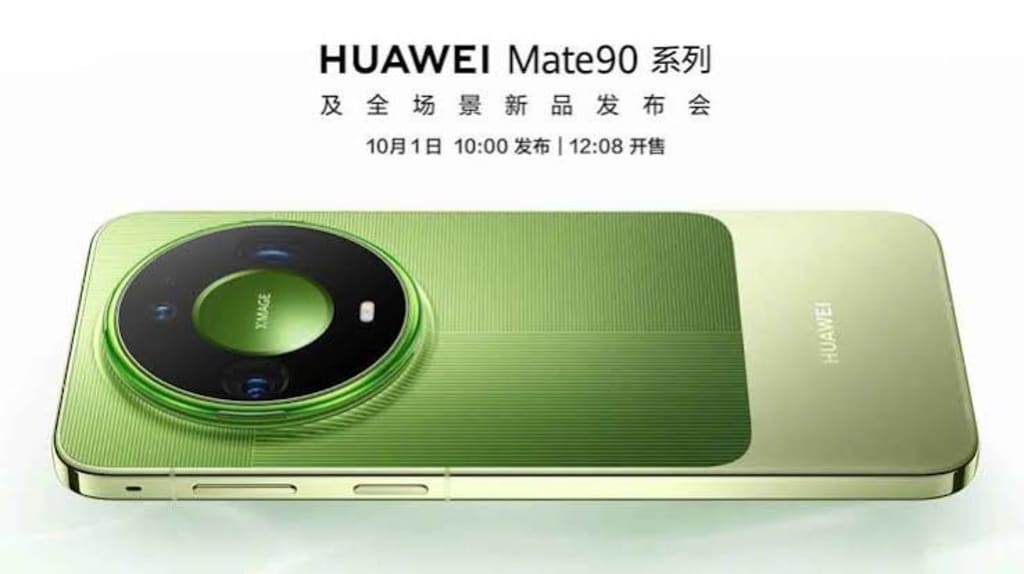
Huawei launched the Mate 90 series on October 1, 2026. Two communication features stand out: multi-device mutual-assistance communication sharing and four-card, triple-standby.
Mutual-assistance sharing
The name sounds like a hotspot. It isn't. A hotspot lets one phone share data with other devices. Mutual-assistance sharing builds a collaborative network among multiple Mate 90 phones. A phone with weak signal can borrow the channel of a phone with strong signal to make calls, send messages, and go online. Multiple phones can also aggregate bandwidth. Up to four phones are supported.
The target scenarios are concerts, high-speed rail stations, and large exhibitions. In those places, base station capacity is saturated, and each phone gets fewer resources. Mate 90's answer: if other Mate 90 users are nearby, your phones can supplement each other's network capacity. Huawei says file download speed at high-speed rail stations rises by 40%, and video sending time at concerts drops by 70%.
The idea comes from collaborative communication research: a terminal with good signal acts as a relay for a terminal with poor signal. Huawei made it a shipping feature.
Most bad signal users encounter is a capacity problem, not a coverage problem. Building base stations solves coverage. Capacity is harder. You can optimize a single phone's antenna and baseband, but that only goes so far. Multi-device collaboration is another route.
Four-card, triple-standby
The Mate 90 Pro Max supports two physical SIM cards and two eSIM numbers. Three of the four numbers can be online and on standby at the same time. All three can independently make calls, go online, and send and receive texts. You can choose a 2 physical SIM + 1 eSIM or 1 physical SIM + 2 eSIM combination.
The target users are businesspeople, self-media professionals, and frequent international travelers. Work number, personal number, data card, overseas number: previously two or even three phones, now one device can carry them all.
One limitation: as of 2026, domestic eSIM phone service in China is still in commercial trial. Activating eSIM requires an operator-owned store and an ID. Online self-service activation is not yet supported. At this stage, domestic eSIM phones are usually limited to one or two numbers. The hardware is ready. The experience ceiling depends on how fast operators roll it out.
Where this sits in Huawei's communications line
Lingxi Communications is layer one: single-device signal quality in weak-signal environments. Wi-Fi and cellular converged antenna architecture is layer two: Wi-Fi and cellular share one antenna system, and signal strength rises by 2 dB. 29 dBm high-power transmission is layer three: when the phone has only one or two bars, uplink rate rises by 30% to 200%.
Those three layers optimize what one phone can do by itself. Multi-device mutual-assistance communication sharing is layer four: it jumps from single-device optimization to multi-device collaboration. The phone becomes a communication node in the HarmonyOS ecosystem rather than an isolated terminal.
This direction matches a judgment from Huawei Rotating Chairman Wang Tao at MWC Shanghai 2026: future communication networks will not be one base station covering a patch of phones. They will be space-ground integrated, multi-node collaborative systems. Mate 90's mutual-assistance sharing is a terminal-side step toward that.
What these features solve, and what they don't
Mutual-assistance sharing addresses bad signal where crowds are. Four-card, triple-standby addresses too many numbers to fit. Satellite communication covers no ground signal at all. Together, they cover most communication needs from daily life to extreme situations.
But "completely" does not hold in communications. Signal blind spots exist. Policy moves at its own pace. Technology adoption takes time. Huawei is pushing the boundary outward.
Other manufacturers compete on cameras and benchmark scores. Huawei keeps deepening its most established field: communications. From Lingxi Communications to satellite communication, from single-device optimization to multi-device collaboration, no single step is dramatic. Put together, it is a strategy built over years.
The Mate 90 communication upgrade is a step in Huawei's transformation of connection from a phone capability into an ecosystem capability.
About the Creator
Jin
Writer of reamstories
https://reamstories.com/jin
Enjoyed the story? Support the Creator.
Subscribe for free to receive all their stories in your feed. You could also become a paid subscriber, letting them know you appreciate their work.
Comments
There are no comments for this story
Be the first to respond and start the conversation.